


What is a plastic flange?
 Oct 29, 2026|
 View:1468
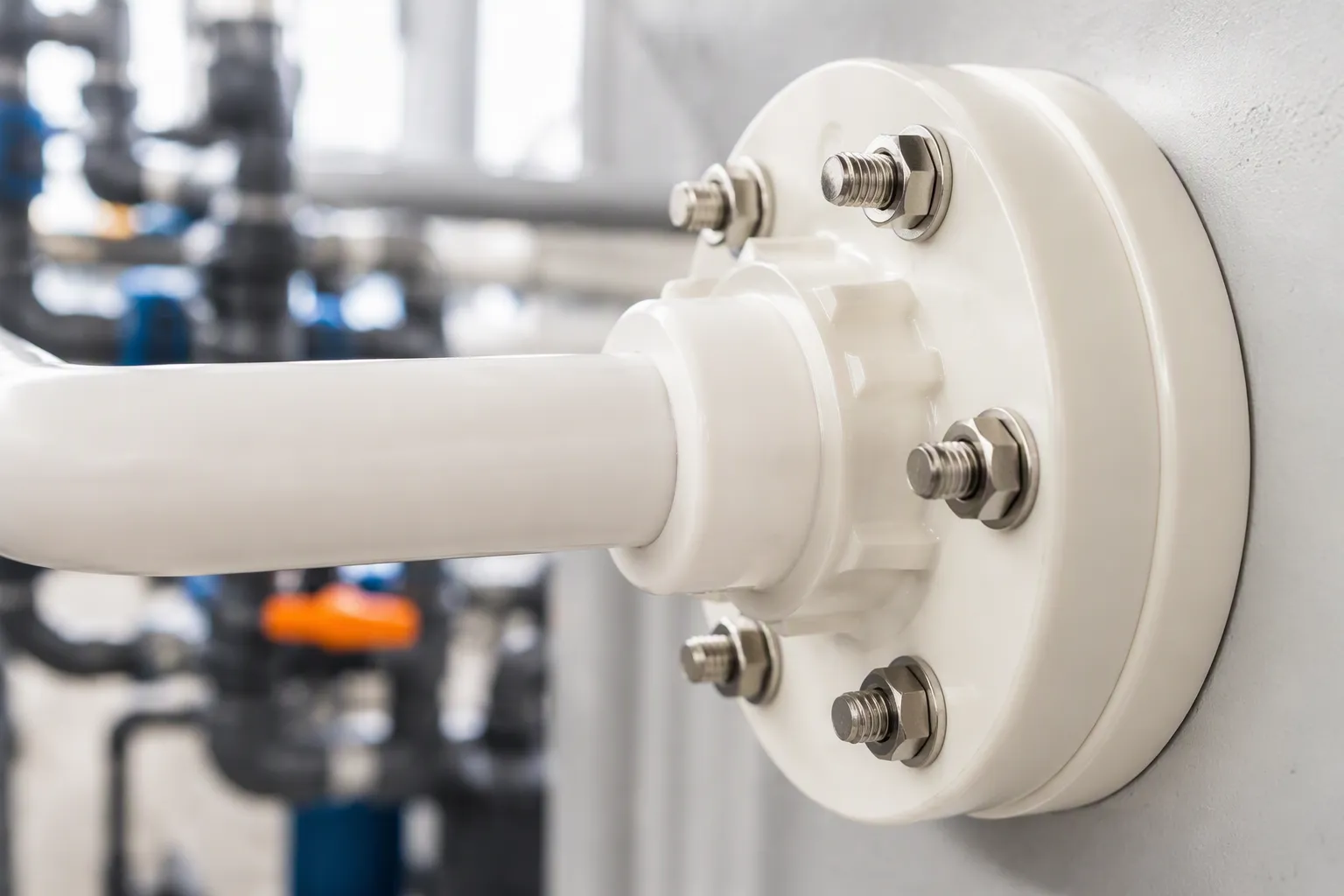
A plastic flange is a polymer pipe fitting that connects pipes, valves, or equipment into a sealed, bolted joint. Its basic job is simple: join pipe sections and keep the line leak-free under pressure. Installers bolt two mating faces together with a gasket trapped between them, and the joint holds. Plastic flanges weigh less than metal ones and install quickly, which makes them a practical choice for many piping systems. So how does a piece of plastic hold a pressurized line together? The answer lies in the flange design, the gasket, and the bolt load that presses them into contact.
Key Takeaways
Match the flange material to the pipe and confirm the resin's chemical limits before choosing a flange.
A plastic flange joins pipes and seals the connection with a gasket and bolts.
Plastic flanges are lightweight and resist corrosion, which makes them easy to install.
Bolts squeeze the gasket to fill surface gaps and stop leaks.
Match the flange material to the pipe material, because dissimilar polymers will not fuse.
Tighten bolts in a cross pattern in stages to avoid distorting the flange.
Plastic flanges suit corrosive, lightweight and non-sparking service; metal flanges handle higher pressure and temperature.
Check working pressure, temperature and fluid before choosing a flange.
What Is a Plastic Flange?
Definition and Purpose
Polymer Pipe Fitting
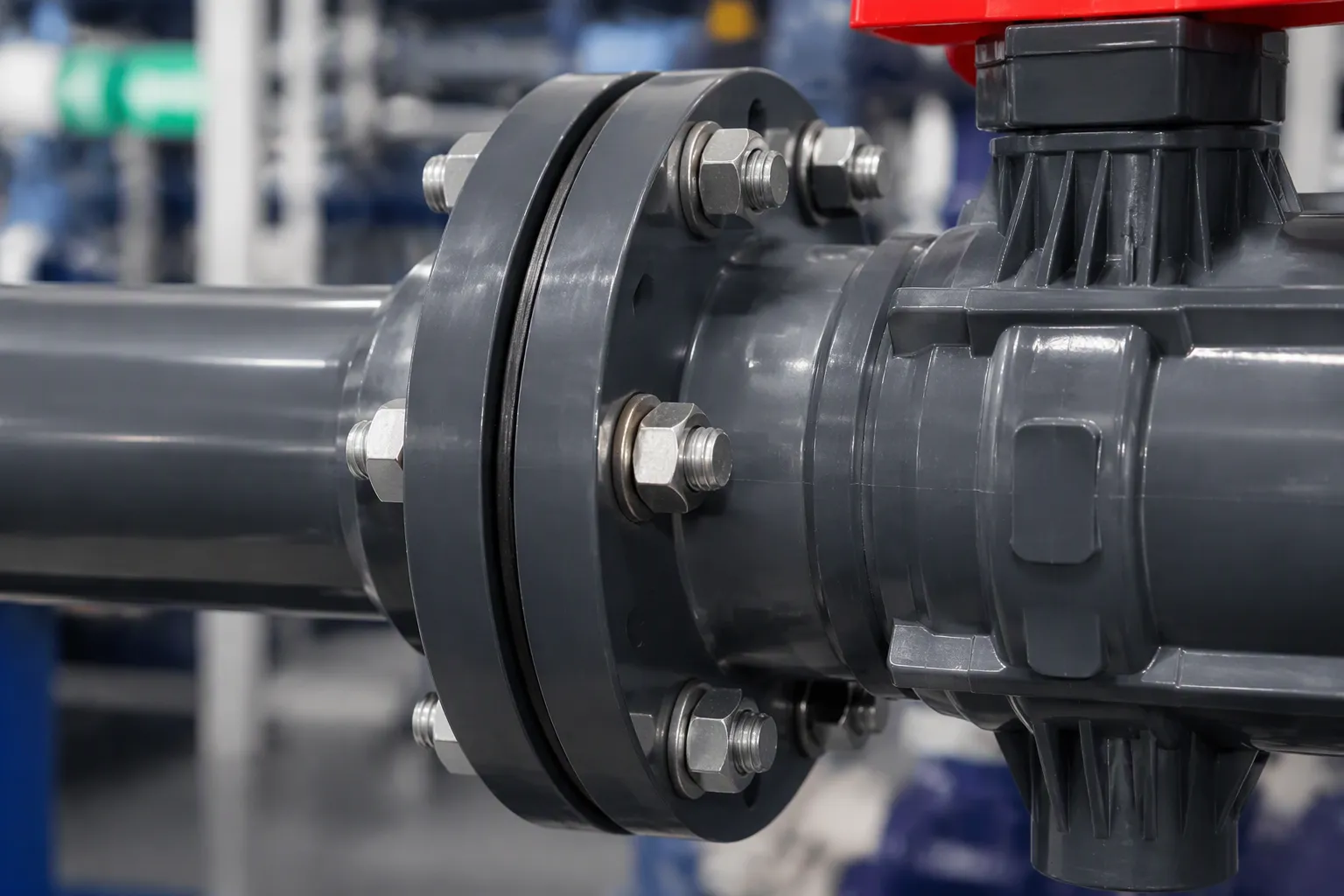
A plastic flange is a fitting moulded from a polymer resin. It attaches to the end of a pipe and provides a flat face with bolt holes. A matching flange on the next pipe section or on a valve, pump, or tank nozzle meets that face. Bolts pull the two faces together, and a gasket between them seals the joint. The fitting turns a permanent pipe connection into one that workers can open for maintenance, inspection, or equipment replacement.
The polymer body gives the part its identity. Manufacturers mould the flange as a single piece, so the face, hub, and bolt holes share one continuous structure. This construction keeps the part light. A plastic flange weighs far less than a comparable metal one, and a single installer can often lift and position it without a hoist. Light weight also reduces the load that the flange places on the pipe supports and the surrounding structure.
Joining Pipes and Valves
The core purpose of any flange is to join system components into one sealed network. A flange connects pipe to pipe, pipe to valve, pipe to pump, and pipe to vessel. Each connection follows the same logic: two faces, one gasket, and a set of bolts. This standardization lets designers mix components from different suppliers as long as the faces and bolt patterns match.
Plastic flanges serve the same role in a polymer piping system. They adapt a plastic pipe line to equipment that carries a flanged connection. They also create service points where a crew can break the line without cutting it. That flexibility explains why flanges appear at pumps, filters, and control valves throughout a plant.
Plastic Flange Types
Socket-Fusion, Threaded, and Blind
Socket-fusion flanges join to the pipe by heat fusion. The pipe end inserts into a socket, and a heated tool melts both surfaces before they are pushed together and held until the melt cools into one continuous wall. Threaded flanges carry a thread in the hub and screw onto a pipe or a male-threaded fitting with a matching thread. Blind flanges have no centre bore. They bolt onto a flange face to close off a line, a branch, or a vessel opening.
Each style suits a different job. Socket-fusion connections give a strong, permanent joint and dominate in smaller pipe sizes. Threaded connections allow disassembly and work well in light-duty lines. Blind flanges seal unused openings and give crews access for inspection.
Full-Face vs. Raised-Face
Full-face flanges carry the gasket across the entire face, including the bolt circle. The bolts pass through the gasket, which protects the face and spreads the sealing load. Raised-face flanges have a small raised ring around the bore, and the gasket sits only on that ring. The raised design concentrates bolt load on a smaller sealing area.
Full-face designs suit softer plastic faces because they spread pressure and reduce the risk of cracking. Raised-face designs match metal mating flanges and standard gasket shapes. The choice depends on the mating component and the gasket type.
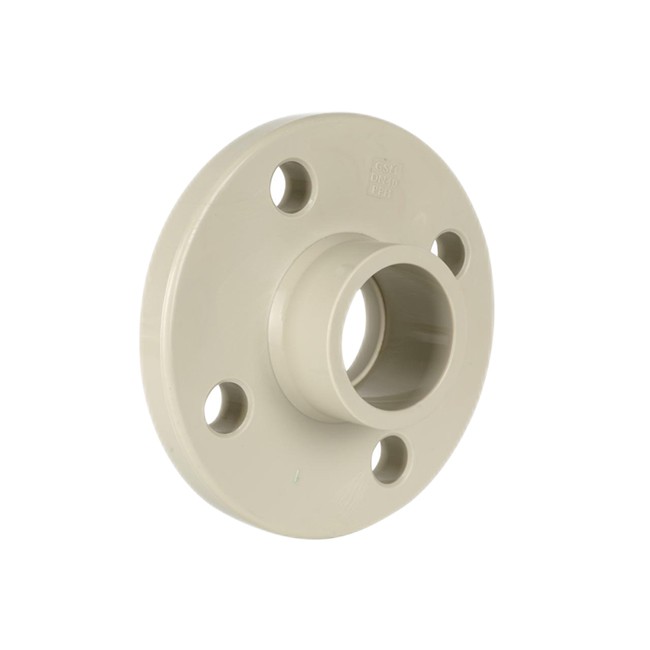
The three flange styles below cover the common joining methods in a β-PPH line: a socket-fusion body for welded runs, and two threaded bodies for connections that must come apart.


PVC or ABS Flanges and Other Materials
PVC, CPVC, PP, and PVDF
Material choice drives performance. PVC flanges serve water, drainage, and many chemical lines at moderate temperatures. CPVC extends the temperature range upward. PP (polypropylene) handles a broad chemical spectrum, and PVDF covers aggressive media and higher thermal duty. ABS flanges appear in drainage and waste systems, where toughness and easy solvent cementing matter.
Drainage work often uses PVC or ABS flanges because both materials cement easily to matching pipe. A solvent-welded PVC flange typically develops a joint close to the strength of the pipe wall itself. ABS flanges behave the same way with ABS cement. Installers must match the flange material to the pipe material, since a PVC fitting will not fuse to an ABS pipe.
Resin grade matters too, but only within a family. In high-performance machined grades such as polyamide-imide (PAI), the unfilled general-purpose grade gives the highest impact resistance at roughly 152 MPa tensile strength; a 30% glass-filled grade reaches about 221 MPa with a flexural modulus near 10.3–10.7 GPa, which suits load-bearing duty; PTFE or graphite fillers lower friction to about 0.20 but cut tensile strength to around 113 MPa. Those figures describe machined seats, seals and insulators, not moulded piping flanges. A commodity PPH or PVC flange sits far lower, typically in the 25–55 MPa range, and takes its performance from wall thickness, hub geometry and the quality of the fusion joint.
Maximum service temperature describes a resin in isolation under controlled conditions, not a moulded part carrying mechanical load, chemical exposure, and thermal cycling simultaneously. Heat deflection temperature better reflects real-world stiffness retention under load. The table below lists reference values for the high-performance grades; moulded commodity flanges fall well below them on every line.
| Property (PAI reference grade) | Value Range | Relevance to Flange Performance |
|---|---|---|
| Tensile Strength | 150–220 MPa (filled grades higher) | Load-bearing capacity of the flange |
| Flexural Modulus | 4–11 GPa (filler-dependent) | Stiffness under bolting load |
| Heat Deflection Temperature | 280 °C | Resistance to deformation under load at heat |
| Coefficient of Thermal Expansion | 9–31 µm/m/°C | Dimensional stability with metal mating parts |
| Chemical Resistance | Excellent against hydrocarbons and most acids; poor against saturated steam, strong bases and hot acids | Media compatibility |
Mismatched expansion between a plastic body and metal fasteners can loosen bolts and crack bosses over thermal cycles. Specifiers should check the expansion figure against the service temperature swing before finalizing a design.
How Does a Flange Work?
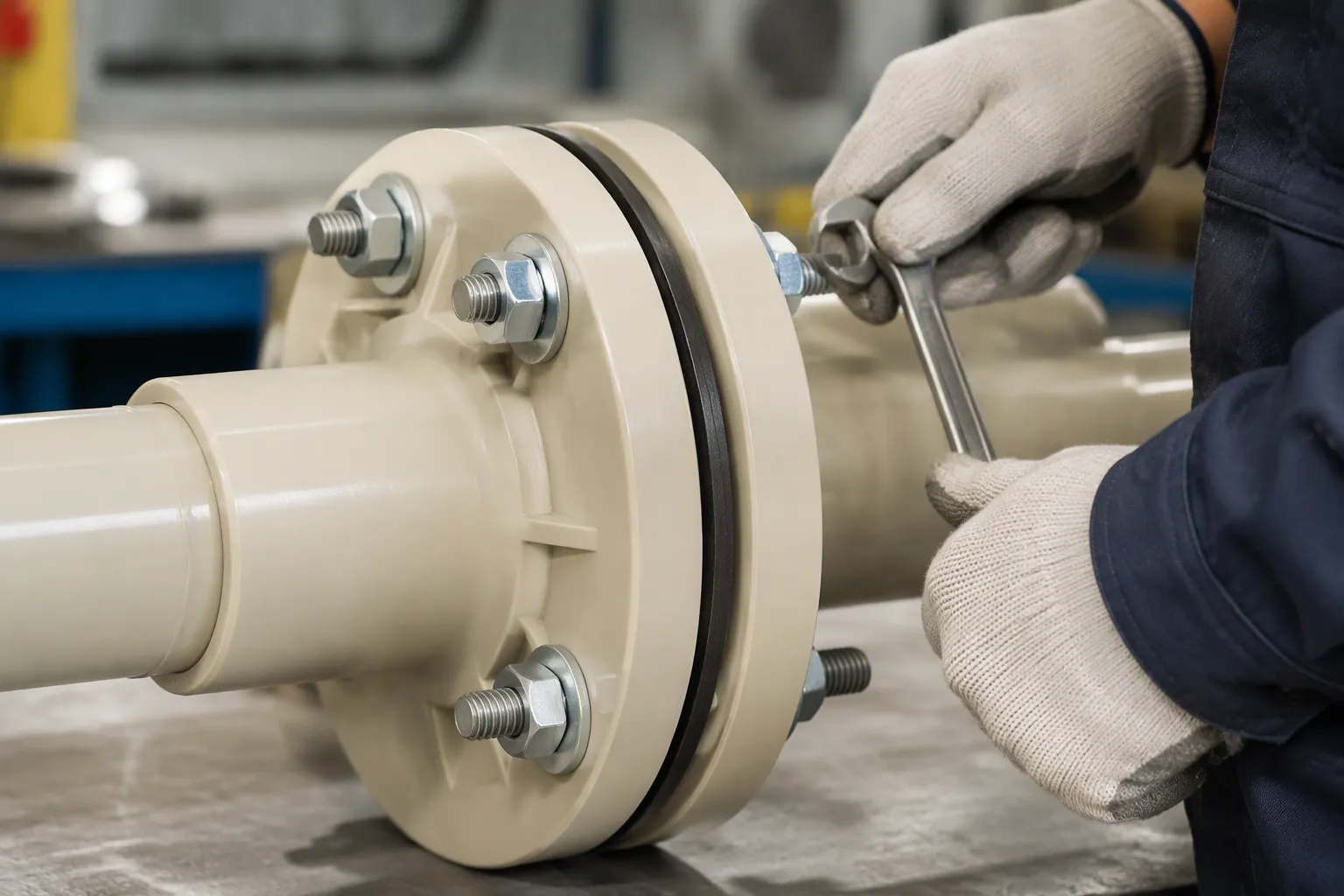
The working principle is straightforward. Bolts pull two flange faces together, and the squeeze traps a gasket between them. That squeeze, called bolt load, compresses the gasket until it fills every tiny gap on both faces. The result is a barrier that stops fluid from escaping. Each part of the joint plays a specific role in making that barrier hold.
Key Components
Flange Body and Bolt Holes
The flange body is the solid ring that carries the sealing face and the bolt holes. The face is the flat surface that meets its partner. Bolt holes sit around the face in a fixed pattern, and the pattern must match the mating part exactly. A flange with a different hole spacing will not line up, no matter how well the rest of the joint is built.
The body also includes a hub, which is the thicker section where the fitting joins the pipe. The hub carries load from the bolts into the pipe wall. A sturdy hub keeps the face flat under tightening, and a flat face is what allows the gasket to seal evenly.
Gaskets and Bolting Hardware
A gasket is a ring of soft material that sits between the two faces. It acts as the deformable element in the joint. Common gasket materials include rubber, PTFE, and fiber-reinforced sheet. The material must resist the fluid inside the line and stay flexible enough to conform under load.
Bolting hardware holds the assembly together. Bolts pass through the holes, and nuts thread onto the ends. Washers spread the clamp force over a wider area of the flange surface. On plastic flanges, wide washers matter because they reduce the chance of cracking around a bolt hole. The bolt material should also suit the environment, since a corroded bolt loses tension over time.
The Sealing Mechanism
Gasket Compression
Gasket compression follows a clear sequence, and each stage builds on the one before it.
Workers tighten the bolts, which applies load to the sealing surface and raises the contact stress between the parts.
Once the stress grows large enough, the gasket material deforms plastically.
The deformed gasket flows into the micro-gaps and small uneven spots on the flange face.
The gasket then clings tightly to the face and closes those surface gaps.
Inside the gasket, compression lowers the porosity of the material, which shrinks the paths that fluid could travel through.
The leak path closes, and the joint seals.
This process relies on the gasket's willingness to deform. A gasket that springs back too stiffly will not fill the surface texture. A gasket that deforms too easily will creep and lose its seal over time.
Face Contact and Leak Prevention
Effective sealing depends on three conditions working together: correct bolt torque, a suitable surface finish, and steady compression load. The gasket must match the peaks and valleys of the flange surface to bridge the gaps between them. A scratched or pitted face gives the gasket nothing to grip, and a leak path opens.
Surface condition matters as much as torque. A clean, smooth face lets the gasket conform across its full width. A face with debris or deep tool marks forces the gasket to bridge a gap it cannot fill. Workers should inspect both faces before assembly and replace any part with damage across the sealing area.
Pressure and Temperature Limits
Pressure Ratings and Thermal Range
Every flange carries a pressure rating, which states the maximum internal pressure it can hold at a given temperature. The rating falls as temperature rises, because heat softens the polymer and reduces its stiffness. A joint rated for a cold line may not hold the same pressure on a hot one. Published design guidance for thermoplastic pressure piping ties the allowable stress to both temperature and service life for exactly this reason.
Thermal range varies by material. A polypropylene flange such as XITA's PPH FT Flange carries a PN10 rating — a nominal 1.0 MPa at 20 °C — and the β-PPH system is quoted for a maximum allowable service temperature of 110 °C with long-term service around 90 °C. PVC flanges serve lower temperature duty, and CPVC extends the ceiling upward. Specifiers should compare the line's working pressure and temperature against the flange rating, not against the resin's isolated limits. A margin between the two protects the joint through temperature swings and pressure surges.
Need a flange that matches your line conditions?
Send the pipe size, working pressure, temperature and medium, and XITA will confirm the resin grade, flange standard and gasket type for your project.
Get a QuoteHow Is a Plastic Flange Installed?
Installation Steps
Aligning and Preparing Faces
Installation begins before any bolt turns. Workers bring the two faces together and check that they sit flush and concentric, with the bolt holes lined up. A flange that sits at an angle builds stress into the joint from day one. Proper pipe support helps here, because a sagging line pulls the faces out of parallel.
Next, the crew cleans both faces and wipes away dirt, oil, and old gasket residue. They slide a new gasket into place and centre it on the bolt circle. An off-centre gasket leaves part of the sealing face uncovered.
Tightening Bolts in a Cross Pattern
Bolts never go straight to full torque. The crew works in stages, moving across the circle so both faces pull together evenly.
Pass one brings every bolt to roughly 30% of final torque in a star pattern.
Pass two raises all bolts to about 60%, using the same sequence.
Pass three reaches the full torque value.
An optional fourth pass circles clockwise to confirm uniform tension.
This staged approach matters more with plastic than with metal. A plastic flange can distort when one side tightens harder than the other. In hot or high-pressure service, crews re-torque after pressurization or a wait of about 4–24 hours.
Best Practices for a Leak-Free Joint
Gasket Selection and Torque
The gasket and the torque value form one system, so match them together. Full-face gaskets suit most plastic joints, and ring gaskets are not advised. A calibrated torque wrench gives repeatable results that a hand-feel estimate cannot.
| Item | Guidance |
|---|---|
| Torque, most sizes | 15–20 ft-lbs (about 20–27 N·m) |
| Torque, 10" and larger | 25 ft-lbs maximum (about 34 N·m) |
| Re-torque | 24 hours after seating, after the first thermal cycle, and annually |
Gasket material shifts the required torque, and larger plastic flanges usually need a higher value than small ones, so the manufacturer's published figure takes precedence over a generic table.
Avoiding Over-Tightening
Excess bolt load cracks flange bodies and crushes gaskets past recovery. Plastic creeps under sustained compression, so a joint that feels tight today can relax over weeks. A re-check after the initial seating period catches that relaxation before a drip appears.
Common Mistakes to Avoid
Mismatched Faces and Dirty Surfaces
Uneven tightening during initial installation damages the gasket and causes leakage, especially in cramped spaces where some bolts are tightened properly while others are not.
Mismatched bolt patterns, wrong gasket sizes, and scratched faces all open leak paths. Clean faces and matched dimensions prevent most of these failures.
Where Are Plastic Flanges Used?
Common Industries
Water Treatment and Chemical Processing
Plastic flanges appear wherever a line carries aggressive or treated water. Chemical plants use them on process piping, chemical dosing lines, storage tank connections, pumps, valves, and treatment equipment. Water and wastewater plants use them in sewage treatment and circulating-water engineering. Designers pick the flange by checking water chemistry, temperature, pressure, the flange standard, and the gasket material together.
| Application Domain | Specific Uses of Plastic (PP) Flanges |
|---|---|
| Chemical Processing | Process piping; chemical dosing lines; storage tank connections; pumps and valves; treatment equipment |
| Water & Wastewater Treatment | Sewage treatment; circulating-water engineering (with selection based on water chemistry, temperature, pressure, flange standard and gasket material) |
PP flanges are suitable for many chemical services, but temperature, concentration, pressure, and chemical compatibility must be verified before final material selection.
Food, Beverage, and Aquaculture
Food and beverage plants favour plastic flanges because the material does not rust and does not alter water quality. Pharmaceutical lines follow the same logic, and marine and aquaculture systems value the resistance to salt water and oxidation. A polypropylene flange such as XITA's PPH FT Flange is rated for pH 1–14 in dilute aqueous service, which covers many acids, alkalis, and wastewater streams; strong oxidizing acids and hot concentrated alkalis still need a check against the resin's compatibility data. The published dimension tables for the PPH flange range run from DN15 to DN100, while the wider β-PPH fittings range is offered from DN15 to DN600 in 1.0 MPa and 1.6 MPa ratings. Flanges are made to DIN 8077/8078, and the product pages list SGS and CE certification.
Toilet Flange and Drainage Uses
Connecting Toilets to Drainage Systems
A toilet flange links a home's drainage system to the toilet drain and acts as a stabilizing base on the floor. A PVC closet flange is the common choice, and it solvent-welds to matching PVC pipe with PVC cement. The flange seals to the toilet with a wax ring, and rust-resistant screws anchor it down. Toilet flange size usually runs 3 or 4 inches to match the drainpipe, and the fitting sits either inside the pipe or over it. Model plumbing codes set the installation requirements that apply to the joint.
Plumbers choose among several toilet flange types. A level fit closet flange installs inside or over 3-inch and 4-inch Schedule 40 DWV pipe and carries a rotating metal ring for bolt alignment. An Easy Tap closet flange fits over 3-inch pipe or inside 4-inch pipe and includes a knockout test cap. A 45-degree closet flange solves clearance problems beneath the toilet. Getting the correct toilet flange height matters, because the flange ring should rest on the finished floor. ABS flanges work the same way with ABS cement, and crews must match flange material to pipe material. A PVC drain pipe joint will not fuse to an ABS fitting.
Best-Fit and Poor-Fit Conditions
Corrosive and Lightweight Environments
Plastic flanges are at their most useful in corrosive service. Polypropylene does not rust and resists many aqueous acids, bases, salts, and treatment chemicals when matched to the duty. Lightweight duty also suits them: polypropylene has a density around 0.91 g/cm³ against roughly 7.85 g/cm³ for carbon steel, so even with thicker walls a moulded PPH flange is a fraction of the weight of its steel equivalent, needs no protective paint, and can be removed and reused. Non-sparking sites add another good fit.
High-Pressure and High-Temperature Lines
High pressure and high temperature are poor-fit conditions. A polypropylene flange rated PN10 holds a nominal 1.0 MPa at 20 °C, and the β-PPH system is quoted to 110 °C maximum allowable service, so hotter or harder-working lines call for a different solution. Weld neck flanges generally serve higher pressure, higher temperature, and fatigue-sensitive duty, because the long tapered hub transfers stress well. Each option has its place.
Working on a chemical or water-treatment line?
Tell us the medium, concentration and temperature. XITA will shortlist the resin and flange standard that fit, and send dimension drawings for approval.
Get a QuotePlastic Flange vs. Metal Flange
Technical Performance
Strength, Weight, and Corrosion Resistance
The two families differ most in mechanical strength. Metal flanges carry higher pressure and temperature ratings and tolerate cyclic and thermal loads better. Plastic flanges trade some of that strength for other gains. A moulded polymer body weighs far less, so one worker can often position it without a hoist, and the lighter load eases demand on pipe supports.
Corrosion resistance favours polymer. PVC, PP, CPVC, and PVDF resist acids, alkalis, salts, and many chemicals, and they need no external coating. Carbon steel offers good strength at moderate temperatures but corrodes readily and depends on paint or coatings for protection. Stainless steel grades such as 316L resist chlorides better than 304, though neither is immune to chloride stress-corrosion cracking at elevated temperature, and titanium excels in seawater and chemical service. Each metal earns its place in harsh duty; the plastic flange simply removes the coating maintenance step.
| Material | Strength | Weight | Corrosion Resistance |
|---|---|---|---|
| Plastic (PVC, PP, CPVC, PVDF) | Lower mechanical strength; limited pressure and temperature ratings | Lightweight | Excellent against acids, alkalis, salts and many chemicals; no coating needed |
| Carbon Steel (A105 forged, A216 WCB cast) | Good strength at moderate temperatures | Heavy | Poor inherent resistance; requires coatings |
| Stainless Steel (304L, 316L) | Good properties across a moderate temperature range | Heavy | Excellent; 316 grades resist chlorides better than 304 |
Application Fit and Compliance
Standards, Certifications, and Compatibility
Plastic flanges follow recognised standards. Pressure-rated polypropylene piping systems are covered by ASTM F2389, which sets requirements for material, dimensions, hydrostatic strength and thermocycling; PVC flanges and blind flanges commonly reference DIN dimensions and pressure classes such as PN10. Metal flanges follow their own established codes. A specifier should confirm that the flange standard, bolt pattern, and face type match the mating component before ordering.
Certification is product- and market-specific, so read the certificate rather than the brochure. XITA's PPH flange pages list SGS and CE, while the wider fittings range is described as ISO-certified; 3-A applies to dairy and food-contact fittings. Confirm which documents cover the exact item and size you are buying.
Compatibility extends beyond dimensions. A PVC flange must join PVC pipe, and an ABS flange must join ABS pipe, because the two materials will not fuse to each other. Metal flanges mate with metal pipe through welding or threading. Mixing families at a joint calls for an adapter and a gasket suited to both faces.
Cost Comparison
Upfront, Installation, and Service Life
Upfront price varies with material and size. Polymer flanges generally cost less than stainless or nickel alloy parts, though specialty polymers narrow that gap. Installation cost shifts the balance further. A lightweight plastic flange needs less lifting equipment, and solvent-welded PVC or ABS joints skip the hot work permits that metal welding demands.
Service life depends on the duty. In corrosive chemical lines, a polymer flange may outlast a coated carbon steel part that needs repainting. In high-pressure, high-temperature service, metal flanges deliver the durability that justifies their price. Buyers should compare total cost across the full service life, not the purchase price alone.
How to Choose the Right Flange
Match the Flange to Line Conditions
Pressure, Temperature, and Media
Selection starts with three line conditions: pressure, temperature, and the fluid inside the pipe. A buyer reads the working pressure and compares it with the flange rating. The rating drops as temperature climbs, so a joint that holds cold may fail hot. The fluid then decides the polymer. PVC suits water and drainage, CPVC raises the thermal ceiling, and polypropylene covers a wide chemical range.
Drainage work follows the same logic on a smaller scale. A toilet flange carries no pressure, yet the material still matters. PVC and ABS are the common choices, and each one bonds only to matching pipe. A homeowner replacing a closet flange should confirm the pipe material before ordering, because a PVC ring will not fuse to an ABS drain.
What to Check Before Buying
Standards, Dimensions, and Support
Dimensions decide whether the part fits. Bolt circle, hole spacing, face type, and bore size must match the mating component. A toilet flange size of 3 or 4 inches must match the drainpipe, and toilet flange height should place the ring on the finished floor. Buyers who skip these checks often order twice.
| Check | What to Confirm |
|---|---|
| Standard | DIN, ISO, or the code named in the project spec |
| Dimensions | Bolt pattern, face type, bore, and pipe size |
| Documentation | Certificates, test reports, and drawings |
| Supplier | Lead time, stock sizes, and technical answers |
Support separates a good supplier from a weak one. Ask for certification documents and dimension drawings before placing an order. A supplier who answers technical questions quickly usually ships with fewer surprises. Price matters, yet the cheapest flange rarely stays cheap when a joint leaks. Compare total cost across the service life, then buy.
A few practical notes help the final decision. The right material for a toilet flange depends on the drain pipe, not on brand claims. Confirm the standard, check the dimensions, and request documentation. These steps take minutes and prevent most returns.
A plastic flange is a polymer fitting that joins pipe sections and seals the joint with a gasket under bolt load. The flange body, bolt holes, and gasket work together, and careful alignment and even tightening keep the seal intact. These fittings suit corrosive, lightweight, and non-sparking service, while metal flanges serve higher pressure and temperature duty. So how does a piece of plastic hold a pressurized line together? Bolt load compresses the gasket, and the compressed gasket closes every leak path.
Ready to specify your flange?
Send your line data and we will reply with the recommended resin, pressure class and gasket, plus a quotation.
Get a QuoteFAQ
What is a toilet flange?
A toilet flange is the fitting that locks a toilet to the drainpipe and anchors it to the floor. It seals the connection with a wax ring and holds the fixture steady. Most homes use a PVC closet flange, and that part bonds to matching PVC pipe with cement.
Does a plastic flange work under pressure?
Yes, within its rating. Bolts squeeze a gasket between two faces, and the compressed gasket blocks every leak path. A polypropylene flange rated PN10 holds a nominal 1.0 MPa at 20 °C, and the β-PPH system is quoted to 110 °C maximum allowable service temperature. Higher pressure lines call for a metal flange instead.
Which toilet flange types fit a home drain?
A level fit closet flange works inside or over 3-inch and 4-inch Schedule 40 DWV pipe. An Easy Tap closet flange fits over 3-inch pipe or inside 4-inch pipe. A 45-degree closet flange solves tight clearance. Match the flange material to the pipe, since pvc will not fuse to abs.
How do I pick the right toilet flange size?
Measure the drainpipe first. A toilet flange size of 3 or 4 inches must match that pipe. Check the toilet flange height too, because the ring should rest on the finished floor. A wrong size forces a second order and delays the job.
When does a toilet flange repair make sense?
A cracked ring or a loose seal often allows a toilet flange repair instead of a full swap. Clean the face, fit a new wax ring, and re-anchor the ring with rust-resistant screws. Damage across the sealing area calls for a full toilet flange replacement.
Can I glue a PVC flange to ABS pipe?
No. Solvent cement bonds only like materials, so a PVC fitting will not fuse to ABS pipe. Use an ABS flange on ABS pipe and a PVC closet flange on PVC pipe. A mismatched joint leaks, and no amount of cement fixes it.
What checks prevent a leaky joint?
Clean both faces and centre the gasket on the bolt circle. Tighten bolts in a cross pattern to 15–20 ft-lbs (about 20–27 N·m), and cap larger sizes at 25 ft-lbs (about 34 N·m). Re-torque after the first thermal cycle. A calibrated wrench beats a hand-feel estimate every time.
Where do plastic flanges fit best?
Corrosive, lightweight, and non-sparking service suits them well. Polypropylene has roughly one-eighth the density of steel, and a PPH flange is rated for pH 1–14 in dilute aqueous service. Check the resin's compatibility data for the specific medium before ordering.
Sources
1. ASTM International. F2389-23, Standard Specification for Pressure-rated Polypropylene (PP) Piping Systems. astm.org/f2389-23.html
2. Plastics Pipe Institute. Technical Documents Index (thermoplastic pressure piping design guidance). plasticpipe.org
3. International Code Council. International Plumbing Code (IPC). iccsafe.org
4. Product data, XITA Plastic: PPH TS / FT / MT flange pages (material, PN10 rating, DIN 8077/8078, SGS and CE). czxita.com


