


Everything You Need to Know About PPR Piping Systems
 Nov 02, 2026|
 View:3194
Piping Systems
Polypropylene random copolymer pipe joins by melting, not by threading or gluing, so the joint and the pipe become one material. This guide covers the classes, the welding window, the pressure test, and the failure modes worth designing out.
A PPR piping system is a network of pipes and fittings made from polypropylene random copolymer, a plastic chosen for heat resistance, fusion joints that need no gasket or thread, corrosion resistance, and a long service life in hot and cold water supply. European builders first used PPR in the 1980s for plumbing and hydronic heating and cooling. Today, PPR piping systems serve residential, commercial, and industrial fluid handling, from domestic tap water to process lines. The material resists corrosion and scale buildup.
This PPR pipe ultimate guide explains types, selection, installation, maintenance, performance, applications, and troubleshooting in plain language, with practical guidance for each stage of a project.
Key Takeaways
PPR pipe and fittings join by heat-fused plastic pipes, so the joint is made of the same polymer as the pipe wall.
Choose the class for the duty: PN20 and PN25 cover most hot water, PN16 cold mains, PN10 lighter service.
Ratings are quoted at 20 °C. Derate for temperature before sizing, because a PN20 line carries far less at 70 °C.
Clean tools, a die held at 260 ±10 °C, and the correct heating time decide whether a joint holds.
Pressure test with water before pipes are covered, and record the result.
PPR resist many chemicals, but not strong oxidizers, chlorinated solvents, or aromatic hydrocarbons.
Ultraviolet light and freezing cause most of the damage that reaches a repair, and both are preventable.
What Is a PPR Piping System?
A PPR piping system is a pressure-rated network of plastic pipes, fittings, and valves joined by heat fusion. The name comes from the raw material: polypropylene random copolymer, a plastic that holds its shape and strength at the temperatures common in domestic hot water and hydronic heating. European contractors began installing PPR in the 1980s for plumbing and hydronic heating and cooling loops. The approach spread because the joints fuse into one continuous piece, so the pipe wall and the connection behave as a single material.
Definition and Structure
Polypropylene random copolymer starts as propylene chains with ethylene units inserted at random points along the chain. That random placement lowers the melting point slightly and improves flexibility compared with homopolymer polypropylene. The material also tolerates hot water over long periods without softening or cracking.
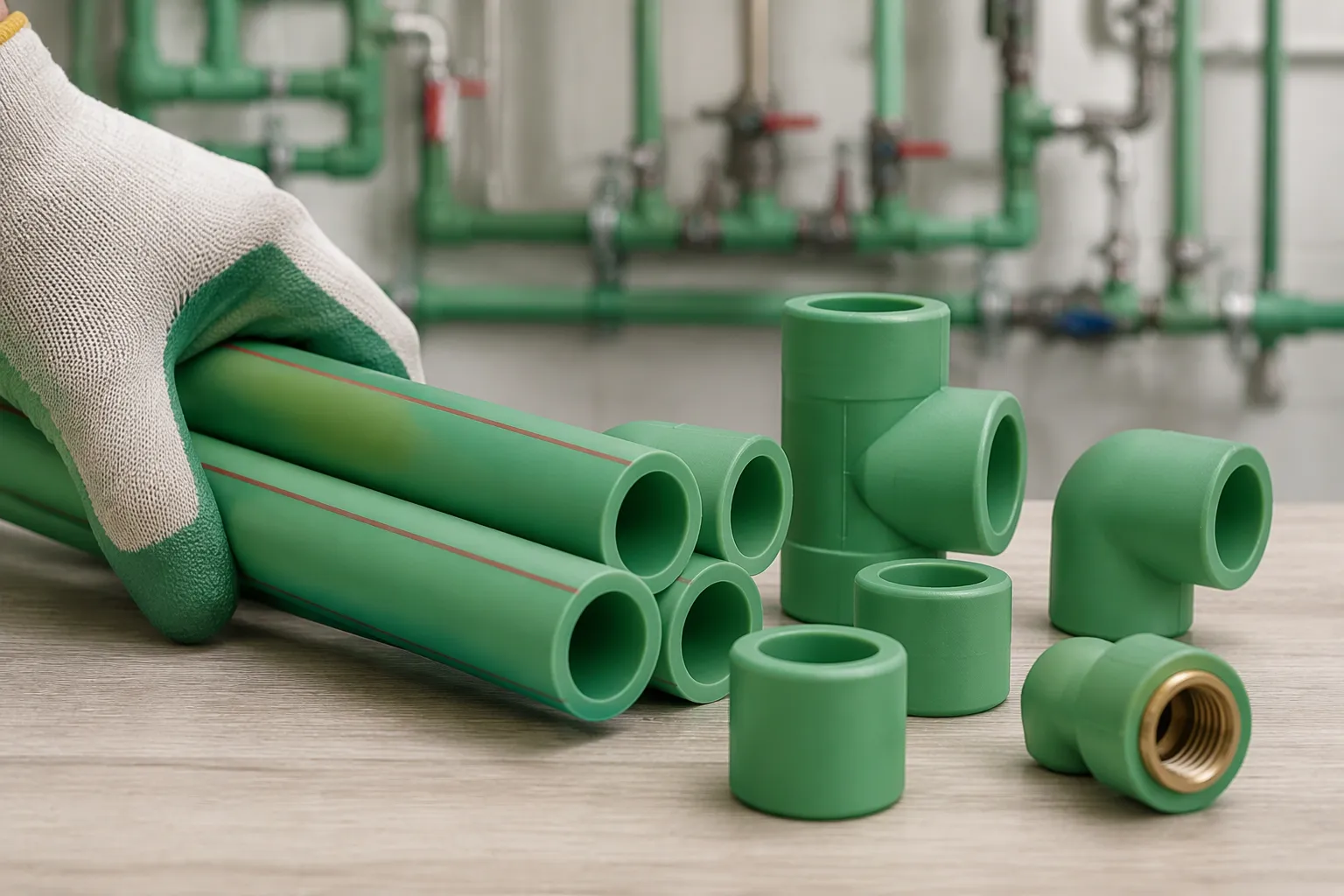
A finished system has three parts: the pipe, the fittings, and the fusion joints that connect them. Pipes come in straight lengths or coils, with smooth inner walls that resist scale. Fittings — elbows, tees, couplings, reducers, and valves — use the same polymer, so every connection shares the same thermal expansion rate. This matching structure supports corrosion resistance across the whole network, because no metal touches the water in a standard all-plastic run.
How PPR Pipes Are Made
Manufacturers produce polypropylene random copolymer pipes by extrusion. Raw granules feed into a heated barrel, where they melt into a uniform mass. The melt passes through a die that forms the round profile, then enters a sizing sleeve and a cooling bath that sets the final diameter and wall thickness. Pullers move the pipe at a steady rate, and a cutter trims it to length or winds it into coils. Throughout the line, sensors check wall thickness, roundness, and surface quality. Makers also mark each length with the pressure class, the standard it meets, and the production batch, which helps installers match components and trace faults later.
Advantages Over Traditional Pipes
The ppr pipe advantages show up most clearly in a direct comparison with older plastics and metals. Standard PP pipes (homopolymer) offer good chemical resistance but crack more easily under impact and lose pressure strength at higher temperatures. PPR improves on both points: it absorbs impact better, holds its pressure rating more steadily as water heats up, and forms stronger fusion-welded joints. Metal pipes bring their own limits — they corrode, scale, and eventually narrow the flow path. PPR avoids those problems and weighs far less, so crews handle and install it with basic tools. In plumbing systems for homes and commercial buildings, these traits translate into fewer callbacks and a service life measured in decades rather than years.
Types of PPR Pipes and Fittings
PPR Pipe Classifications
Pressure ratings sort PPR pipes into classes. Under DIN 8077, catalog classes run from PN10 to PN25, and each class pairs with a wall-thickness ratio called SDR. At 20 °C the mapping is fixed: SDR 6 gives PN25, SDR 7.4 gives PN20, SDR 9 gives PN16, and SDR 11 gives PN12.5. Hot water lines most often use PN20 or PN25, while PN16 suits cold water mains.
SDR is the outside diameter divided by the wall thickness, so a lower SDR means a thicker wall at the same diameter. The four pairs above appear in every PP-R catalogue. Below PN12.5 the classes are usually quoted by SDR rather than by a round pressure number, which is why catalogues list SDR 13.6 and SDR 17 instead of PN10 and PN8.
Schematic section, not to scale. Wall thickness and outside diameter are the only two measurements needed to place a pipe in a class.
Table 1. Two common PP-R classes and what they are rated for.
| Material | Standard | Common SDR | PN at 20 °C | Max cont. temp |
|---|---|---|---|---|
| PP-R (type 3) | DIN 8077 / ISO 15874 | SDR 7.4 | PN 20 | 70 °C |
| PP-R (type 3) | DIN 8077 / ISO 15874 | SDR 6 | PN 25 | 70 °C |
Several PPR pipe standards govern the market. DIN 8077 and DIN 8078 cover dimensions, wall thickness, and quality testing. ISO 15874 sets international requirements for hot and cold water systems, and ASTM F2389 covers pressure-rated polypropylene piping systems for US plumbing codes. Buyers should confirm which standard a supplier follows before ordering.
Common PPR Fittings
A complete line needs more than straight pipe. Common PPR fittings include elbows, tees, couplings, reducers, unions, end caps, and threaded adapters that join welded PPR to metal taps, meters, or heaters. A reducer steps one diameter down, such as DN25 to DN20.
Valves complete the network. Ball valves give quick full shut-off with low flow resistance. Butterfly valves suit larger distribution lines. Check valves prevent backflow at boilers and pumps. Foot valves, diaphragm valves, Y strainers, sampling valves, and back pressure valves appear in fuller systems. Each ppr pipe and fittings set should match the pipe class, so the joint carries the same pressure rating as the run.
Four product families cover what this guide describes. The first three are the parts of a standard all-plastic run; the fourth adds a barrier for long exposed lines.


PP-RCT and β-PPH Variants
Standard polypropylene random copolymer handles most jobs well. Two related materials extend performance for demanding conditions. PP-RCT is a random copolymer with modified crystallinity: the crystal structure is more stable, which raises the allowable stress at elevated temperature. The minimum hydrostatic pressure ratings are typically higher for PP-RCT, and a PP-RCT pipe can reach a given class on a thinner wall than PP-R. At SDR 9, published rating tables put PP-RCT at 100 psi at 180 °F, which meets national plumbing and mechanical codes. PP-RCT fuses directly to standard PP-R, so crews can mix the two.
β-PPH is a different material rather than a PPR grade: a beta-nucleated polypropylene homopolymer with higher stiffness and better performance at high temperature, used in industrial work where standard PPR would be under-specified. Both options cost more than standard PPR, and both repay that cost where temperatures run high or walls must stay thin. Standard PPR remains the right choice for routine hot and cold water lines.
Choosing a PPR Piping System
Matching Ratings to Temperature and Pressure
A pressure rating stamped on a pipe does not guarantee that pressure at every temperature. Temperature and pressure have to be evaluated together, never separately. A sound specification answers two questions at once: what temperature will the pipe see, and what pressure must it hold at that temperature? Designers weigh operating temperature, design pressure, expected service duration, pipe dimensions, safety factors, and application conditions as one package.
Table 2. What each class is normally chosen for.
| PPR classification | Typical selection focus |
|---|---|
| PN10 | Lower-demand applications where permitted |
| PN16 | Cold or selected water systems |
| PN20 | Commonly considered for hot and cold water |
| PN25 | More demanding system conditions |
ISO 15874 frames this work through defined application classes rather than a single temperature statement. Designers should separate continuous operating temperature from temporary peaks. Hotels with repeated hot water demand and hospitals with continuous building services both push temperature and pressure compatibility harder than a simple cold main. SDR offers a quick check: a lower SDR means a thicker wall at the same diameter.
Standards and Certifications
PPR pipe standards give buyers a common language. ISO 15874 covers dimensions, materials, performance, and testing for polypropylene hot and cold water plumbing systems. DIN 8077 and DIN 8078 set European dimensions and quality requirements, and ASTM F2389 governs pressure-rated systems in the US market. Potable water work often calls for potable water approval in the UK or NSF/ANSI 61 certification in North America. ISO 9001 certification signals documented production controls.
These marks do real work. DIN 8078, for example, keeps PPR pipes and fittings from different manufacturers dimensionally compatible, which simplifies later repairs. A certification check also protects public health, because potable water approvals confirm that a product will not leach harmful substances into drinking water. Fittings must meet the same temperature and pressure standards as the pipe to keep the whole network sound.
Cost-Performance Balance
The cheapest pipe per metre rarely delivers the lowest total cost. Take an illustrative residential job: a PPR material package of a few hundred dollars buys a system designed on a 50-year basis, while a solvent-welded PVC package at roughly 70% of that figure may need replacement inside two decades. A commercial project widens the gap, because copper runs several times the material cost of PPR at the same duty. Buyers comparing PPR pipe price should weigh installation labor, maintenance calls, and corrosion resistance across the full system over its lifecycle. Fusion joining needs only basic training, which trims labor cost per connection.
Composite variants such as PPR aluminum pipe cost slightly more than ordinary PPR and still sit below many metal options. They add strength and an oxygen barrier where the design calls for it. Anyone ready to buy PPR pipes should confirm the class, standard, and certification match the job before ordering.
Selection
Match the class to the duty, not to the catalogue cover
Send the working temperature, the design pressure, and the fluid. We will confirm the class, the SDR, and the certification set that the project actually needs.
PPR Pipe Installation Process
A sound ppr pipe installation depends on three things: the right tools, a controlled fusion process, and a pressure test that proves every joint holds. Each stage builds on the one before it. Skipping a step rarely shows up immediately, but it often surfaces later as a leak behind a wall.
Tools and Preparation
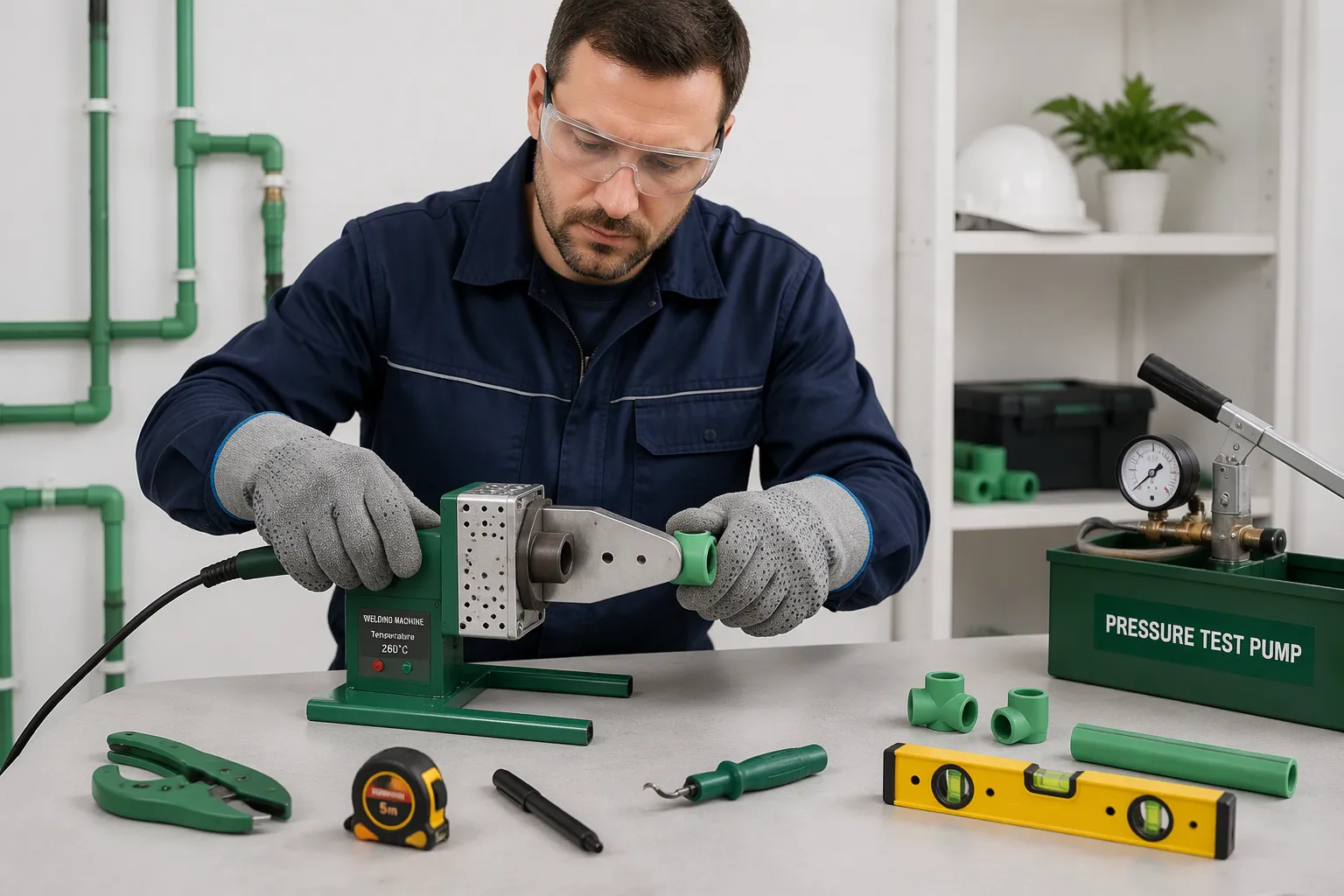
The core kit for a PPR installation is short. A fusion welding machine heats the pipe and fitting to the correct temperature. Heating sockets, or fusion dies, attach to the machine and must match each pipe diameter. A dedicated PPR pipe cutter makes clean, square cuts. A measuring tape sets pipe lengths and support spacing, and a marker pen records cutting points and insertion depths. Deburring and chamfering tools smooth the cut edge. Pipe supports and clamps hold the pipe in line and allow for thermal expansion. A spirit level keeps exposed runs straight, and a pressure testing pump checks the finished network. Adjustable wrenches handle threaded transition fittings, and personal protective equipment — heat-resistant gloves, goggles, and protective footwear — protects the crew.
Preparation matters as much as the weld itself. Cut squarely, then chamfer the pipe end about 2–3 mm deep at a 15°–30° angle. Wipe the pipe end and fitting socket with a clean, dry cloth. Solvents and alcohol should stay away from the joint area. Before heating, confirm the cut is square, the measurement is correct, the burrs are gone, the surface is dry, and the fitting is the right size.
PPR Welding Steps
Welding machine operators should be trained and follow written procedures. The machine is set to 260 ±10 °C. Temperatures above 270 °C degrade the polymer, and temperatures below 250 °C fail to melt it fully. Heating time rises with pipe diameter, as the table below shows.
Table 3. Socket fusion times by pipe diameter.
| Pipe OD (mm) | Welding depth (mm) | Heating time (s) | Insertion time (s) | Cooling time (s) |
|---|---|---|---|---|
| 20 | 14 | 5 | 4 | 30 |
| 25 | 15 | 7 | 4 | 30 |
| 32 | 16 | 8 | 6 | 120 |
| 40 | 18 | 12 | 6 | 120 |
| 50 | 20 | 18 | 6 | 180 |
| 63 | 24 | 24 | 8 | 240 |
The joint is made by melting both faces and pushing them together while still molten. The bead that forms at the mouth is the visible evidence that the melt reached the full depth.
The sequence follows a fixed order. Calibrate the machine to 260 °C. Cut, chamfer, and clean the pipe and fitting. Insert both into the heating die at the same time. Heat for the time the table gives. Push the pipe into the socket in one smooth motion without twisting, because rotation breaks the fusion layer. Hold the joint still while it cools. Water or compressed air must never speed up cooling.
A correctly made fusion joint develops close to the full strength of the pipe wall, which is why the joint is not treated as a weak point in design. The acceptance test is the hydrostatic pressure test, not a tensile figure. Published heating and cooling charts differ slightly between manufacturers, so the fitting supplier's own table governs on site.
Pipe supports secure pipes and keep them stable during installation and use. They also carry the weight of filled lines and guide movement as the material expands and contracts.
Pressure Testing and Inspection
Testing uses clean water only, never air or gas, and happens before any pipe disappears into a wall or floor. A three-stage method is standard. Raise pressure gradually to 1.5 times the maximum working pressure — 30 bar for PN20 pipe, 15 bar for PN10 — and hold for 30 minutes. Then stop adding water and watch the gauge for 30 minutes; the pressure must not drop more than 0.6 bar. Finally, hold pressure for another 120 minutes with no re-pressurizing, and the drop must stay within 0.2 bar. A 10 °C shift in pipe temperature moves pressure by roughly 0.5–1.0 bar, so crews record ambient temperature at the start and end.
Inspectors check every fusion joint, valve, and threaded connection for moisture or deformation while the system sits under pressure. They then record the test pressure, duration, findings, and date. Good installation technique at this stage catches faults while they are still easy to reach.
PPR Maintenance and Care
A well-installed network still needs attention over time. Regular PPR pipe maintenance protects the investment and catches small faults before they grow. Visual inspections at least once a year are the baseline, and critical systems deserve more. Crews should check for wear, damage, and leaks at set intervals, then run pressure tests to confirm the system still holds. A written schedule keeps these tasks from slipping.
Routine Checks and Cleaning
A simple routine covers most needs: periodic visual checks, pressure tests, and leak checks.
Table 4. A maintenance schedule that fits most buildings.
| Task | Recommendation |
|---|---|
| Visual inspection | Look for discoloration, cracks, or leaks; check at least yearly, and every 3–6 months on busy services |
| Cleaning | Wipe dust and buildup with soft cloths and mild detergent; avoid harsh chemicals |
| Flushing | Run clean water through lines to clear sediment and scale |
| Pressure testing | Test at regular intervals to confirm joint integrity |
| Scheduling | Build inspections, cleaning, and testing into one calendar |
Busier buildings need a tighter rhythm. A common schedule runs visual checks every 30 days for stress whitening, deformation, or scratches, pressure testing every 6 months, and joint and support examinations every 12 months. Cleaning should never involve abrasive pads or strong solvents, which can dull the surface and hide small cracks.
Freezing and UV Protection
Cold weather poses a real risk. Water expands as it freezes, and the resulting pressure can split a pipe or push a fusion joint apart. Installers should route lines inside the thermal envelope where possible, add insulation to exposed runs, and drain outdoor or seasonal lines before freezing weather arrives. A burst from ice often appears at a joint rather than mid-pipe, so check fittings first after a cold snap.
Sunlight breaks down polypropylene over time. UV radiation and harsh chemicals degrade the plastic polymers. Pipes stored outdoors or run on exterior walls need opaque insulation, a UV-resistant jacket, or a painted cover. Keep stored lengths under cover and off direct sun before installation.
When to Repair or Replace
Some symptoms point to a hidden leak rather than a worn washer. The warning signs that warrant a closer look:
Water stains on walls or ceilings
Mold growth or musty smells suggesting trapped moisture
A water meter that moves when no water is in use
Warm spots on the floor or unusually high water bills
Persistent low pressure or a sudden pressure drop
Hissing sounds inside walls
Installation errors, material fatigue, vibration, thermal expansion, and water hammer all stress joints over time. A single failed joint usually calls for a cut-and-refuse repair. Repeated failures along one run, deep cracks, or bulging suggest replacement. Early detection keeps repair costs low, while ignored leaks lead to wider damage. The corrosion resistance of PPR pipes removes one common failure mode, yet joints and supports still deserve a trained eye.
PPR Pipes Performance in Different Conditions
Hot and Cold Water Performance
Temperature and pressure compatibility decides how well a PPR line performs. Standard PPR carries water continuously at about 70 °C, with short peaks near 95 °C. The material softens only around 130 °C, so normal service stays far below its deformation point. Pressure capacity falls as heat rises: a PN20 pipe rated 20 bar at 20 °C carries roughly 11 bar at 70 °C on a 50-year basis, because the design stress in the standard drops with temperature. Designers therefore apply derating factors based on temperature, SDR, and service life, with a safety factor of 1.25 to 1.5 under ISO 15874.
Table 5. Temperature limits for standard PP-R in water service.
| Parameter | Typical value | Notes |
|---|---|---|
| Continuous working temperature | Up to ~70 °C | Depends on pressure and SDR |
| Short-term peak | ~95 °C | Limited duration only |
| Brief disruption tolerance | ~100 °C | Short, occasional spikes |
| Vicat softening temperature | ~130 °C | Material begins to deform |
Cold lines pose fewer problems. PPR fittings resist cold and do not become brittle like some other materials. Domestic water systems commonly use fittings rated around 10–16 bar. These traits make PPR pipes a steady choice for hot and cold water supply systems in most buildings.
Chemical Resistance and Water Quality
PPR handles most fluids found in building services. The material rates as resistant to distilled, soft, and hard water, sodium chloride, seawater, calcium chloride at 50%, and sodium hydroxide. Weak acids such as citric and acetic acid perform well. Strong oxidizers — chlorine gas, fuming nitric acid, chromic acid — break the polymer chains and must be kept away from PPR. Chlorinated solvents, ketones, and aromatic hydrocarbons soften the wall and lower the pressure rating.
Water quality benefits from the same chemistry. PPR uses non-toxic, food-grade polypropylene free of lead, cadmium, and phthalates. The smooth bore limits scale and biofilm formation, and the material's corrosion resistance keeps rust out of the flow. PP-R itself has no inherent antimicrobial action; what limits growth inside a line is the smooth wall, the absence of corrosion products, and the disinfectant residual in the water. Products sold as antibacterial rely on additives and should be judged on their potable water certification, not on the claim.
Long-Term Durability
A correctly specified PPR network is designed on a 50-year basis and often exceeds it in cool service. That lifespan rests on resistance to corrosion, high temperatures, and pressure, together with thermal stability, mechanical strength, and flexibility. Heat-fused joints remove the mechanical connections that fail first in metal and PVC networks.
One property runs the other way, and it matters at the design stage. PP-R expands more than PVC under temperature swings — roughly 0.15 mm per metre per kelvin against 0.05–0.08 for PVC — so long hot runs need expansion allowance, sliding supports, or a change of direction to absorb movement. Composite pipe with a fibre or aluminium core cuts that figure by about three quarters, which is why it appears on long exposed runs.
Several factors shorten service life. Poor installation, operation beyond rated temperature or pressure, direct sunlight, and incompatible chemicals are the main risks; UV exposure and physical impact add to them. Accelerated aging, hydrostatic pressure tests, and creep rupture tests predict performance under real conditions. Proper installation and routine checks preserve the advantages that matter most — a long, leak-free run.
Technical support
Fusion parameters, derating, or certification questions
Tell us the fluid, the temperature, and the pipe size. We will send the fusion table, the derating figures, and the certificates that apply to that combination.
Advanced PPR Applications
PPR systems earn their place in demanding projects through three traits: corrosion resistance, thermal stability, and simple installation. These traits also make PPR a practical option for retrofitting old pipe networks. Crews can cut into an existing line, fuse new sections, and restore service without the welding permits that metal work requires. The sections below show where PPR pipe applications fit best across building types and industries.
Residential and Commercial Plumbing
Homeowners and building managers value steady pressure and few repairs. Many residential and commercial projects select PN25 PPR pipes because one class covers both cold and hot lines. That choice simplifies material planning, but the same class still has to be confirmed against the project design: a higher rating alone does not prove a better pipe. Buyers should also check raw material quality, manufacturing consistency, and wall thickness accuracy.
Building type shapes the design. Apartments and multi-storey homes face pressure differences between floors, especially where booster pumps or overhead tanks feed the line. Hotels and hospitals run continuous demand across guest rooms, kitchens, and critical care areas. Schools, offices, and shopping centers add high occupancy and long daily operating hours. For all of these, PPR pipes and fittings from one manufacturer keep dimensions and fusion behavior consistent. These plumbing systems also serve HVAC loops and pressurized hot-water circuits, where the low thermal conductivity of PPR pipes limits energy loss.
Industrial Fluid Handling
Factories use PPR wherever aggressive fluids would attack metal. Chemical plants transport acids, alkalis, and solvents through PPR lines, and fusion-welded joints stay seamless under high temperatures. Food processing relies on the smooth, non-toxic interior during regular washdowns and sterilization. Pharmaceutical production uses the same hygienic surface to prevent cross-contamination. Agricultural irrigation benefits from UV-resistant grades built for outdoor pressure service.
The material suits new builds and infrastructure upgrades alike. A life cycle of 50+ years, lower maintenance than steel or copper, and a smooth bore that reduces flow resistance make it competitive where hot service and moderate chemicals meet. These PPR pipe applications reward planners who match the pressure class to the duty. Each material has a fit zone rather than a ranking: UPVC and CPVC serve their own chemical and cost profiles, PVDF handles extreme purity needs, and HDPE dominates large buried mains. PPR fills the middle ground of hot service, moderate chemicals, and clean fluid transport.
Water Treatment and Chemical Processing
Water plants need lines that never shed rust or metal ions into treated water. The non-metallic composition of PPR makes it immune to corrosion, so taste, color, and odor stay unchanged even in hard water. The smooth inner wall gives bacteria and algae no foothold, which helps disinfection processes hold their effect through distribution. Food, beverage, pharmaceutical, and electronics plants also move process water through PPR to keep contaminants out of production.
Chemical processing draws on the same strengths. Chemical resistance is the core reason PPR lasts in harsh environments, and the material supports safe transport of aggressive fluids with minimal maintenance. Temperature resistance from -20 °C to 95 °C covers most process and washdown duties. Designers should still confirm each fluid against published chemical resistance charts before specifying PPR pipes for a new line.
Common PPR Troubleshooting Issues
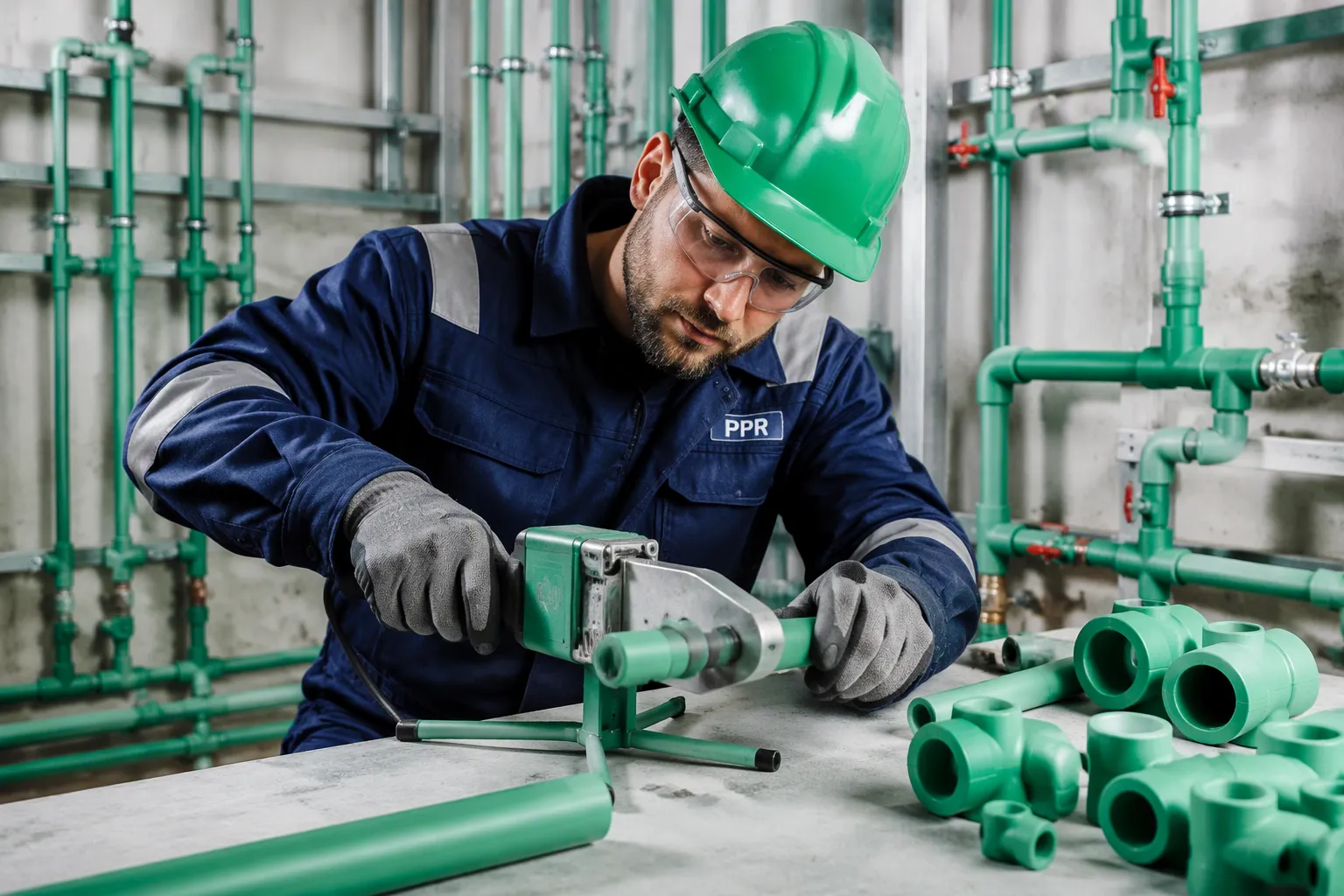
Most problems in a PPR network trace back to a handful of causes: heat, dirt, movement, or pressure. Joint leaks fall under a few repeatable mistakes. The table below pairs each cause with a practical fix.
Table 6. Why a fusion joint fails, and what prevents it.
| Cause | Solution or prevention |
|---|---|
| Under-heating (cold weld) | Bring the die to about 260 °C, keep heating surfaces clean, and apply the exact heating time for the pipe diameter |
| Over-heating (collapsed joint) | Follow the maximum heating time for each size and add no extra seconds |
| Dirty, wet, or greasy surfaces | Cut ends square, clean and dry them right away, and never weld a wet joint |
| Misalignment or movement during cooling | Insert straight without twisting and hold the joint still until fully cooled |
| Wrong heating time for the diameter | Keep a heating time chart on hand and count seconds carefully |
| Poor-quality pipe or fittings | Choose reputable materials, since good technique cannot fix weak stock |
Leaks at Joints
A failed fusion joint rarely repairs well in place. Sealants and clamps only mask the fault for a while. Cut out the faulty section and fuse a new joint properly. Crews should then pressure test the line before closing walls or ceilings, using the recommended cooling times for each diameter.
Good PPR pipe installation prevents most of these failures. Training, clean tools, and a written procedure cover the main risks. Careful technique at the welding stage saves far more time than a repair behind a finished wall.
Low Pressure and Flow
Restricted flow usually comes from rough walls, narrow passages, scale, or poorly designed joints. Smooth inner surfaces cut friction and turbulence, and correct sizing with a flow rate chart keeps passages wide enough. Heat fusion joints form one continuous smooth path, so they remove the steps and gaps that threaded joints leave behind.
A short checklist covers most weak-pressure calls:
Insulate pipes in cold areas such as basements, attics, and crawl spaces to prevent freezing and bursting
Install a pressure regulator to keep pressure within a safe range and reduce stress on the pipes
Perform regular inspections and maintenance to catch problems early
Flush the pipes to clear mineral deposits or debris
Replace corroded pipes when rust or corrosion causes discoloration
Deformation and Cracking
Heat, impact, chemicals, sunlight, and pressure swings all stress PPR pipes over time. High temperatures soften the material and low temperatures make it brittle. Mechanical impact from poor handling or ground movement can start small cracks that grow. Strong acids, bases, and some organic solvents attack the polymer, and prolonged UV exposure breaks down its chains.
Prevention starts at the design stage: insulation in both hot and cold settings, the correct grade for the expected temperature range, and pressure relief valves or surge protectors to tame fluctuations. Proper support spacing and gentle handling protect the pipe during work. UV-resistant grades or protective coatings help outdoor runs, and shaded storage keeps stock in good condition. These habits keep plumbing systems reliable for decades.
Selecting a PPR Supplier
A good supplier does more than ship boxes. The right partner helps a buyer match material to duty, confirms certification, and stands behind the product after delivery. Weigh application requirements first — temperature range, pressure rating, and fluid compatibility — before comparing vendors. The installer must also be trained in fusion technique, since even premium stock fails in untrained hands.
What to Look for in a Manufacturer
Certification tops the list. Check marks such as ISO 15874, WRAS, or DVGW approval, then inspect the goods themselves for consistent coloration, a smooth finish, accurate size labeling, and legible markings. A manufacturer that controls its raw material supply usually shows more consistent output. Full certification sets and premium raw materials are the difference between a supplier and a trader.
Table 7. How a strong supplier differs from a weak one.
| Key factors | Strong supplier | Weaker supplier |
|---|---|---|
| International certifications (ISO, WRAS, CE) | Full set | Partial or none |
| Raw materials | Premium grades | Recycled or low-grade |
| Delivery reliability | Reliable schedule | Uncertain |
| OEM support | Branding and packaging | Weak or none |
| Technical match | Broad mold range | Limited compatibility |
Buyers sourcing wholesale PPR pipes should also request samples and batch records. A short trial run reveals how the material cuts, heats, and fuses before a large order commits.
Quality Assurance and Support
Quality assurance covers the factory and the field. Ask how the maker tests wall thickness, roundness, and pressure class, and whether each length carries a traceable batch mark. Delivery terms matter too: lead time after deposit, the certification set that ships with the goods, and who answers technical questions once the pipe is on site. Support after the sale separates a reliable supplier from a box mover — confirm how fast spare fittings arrive and what the warranty actually covers.
PPR piping systems offer a durable, corrosion-resistant, and cost-effective answer for hot and cold water supply, HVAC, and industrial fluid handling. These strengths hold true only when buyers select the right class and install it correctly. Proper installation and maintenance, together with certified products, decide how long a PPR piping system performs. The same rules apply across PPR pipe applications, from home plumbing systems to process lines. Crews who follow fusion procedures and routine checks protect their investment for decades. A quick conversation about the project's temperature, pressure, and certification needs is a sensible first step.
Sourcing
Pipes, fittings and valves from one certified line
PP-R and PP-RCT in PN10 to PN25, the fittings that match them, and the fusion and test data that goes with the order. Send the schedule or the drawing and we will confirm class, size and lead time.
FAQ
What temperature can a PPR pipe handle?
Standard PPR carries water continuously at about 70 °C, with short peaks near 95 °C. The material softens only around 130 °C, so normal hot water service stays well below its deformation point. Designers should still derate pressure as temperature rises.
How long does a PPR piping system last?
A correctly specified network is designed on a 50-year basis at its rated temperature and pressure, and often exceeds that in cool service. Corrosion resistance against water and most building fluids supports that lifespan. Poor installation, operation beyond rated temperature or pressure, and direct sunlight shorten it.
Can PPR pipes handle drinking water?
Yes. PPR uses non-toxic, food-grade polypropylene free of lead, cadmium, and phthalates. The smooth bore limits scale and biofilm growth. Buyers should confirm potable water certification, such as WRAS or NSF/ANSI 61, before installation.
What is the difference between PN20 and PN25?
Both classes suit hot and cold water, but PN25 carries a thicker wall at the same diameter: SDR 6 against SDR 7.4. Many projects choose PN25 so one class covers every line. The project design should always confirm the final choice.
Can crews join PPR to metal pipes?
Yes. Threaded transition fittings connect welded PPR to metal taps, meters, or heaters. The fusion joint stays plastic-to-plastic, and the threaded adapter handles the metal side. Matching the pipe class keeps the full run at one pressure rating.
Why does a fusion joint leak?
Most joint leaks trace to under-heating, over-heating, dirty or wet surfaces, or movement during cooling. Operators should hold the welding machine at 260 ±10 °C, follow the heating time for each diameter, and keep the joint still until it cools.
Does sunlight damage PPR pipes?
Yes. UV radiation breaks down polypropylene chains over time. Outdoor runs need opaque insulation, a UV-resistant jacket, or a painted cover. Stored lengths should stay under cover and out of direct sun before installation.
Is PPR suitable for HVAC and industrial lines?
PPR serves HVAC loops, pressurized hot-water circuits, water treatment, and chemical processing. Its thermal stability and smooth interior fit these duties. Designers should check each fluid against published chemical resistance charts before specifying PPR pipes for a new line.
Tip: size on temperature, not on the stamp. A PN20 pipe is a 20 bar pipe only at 20 °C; at 70 °C the same wall carries roughly half that, and the derating table in the standard is what the design should follow.
Related reading: What is a plastic flange?
Sources
ASTM International, F2389 Standard Specification for Pressure-rated Polypropylene (PP) Piping Systems. Read the standard scope
Plastics Pipe Institute, PP-R and PP-RCT pressure piping systems: materials, dimension ratios and hydrostatic ratings. Read the technical page
Water Regulations Advisory Scheme, approval of products that come into contact with drinking water in the UK. Read the scheme overview


