


 Feb 12, 2026
 View:975
In industries where corrosive chemicals, extreme temperatures, and stringent purity requirements dominate daily operations, the choice of valve material can mean the difference between smooth production and costly downtime. The PVDF butterfly valve has emerged as a critical solution in chemical processing, semiconductor manufacturing, water treatment, and pharmaceutical production — environments where standard metal valves corrode rapidly and traditional plastic valves fail under thermal stress. Yet despite their growing presence in industrial piping systems worldwide, many engineers and facility managers remain unclear about what exactly defines these valves, what makes their material properties unique, and how to select the right configuration for specific applications. This comprehensive guide clarifies the definition, construction, and key features that make PVDF butterfly valves an essential component in modern chemical-resistant piping infrastructure.
KEY TAKEAWAYS
PVDF butterfly valves are quarter-turn flow control devices manufactured from polyvinylidene fluoride (PVDF), a fluoropolymer offering exceptional chemical resistance to acids, alkalis, solvents, and oxidizers across a temperature range of -30°C to +150°C.
The material delivers superior chemical inertness compared to PVC, CPVC, or PP, withstanding continuous exposure to 98% sulfuric acid, 40% sodium hydroxide, chlorine, and most organic solvents without degradation.
Standard construction features a disc-style closure element rotating 90 degrees within the flow path, mounted on a shaft that penetrates the valve body through precision seals.
Typical pressure ratings range from PN10 (10 bar / 145 psi) to PN16 (16 bar / 232 psi), with sizes available from DN15 (½ inch) to DN300 (12 inches) depending on manufacturer capabilities.
The material maintains mechanical strength and dimensional stability at continuous operating temperatures up to 120°C (248°F), with short-term resistance to 150°C (302°F).
PVDF's inherent flame resistance (UL-94 V-0 rated, LOI of 44%) eliminates the need for flame retardant additives, ensuring purity in sensitive applications.
Modern variants include motorized butterfly valve configurations with electric or pneumatic actuators for automated control in process automation systems.
What Is a PVDF Butterfly Valve? The Essential Definition
A PVDF butterfly valve is a quarter-turn rotary valve constructed primarily from polyvinylidene fluoride, in which a circular disc-shaped closure element (the "butterfly") rotates 90 degrees around a central shaft to control fluid flow through a pipeline. When the disc aligns parallel to the flow direction, the valve is fully open; when rotated perpendicular to flow, the valve closes, sealing against an elastomer or PTFE seat to stop fluid passage.
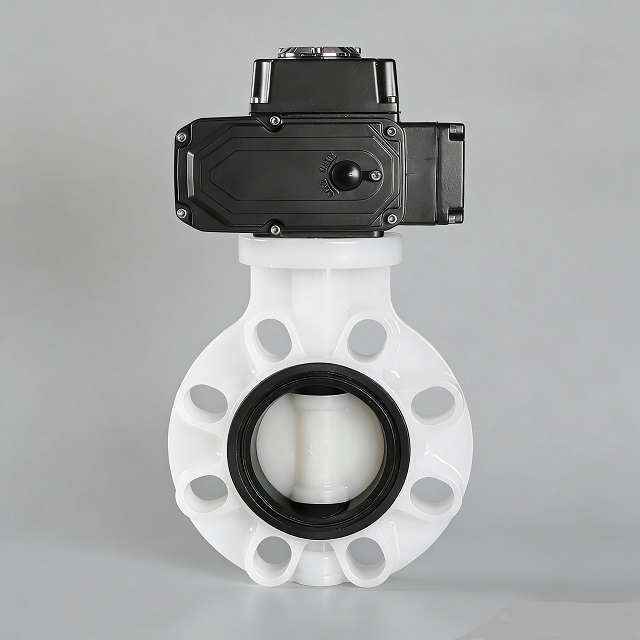
The defining characteristic is the material: PVDF, a semi-crystalline thermoplastic fluoropolymer with the chemical formula (C2H2F2)n. This material choice distinguishes PVDF butterfly valves from metal alternatives (stainless steel, carbon steel) and other plastic valve types (PVC, CPVC, polypropylene). The PVDF construction delivers chemical resistance profiles that metal valves cannot match in acidic or chlorinated environments, while offering thermal performance that standard thermoplastics cannot achieve.
The valve body, disc, and shaft are typically manufactured from virgin PVDF material, while sealing elements use EPDM (ethylene propylene diene monomer), FKM (fluoroelastomer), or PTFE (polytetrafluoroethylene) depending on chemical compatibility requirements. Connection methods include flanged ends conforming to DIN, ANSI, or JIS standards, wafer-style installations, or lug-style mounting configurations.
Material reference: Polyvinylidene Fluoride (PVDF) — Wikipedia
Understanding PVDF: The Material That Defines Performance
To understand why PVDF butterfly valves excel in chemical service, one must first understand the polymer itself. Polyvinylidene fluoride results from the polymerization of vinylidene fluoride monomers, creating a molecular chain with alternating -CH2- and -CF2- groups. This specific structure produces a balance of properties unavailable in other thermoplastics.
Chemical Composition and Structure
PVDF is a partially fluorinated polymer — containing approximately 59% fluorine by weight — which places it between fully fluorinated polymers like PTFE (76% fluorine) and non-fluorinated plastics like polyethylene (0% fluorine). This intermediate fluorination delivers exceptional chemical resistance while maintaining melt-processability that allows for injection molding, extrusion, and welding — manufacturing techniques impossible with PTFE.
The semi-crystalline structure (typically 50–60% crystallinity) contributes to mechanical strength, while the fluorinated carbon backbone provides chemical inertness. The material density is approximately 1.78 g/cm³, significantly higher than PVC (1.4 g/cm³) or polypropylene (0.9 g/cm³), contributing to better mechanical properties and abrasion resistance.
Chemical Resistance Profile
The chemical resistance of PVDF is its defining engineering advantage. The material demonstrates resistance to strong acids including sulfuric acid (up to 98% concentration), hydrochloric acid, nitric acid, and phosphoric acid across broad temperature ranges. Alkali resistance encompasses sodium hydroxide (40% concentration), potassium hydroxide, and ammonia solutions. Halogen resistance includes chlorine gas, chlorine dioxide, sodium hypochlorite solutions, and bromine.
PVDF also resists most organic solvents including alcohols, ketones, aliphatic hydrocarbons, and many aromatic solvents. However, polar aprotic solvents such as dimethylformamide (DMF), dimethylacetamide (DMAc), and N-methyl-2-pyrrolidone (NMP) can attack PVDF, particularly at elevated temperatures. Strong amines and some concentrated ketones above 80°C also present compatibility challenges.
Chemical resistance data: PVDF Properties and Applications — PMC (National Institutes of Health)
Thermal Performance
PVDF maintains mechanical integrity across a wide temperature range. The continuous service temperature reaches 120°C (248°F) for most industrial grades, with short-term excursions to 150°C (302°F) permissible. The material remains ductile down to -30°C (-22°F), avoiding the brittle failure common in PVC below 0°C. The melting point of PVDF is approximately 170–180°C, well above its maximum service temperature, providing a safe operating margin.
This thermal range makes PVDF butterfly valves suitable for hot acid processes, steam sterilization cycles (in pharmaceutical applications), and cold brine systems — a versatility that no single metal alloy can match without corrosion concerns.
Key Features of PVDF Butterfly Valves
1. Superior Chemical Resistance in Harsh Environments
The primary feature driving adoption of PVDF butterfly valves is chemical inertness that protects system integrity in aggressive media. In semiconductor wet benches handling hydrofluoric acid (HF) and sulfuric acid/hydrogen peroxide mixtures (piranha etchants), PVDF valves withstand daily contact with chemicals that would dissolve stainless steel within hours. In chlor-alkali production facilities, PVDF components resist degradation from chlorine gas and sodium hydroxide solutions that corrode even titanium-lined equipment over time.
Water treatment plants dosing chlorine dioxide or sodium hypochlorite rely on PVDF valves because the material neither reacts with oxidizing agents nor contributes to disinfectant demand through oxidation reactions. Chemical manufacturing plants producing specialty solvents, pharmaceuticals, or agricultural chemicals select PVDF for process lines where product purity requirements prohibit metal ion contamination.
2. High Purity and Non-Contaminating Properties
PVDF's chemical inertness translates directly to high-purity performance. The material does not leach ions, plasticizers, or stabilizers into process fluids — a critical requirement in ultra-pure water (UPW) systems for semiconductor fabrication, pharmaceutical water-for-injection (WFI) loops, and food-grade chemical processing. Unlike PVC, which requires tin-based stabilizers, or metal valves that can release iron or nickel ions, PVDF components introduce no contamination risks.
This purity advantage makes PVDF butterfly valves standard equipment in cleanroom environments, laboratory chemical supply systems, and pharmaceutical manufacturing suites where trace contamination can invalidate entire production batches.
3. Mechanical Strength and Dimensional Stability
Despite being a thermoplastic, PVDF delivers impressive mechanical performance. The tensile modulus of approximately 2,200 MPa provides structural rigidity that resists pressure-induced deformation. Compared to polypropylene (tensile modulus ~1,500 MPa) or PVC (tensile modulus ~3,000 MPa), PVDF offers an optimal balance — stiffer than PP but more impact-resistant than rigid PVC, particularly at low temperatures.
The material exhibits excellent creep resistance, meaning PVDF butterfly valves maintain dimensional stability under sustained pressure loads. This property is superior to other fluoropolymers and prevents the gradual deformation that can cause seat leakage in valves subjected to continuous line pressure over years of service.
4. Inherent Flame Resistance Without Additives
PVDF achieves a UL-94 V-0 flame classification and a limiting oxygen index (LOI) of 44% without requiring flame retardant additives. The material is self-extinguishing and does not support combustion in normal atmospheric oxygen concentrations. This inherent fire safety eliminates the use of halogenated or phosphorus-based flame retardants that could compromise chemical purity or degrade over time.
For facilities operating under strict fire codes — chemical plants, offshore platforms, pharmaceutical manufacturing — this feature reduces installation restrictions and fire suppression system requirements compared to flammable plastic piping materials.
5. UV and Weather Resistance for Outdoor Applications
Unlike many thermoplastics that degrade under ultraviolet exposure, PVDF demonstrates exceptional UV stability with degradation rates below 0.1% annually under direct sunlight. This weatherability allows outdoor installation of PVDF butterfly valves in chemical tank farms, cooling water systems, and wastewater treatment facilities without protective covers or UV inhibitors.
The material resists ozone attack, maintains properties through freeze-thaw cycling, and tolerates exposure to rain, snow, and atmospheric pollutants — environmental factors that corrode metal valves or embrittle standard plastics within years.
6. Weldability and Fabrication Advantages
PVDF components can be thermally welded using hot gas, hot plate, or electrofusion techniques — creating homogeneous joints with strength equivalent to the base material. This weldability enables field fabrication of custom piping configurations, repair of damaged components, and integration of valves into complex manifold assemblies without relying on mechanical joints that could introduce leak paths.
The material can also be machined using standard metalworking tools (with appropriate speeds and feeds to avoid thermal damage), allowing for custom modifications or emergency repairs that would be impossible with thermoset plastics or ceramics.
Construction and Design Elements
Understanding the physical construction of PVDF butterfly valves helps engineers specify appropriate configurations for their applications and anticipate maintenance requirements.
| Component | Material Options | Function and Considerations |
|---|---|---|
| Valve body | Virgin PVDF homopolymer or copolymer | Provides structural containment and pressure boundary. Homopolymer offers maximum chemical resistance; copolymers improve impact strength. |
| Disc (butterfly element) | PVDF, sometimes PTFE-coated for enhanced sealing | Rotating closure element. Disc thickness and diameter tolerance directly affect flow coefficient (Cv) and shutoff performance. |
| Shaft | PVDF, or stainless steel with PVDF/PTFE sleeve | Transmits torque from actuator to disc. Material choice affects chemical exposure risk if shaft penetrates wetted area. |
| Seat/seal | EPDM (general service), FKM/Viton (high temp/chemical), PTFE (universal chemical resistance) | Creates shutoff seal when valve closes. Elastomer selection must match chemical service and temperature range. |
| Shaft seals | O-rings (EPDM, FKM) or mechanical shaft seals (PTFE packing) | Prevents external leakage around shaft penetration. Double-seal designs isolate actuator from process media in corrosive service. |
| End connections | Integral PVDF flanges (DIN/ANSI drilling), wafer lugs, or threaded sockets | Determines installation method. Flanged connections offer easiest removal; wafer designs minimize installation length. |
Motorized Butterfly Valve Configurations
Many industrial applications demand automated control rather than manual operation. Motorized butterfly valve assemblies integrate electric actuators (typically quarter-turn rotary actuators with 90-degree travel) directly mounted to the valve shaft. These electric actuators offer several advantages: precise positioning for flow modulation (not just on/off operation), integration with SCADA or DCS control systems via 4-20mA analog signals or digital protocols, fail-safe positioning (spring-return or capacitor-powered close-on-power-loss), and elimination of manual access requirements in hazardous areas.
Pneumatic actuators provide an alternative for facilities with compressed air infrastructure, offering faster actuation speed and inherent fail-safe operation through spring-return mechanisms. The choice between electric and pneumatic actuation depends on control precision requirements, available utilities, response time specifications, and budget constraints.
Performance Specifications and Standards
Professional specification of PVDF butterfly valves requires understanding standard performance parameters and compliance benchmarks.
| Specification Parameter | Typical Values | Standards/Notes |
|---|---|---|
| Pressure rating | PN10 (10 bar / 145 psi), PN16 (16 bar / 232 psi) | At 20°C. Pressure rating decreases with temperature — consult pressure-temperature curves. |
| Temperature range | -30°C to +120°C continuous; +150°C short-term | Elastomer seal limitations may further restrict temperature range. |
| Size range | DN15 (½") to DN300 (12"), larger on custom order | Availability depends on manufacturer; DN50–DN150 most common stock sizes. |
| Connection standards | DIN 2501, ANSI B16.5, JIS B2220 | Flange drilling pattern must match mating pipe flanges. |
| Seat leakage class | Class IV or Class VI per ANSI/FCI 70-2 | Class VI offers tighter shutoff (leakage<0.005% of Cv with water at 50 psi) |
| Flow coefficient (Cv) | Varies by size; approximately 25× nominal diameter | Example: DN50 valve ≈ Cv 1250. High Cv indicates low pressure drop at full open. |
| Operating torque | Depends on size, pressure, seal compression | Critical for actuator sizing; manufacturers provide torque curves. |
| Cycle life | 50,000+ full-stroke cycles (manual), 100,000+ cycles (automated, with proper maintenance) | Seat wear and shaft seal life typically limit service life. |
Industry standards: Butterfly Valve Technical Overview — Wikipedia
Applications Where PVDF Butterfly Valves Excel
Chemical Processing and Manufacturing
Chemical plants producing acids, alkalis, solvents, and specialty chemicals deploy PVDF butterfly valves throughout process lines, reactor feed systems, and product transfer piping. The material's resistance to thermal cycling during batch operations, combined with immunity to chemical attack, eliminates the frequent valve replacement cycles common with metal components in these environments.
Semiconductor Fabrication (Wet Process Tools)
Chip manufacturing facilities require ultra-pure chemical delivery for wet etching, cleaning, and photoresist stripping processes. PVDF valves in these systems must resist mixtures of hydrofluoric acid, sulfuric acid, hydrogen peroxide, and ammonium hydroxide while contributing zero ionic contamination that could cause wafer defects. The combination of chemical compatibility and high purity makes PVDF the standard valve material in semiconductor wet benches and chemical supply cabinets.
Water and Wastewater Treatment
Municipal and industrial water treatment systems use chlorine, chlorine dioxide, ozone, and other oxidizing disinfectants that rapidly corrode metal valves and degrade standard plastic components. PVDF butterfly valves withstand continuous exposure to these oxidizers in chemical feed systems, clearwell distribution, and backwash control applications. The material also resists biofouling and scale formation better than metal alternatives, reducing maintenance frequency.
Pharmaceutical and Biotechnology Production
Pharmaceutical manufacturing demands materials that withstand aggressive cleaning protocols (caustic solutions, steam sterilization) while maintaining validation-compliant purity. PVDF valves in water-for-injection (WFI) systems, clean-in-place (CIP) circuits, and active pharmaceutical ingredient (API) processing lines meet these dual requirements. The material's FDA compliance for direct food contact and biocompatibility further expand its use in fermentation systems and bioreactor applications.
Electroplating and Metal Finishing
Plating bath circulation, chemical rinse systems, and waste treatment lines in metal finishing facilities operate with concentrated acids (chromic, sulfuric, nitric, hydrochloric) and alkaline cleaners that destroy metal valves. PVDF components throughout these systems deliver multi-year service lives compared to months-long survival of stainless steel alternatives, significantly reducing total cost of ownership despite higher initial material cost.
Mining and Ore Processing
Hydrometallurgical operations — particularly copper heap leaching, uranium processing, and rare earth extraction — handle highly acidic or alkaline process solutions at elevated temperatures. PVDF butterfly valves in pregnant leach solution (PLS) lines, solvent extraction circuits, and tailings neutralization systems resist both chemical attack and abrasive wear from suspended solids, extending service intervals in remote locations where maintenance access is limited.
PVDF vs. Alternative Valve Materials
Understanding how PVDF compares to other valve construction materials helps engineers make informed selection decisions based on application requirements and budget constraints.
| Material | Chemical Resistance | Temperature Range | Mechanical Strength | Cost (Relative) | Best Applications |
|---|---|---|---|---|---|
| PVDF | Excellent — broad acid, alkali, solvent resistance | -30°C to +150°C | High for thermoplastics; creep resistant | 3-4× | Corrosive chemicals, high purity, elevated temperature |
| PVC (UPVC) | Good — acids, alkalis; limited solvents | 0°C to +60°C | Moderate; brittle at low temp | 1× | Water systems, mild chemicals, ambient temperature |
| CPVC | Good — similar to PVC with better chlorine resistance | 0°C to +95°C | Moderate; better than PVC | 1.5× | Hot water, chlorinated systems, mild chemicals |
| Polypropylene (PP) | Good — acids, alkalis; poor to aromatic solvents | -10°C to +100°C | Lower than PVDF; prone to creep | 1.2× | General chemical service, lower cost alternative |
| 316 Stainless Steel | Poor to acids (especially chloride-containing); good to alkalis | -200°C to +400°C | Excellent mechanical properties | 2-3× | High pressure, high temperature, non-corrosive media |
| Hastelloy C | Excellent — broad chemical resistance including hot acids | -200°C to +600°C | Excellent mechanical properties | 15-20× | Extreme chemical service where PVDF temperature limits are exceeded |
The decision matrix typically favors PVDF when chemical service eliminates metal options but temperature and pressure requirements fall within PVDF's capabilities. The material offers dramatically better chemical resistance than lower-cost plastics (PVC, PP) while avoiding the extreme cost of exotic metal alloys.
Selection Criteria and Specification Guidelines
Properly specifying a PVDF butterfly valve requires systematic evaluation of application parameters:
Chemical compatibility verification: Confirm that PVDF resists all process chemicals, cleaning agents, and potential contaminants at maximum operating concentrations and temperatures. Cross-reference against chemical resistance charts from multiple sources, as resistance can vary between homopolymer and copolymer grades.
Temperature and pressure boundaries: Verify that operating conditions remain within valve pressure-temperature ratings throughout normal operation and upset conditions. Remember that pressure rating decreases with temperature — a valve rated PN16 at 20°C may drop to PN10 at 100°C.
Seat material selection: Choose elastomer seals compatible with both the process chemistry and temperature range. EPDM suits general water service and mild chemicals; FKM handles higher temperatures and aggressive chemicals; PTFE provides universal chemical resistance but requires higher seating forces.
End connection configuration: Flanged connections simplify removal for maintenance but increase installation cost and space requirements. Wafer-style valves minimize length and weight but require careful bolt tensioning during installation.
Actuation requirements: Specify manual, electric, or pneumatic operation based on control system integration needs, cycle frequency, and fail-safe requirements. For motorized butterfly valve configurations, determine required control signals (on/off, modulating), feedback provisions (position switches, analog position transmission), and power supply availability.
Compliance and certification needs: Verify that valves meet applicable standards for the installation jurisdiction — FDA compliance for food/pharma, ATEX/IECEx certification for hazardous areas, NSF-61 for potable water, or ISO 9001 manufacturing quality systems.
Summary: PVDF Butterfly Valves as Chemical-Resistant Flow Control Solutions
PVDF butterfly valves represent a critical technology for industries requiring chemical-resistant, high-purity, thermally stable flow control. The material — polyvinylidene fluoride — delivers a unique combination of properties: chemical resistance rivaling exotic metal alloys, thermal performance exceeding standard thermoplastics, mechanical strength maintaining dimensional stability under pressure, and purity meeting semiconductor and pharmaceutical requirements.
Key features include resistance to concentrated acids and alkalis across broad temperature ranges (-30°C to +150°C), inherent flame resistance without additives (UL-94 V-0), UV and weather stability for outdoor installation, and weldability enabling field fabrication. Construction typically features virgin PVDF bodies and discs with EPDM, FKM, or PTFE sealing elements, available in sizes from DN15 to DN300 with pressure ratings of PN10 to PN16.
Applications span chemical manufacturing, semiconductor fabrication, water treatment, pharmaceutical production, electroplating, and mining — wherever corrosive media, high purity, or thermal cycling eliminate metal valves and exceed the capabilities of standard plastic materials. Modern configurations include motorized butterfly valve assemblies integrating electric or pneumatic actuators for automated process control.
Proper selection requires systematic verification of chemical compatibility, temperature/pressure boundaries, seal material appropriateness, and compliance with industry-specific regulations — ensuring that the valve specification matches both current operating conditions and potential future process changes.
For chemical processors, semiconductor fabricators, water treatment facilities, and pharmaceutical manufacturers requiring PVDF butterfly valves that combine proven chemical resistance with manufacturing quality and technical support — XITA offers comprehensive solutions. Based in Changzhou, China, XITA operates ISO 9001-certified production facilities specializing in thermoplastic valve and piping systems. With over 20 years of industry experience, annual production capacity of 2,000 tons for PVDF products, and a complete range from manual to motorized butterfly valve configurations in sizes DN15–DN300, XITA serves chemical, semiconductor, pharmaceutical, and water treatment applications globally.
View XITA PVDF Butterfly Valve Range | Request Technical Datasheet or Quote
Frequently Asked Questions
Q1: What is the main advantage of PVDF butterfly valves over PVC or stainless steel valves?
PVDF offers superior chemical resistance to both acids and alkalis compared to stainless steel (which corrodes in chloride-containing acids) while providing much higher temperature capability (up to 150°C) compared to PVC (limited to 60°C). This makes PVDF the optimal choice for hot corrosive chemical service.
Q2: Can PVDF butterfly valves handle chlorine and chlorinated chemicals?
Yes — PVDF demonstrates excellent resistance to chlorine gas, sodium hypochlorite solutions, and chlorine dioxide across broad concentration ranges. This makes PVDF valves standard equipment in water treatment chlorination systems and chemical bleaching processes where metal valves corrode rapidly.
Q3: What chemicals are NOT compatible with PVDF?
PVDF is attacked by polar aprotic solvents (DMF, NMP, DMAc), strong amines (especially at elevated temperatures), and some concentrated ketones above 80°C. Always consult chemical resistance charts for specific chemical/concentration/temperature combinations before specifying PVDF.
Q4: How do I select between EPDM, FKM, and PTFE seats for a PVDF butterfly valve?
EPDM suits water and mild chemical service up to 120°C. FKM (Viton) handles aggressive chemicals and temperatures to 150°C. PTFE provides universal chemical resistance and the widest temperature range but requires higher operating torque. Match seat material to the most aggressive chemical and highest temperature in your application.
Q5: What is the typical lifespan of a PVDF butterfly valve in chemical service?
With proper chemical compatibility and installation, PVDF valve bodies can last 20–30+ years. Seat seals typically require replacement every 3–5 years in continuous service or after 50,000–100,000 cycles, depending on operating conditions and media aggressiveness. Shaft seals may need service at similar intervals.
Q6: Can PVDF butterfly valves be used for steam service?
PVDF can handle steam sterilization cycles (typically 121°C for 20–30 minutes in pharmaceutical applications) but is not suitable for continuous steam service. The 120–150°C temperature limit and pressure derating at elevated temperatures restrict steam applications to intermittent sterilization rather than continuous steam transport.
Q7: What is the difference between a manual and motorized butterfly valve?
Manual valves use lever or gearbox handles for local operation. Motorized butterfly valves integrate electric or pneumatic actuators for remote/automated operation, enabling process control system integration, precise flow modulation, and fail-safe positioning. Motorized versions cost 3–5× more but eliminate manual access requirements and enable automation.
Q8: How does PVDF compare to PTFE (Teflon) for valve applications?
PTFE offers broader chemical resistance and higher temperature capability (260°C continuous) but cannot be injection molded or conventionally machined. PVDF provides excellent chemical resistance (though slightly narrower than PTFE) with the manufacturing advantages of a melt-processable thermoplastic, enabling lower cost and better mechanical properties.
Q9: Do PVDF butterfly valves require special installation procedures?
Follow standard butterfly valve installation practices: ensure pipe alignment to avoid stress on valve body, torque flange bolts to manufacturer specifications (typically 50–70% of metal flange torque values for plastic), and avoid over-compression of gaskets. Do not use PVDF valves as pipe supports or subject them to external bending loads.
Q10: Are PVDF butterfly valves approved for drinking water applications?
PVDF material itself is approved for potable water contact under various standards (NSF-61, WRAS). However, complete valve approval depends on all wetted components including seals and lubricants meeting drinking water standards. Verify that the specific valve model carries appropriate certifications for your jurisdiction's potable water requirements.
External References:Polyvinylidene Fluoride (PVDF) — Wikipedia | PVDF Properties and Applications — PMC (NIH) | Butterfly Valve Overview — Wikipedia

