


PVDF Pipe Versus Other Plastics Which Delivers Superior Performance
 Jul 29, 2026|
 View:176
You need pipes that can handle strong chemicals and hot or cold temperatures. The pipes must last for many years, even when used a lot. PVDF pipe does all these things well. It has great chemical resistance, is tough, and stays stable in demanding industrial environments. As a fluoropolymer material, PVDF's molecular structure gives it this unusual combination of purity, strength and long-term stability[1]. XITA's PVDF pipe is a top choice for these harsh areas. The table below shows how PVDF compares with other plastics on the properties that matter most:
| Property | PVDF | Other Plastics |
|---|---|---|
| Chemical Resistance | 99.5% | Varies (lower) |
| Temperature Tolerance | Up to 150°C | Typically lower |
| Service Life | 25+ years | Often less than 5 yrs |
Key Takeaways
PVDF pipes are very good at resisting chemicals. This makes them great for tough places like chemical plants and semiconductor factories.
These pipes can take high heat, up to 150°C. They stay strong and keep their shape in very hot conditions.
PVDF pipes last a long time, over 25 years. This means you do not need to fix them often, and you save money over time.
The inside of PVDF fittings is smooth, which stops contamination from building up. This makes them good for jobs that need to stay very clean, like pharmaceutical production.
PVDF pipes might cost more at first, but they last long and do not need much maintenance. This helps you save a lot of money over the life of the system.
Need the Right PVDF Piping Solution for Your Project?
XITA brings extensive experience in manufacturing and engineering PVDF piping systems. Get expert selection guidance and a tailored solution for your application — chemical processing, semiconductor, pharmaceutical, water treatment, and more.
Request a Quote →PVDF Pipe Key Performance Differentiators
Chemical Resistance
Pipes must handle strong chemicals every day. PVDF pipe is special because it resists many chemicals. It stands up to acids, alkalis, halogens, and hydrocarbons. You can use PVDF pipe and PVDF fittings in places like chemical plants, semiconductor fabs, and pharmaceutical factories. These pipes do not rust or break down, so your system keeps working well for a long time.
PVDF pipe is made for systems that need to resist corrosion and move high-purity liquids.
You can move strong chemicals safely, so PVDF fittings are well suited to high-purity systems.
People choose PVDF pipes in chemical plants because they stay strong and help prevent dangerous leaks.
PVDF's chemical resistance keeps your system running when you cannot afford downtime.
PVDF fittings do not release harmful substances, so they work well where cleanliness is critical, such as in pharmaceutical and semiconductor manufacturing.
Temperature Stability
Your pipes need to work in both hot and cold environments. PVDF pipe stays strong at temperatures many other pipe materials cannot handle. Independent material data confirms PVDF's continuous service range extends up to roughly 150°C, well above standard PVC and CPVC[1].
PVDF pipes work continuously up to about 140°C and can tolerate short bursts up to 150°C.
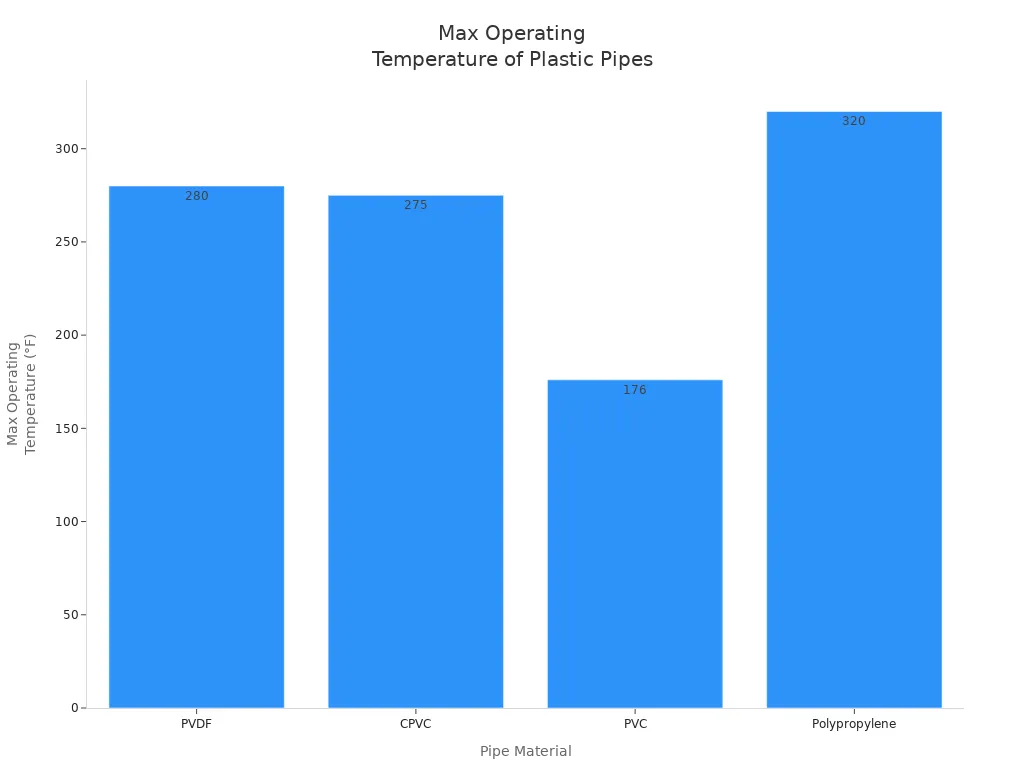
The maximum operating temperature for PVDF pipe is around 280°F, higher than PVC and CPVC.
PVDF fittings keep their shape and strength even under high-heat conditions.
You can use PVDF pipe where temperatures fluctuate quickly.
| Material | Maximum Operating Temperature |
|---|---|
| PVDF | 280°F |
| CPVC | 275°F |
| PVC | 176°F |
| Polypropylene | 320°F |
Durability and Longevity
You want pipes that last a long time. PVDF pipe is strong and does not wear out quickly.
| Property | Description |
|---|---|
| High Impact Strength | PVDF pipes resist cracking under impact. |
| Excellent Wear Resistance | PVDF fittings last longer in abrasive environments. |
| Good Creep Resistance | PVDF pipe keeps its shape under sustained stress. |
| High Mechanical Strength | PVDF fittings can hold heavy and harsh liquids. |
Contamination Risk
You want your pipes to keep liquids clean. PVDF pipe and PVDF fittings resist leaching and outgassing far better than many alternatives. As a chemically inert fluoropolymer, PVDF has very limited solubility and reactivity, which is part of why it releases so few extractables into the process stream[3].
| Property | PVDF Fittings | PPH Fittings |
|---|---|---|
| Extractables | Very low | May release trace amounts |
| Internal Surface Smoothness | Smooth, suited to high-purity liquids | Not specified |
| Ideal Use Cases | Electronics, semiconductor fabrication | Not for ultra-pure applications |
| Contamination Risk | No contamination tolerated | Less suitable for critical systems |
Cost-Effectiveness
You want pipes that save money over time. PVDF pipe costs more upfront, but it pays off over the life of the system.
| Material | Initial Cost ($/foot) | Service Life (years) | Maintenance Needs |
|---|---|---|---|
| PVDF | 8–15 | 15–20 | Low |
| PVC | 2–4 | N/A | N/A |
| CPVC | N/A | N/A | N/A |
| Polypropylene | 2–4 | 5–7 | High |
Tip: Choosing PVDF pipe and PVDF fittings for your system can help you avoid costly failures and keep production running without interruption.
PVDF Pipe vs Other Plastics
PVDF Pipe vs PVC
PVDF pipe and PVC pipe are not interchangeable. PVC works well for standard jobs, while PVDF performs better in demanding environments where you need to move strong chemicals or keep liquids pure.
| Property | PVDF Pipe | PVC Pipe |
|---|---|---|
| Chemical Resistance | Superior to PVC | Adequate for standard applications |
| Temperature Resistance | Higher than PVC | Limited compared to PVDF |
| Purity | Higher than PVC | Lower than PVDF |
| Suitable For | Strong corrosive chemicals, high-purity water | Standard water treatment applications |
PVDF pipe handles strong acids and bases better than PVC and keeps liquids cleaner. If you need high purity or deal with harsh chemicals, PVDF is the better choice. PVC costs less initially, but PVDF lasts longer and keeps your system safer over time.
Note: PVDF is rated higher than PVC for demanding applications. You can rely on PVDF in environments with strong chemical exposure.
PVDF Pipe vs CPVC
CPVC is another common plastic pipe material. It handles hotter water than PVC and works with some chemicals, but PVDF offers broader benefits — a wider temperature range and stronger chemical resistance.
With PVDF, you don't need to worry about pipes failing from heat or chemical exposure. CPVC handles hot water well, but PVDF performs in both hot and cold environments. PVDF also suits systems that must stay clean, such as pharmaceutical or semiconductor lines. CPVC does not match PVDF's purity or service life. PVDF also offers strong fire resistance and low smoke/toxic-gas emission — a synthetic resin known for its resistance to flame as well as chemical attack — which matters where safety is critical[4].
PVDF works up to 150°C; CPVC cannot handle that much heat.
PVDF keeps its shape and strength through rapid temperature swings.
PVDF is well suited to high-purity systems and strong chemical resistance requirements.
PVDF Pipe vs Polypropylene
Polypropylene pipes are widely used in industrial settings and resist some acids and bases. PVDF offers greater strength and a broader range of applications, particularly where you need to move strong chemicals or install pipe outdoors.
| Property | PVDF | Polypropylene (PP) |
|---|---|---|
| Mechanical Strength | Superior mechanical strength | Good mechanical strength |
| Temperature Range | -40°F to 250°F (short-term up to 302°F) | Up to 195°F (90°C) |
| Chemical Resistance | Highly resistant to strong acids and halogens | Excellent resistance to many acids and bases |
| Pressure Ratings | 230 psi (SDR 21), 150 psi (SDR 33) | 150 psi, 45 psi, options for 90 psi |
| Applications | Suitable for harsh chemical environments | Good for varying pH levels |
PVDF is better suited to demanding applications — it handles higher pressure and a wider temperature range. Polypropylene works well for many general uses, but PVDF is the stronger choice for harsh chemicals and high-purity requirements.
PVDF pipes resist UV exposure and weathering, making them suitable for outdoor installation.
Polypropylene pipes degrade faster under sunlight and rain exposure.
PVDF resists damage from sunlight and outdoor exposure, making it a good choice for rooftop or exterior piping.
PVDF stands out for strength, chemical resistance, and versatility across environments. You can rely on PVDF for the most demanding applications in your industry.
Application Advantages of PVDF Pipe
Chemical Processing
Chemical processing requires pipes strong enough to handle harsh and varied liquids — including acids, bases, and gases like sulfuric acid. PVDF pipe performs well because it resists chemical attack and stays strong at elevated temperatures.
| Benefit | Description |
|---|---|
| High Chemical Resistance | PVDF is widely used for pipes and fittings in chemical processing because it resists a broad range of chemicals. |
| Ability to Withstand Attack | It withstands repeated chemical exposure, making it suitable for harsh environments. |
| High-Temperature Suitability | PVDF performs well in high-heat applications. |
Semiconductor Manufacturing
In semiconductor manufacturing, everything must remain clean and controlled. PVDF pipes move strong chemicals without leaking. Their high purity means less risk of contamination, and PVDF's inherent fire resistance adds an extra layer of safety in the cleanroom.
PVDF pipes move strong chemicals safely.
High purity reduces the risk of contamination.
Fire-resistant properties help protect the facility.
Pharmaceutical Production
Product purity matters in pharmaceutical manufacturing. PVDF contains no leachable additives that could compromise your product, and its smooth interior surface resists microbial buildup. It also withstands repeated cleaning and sterilization cycles, helping you stay compliant while keeping products safe.
High purity with no problematic additives.
Smooth interior resists microbial growth.
Handles repeated cleaning and sterilization well.
Water Treatment
Water treatment systems need pipe you can trust. PVDF withstands the chemicals commonly used in water treatment without breaking down or allowing contamination. It performs well in both standard and demanding water treatment applications, keeping water clean and your system reliable.
Outdoor and Extreme Environments
PVDF performs well outdoors and in harsh conditions. Its UV resistance protects both the pipe and its contents from sun damage. PVDF is commonly used for outdoor chemical lines, chlorine, and peroxide systems, and it withstands strong acids, solvents, and heat up to roughly 280°F (138°C).
| Feature | UV-Stabilized PVDF |
|---|---|
| UV Resistance | Blocks UV penetration into the pipe wall |
| Typical Use | Outdoor chemical lines, chlorine, and peroxide systems |
| Media Protection | Blocks UV exposure to protect contents |
| Max Temperature | 280°F (138°C) |
| Chemical Resistance | Handles strong acids, halogens, solvents, and mild alkalis |
PVDF delivers distinct advantages across many industries — safety, purity, and long-term durability.
Engineering and Installation Considerations
Mechanical Reliability
PVDF pipe is tough and performs well under stress, handling both pressure and impact reliably. The table below summarizes typical mechanical test values:
| Property | Value Range |
|---|---|
| Tensile Strength | 5075 to 7250 psi (35 to 50 MPa) |
| Flexural Strength | ~2100 psi (11.165 MPa) |
| Impact Strength | 2.25 ft-lbf/in (120 J/m) |
| Elongation at Break | 20% to 50% |
| Compressive Strength | 70 to 100 MPa |
| Hardness | R110 to R115 |
| Abrasion Resistance | 5–10 mg/1000 cycles |
| Young's Modulus | 2.5 to 3.5 GPa |
PVDF pipe keeps its shape even under heavy loads and resists cracking. You can count on PVDF in demanding environments, including rapid temperature swings.
Connection Methods
PVDF pipe can be joined several ways. Heat fusion melts the pipe ends together for a strong, leak-proof joint. Mechanical couplings are easy to install and remove. Flanged joints suit larger pipe systems. Each method, when properly executed, helps you build a reliable PVDF pipe network.
Tip: Always follow the manufacturer's installation guidelines for PVDF pipe to ensure reliable, long-term performance.
Quality Assurance
Quality checks help catch problems before they start, which matters most in critical applications. PVDF pressure piping in North America is commonly specified and tested against recognized industry standards, such as ASTM's specification covering PVDF corrosive-waste drainage systems[2]. Typical quality assurance steps include:
| Quality Assurance Protocol | Description |
|---|---|
| Dimensional inspection | Laser tools verify size and shape within tight tolerances. |
| Pressure testing | Pipes are tested with water at high pressure over extended periods. |
| Chemical resistance validation | Pipes are exposed to real chemicals at elevated temperatures to verify performance. |
| Thermal cycling | Pipes are repeatedly heated and cooled to confirm they retain strength. |
These checks should always be performed during PVDF pipe installation to catch issues early and keep the system reliable.
PVDF Pipe Cost and Lifecycle Value
Initial Investment
PVDF pipe costs more upfront because it relies on specialized materials and careful engineering. You pay more per foot for a pipe that resists strong chemicals and does not fail easily. Many companies consider this a worthwhile trade-off when they need piping systems they can depend on.
Long-Term Savings
PVDF pipe saves money over the years because you replace it less often. PVDF resists corrosion and wear, so you spend less on repairs, and fewer repairs mean less production downtime. You also avoid the high cost of unplanned leaks or failures. Choosing PVDF pipe generally means lower total cost of ownership over the life of your system.
Risk Mitigation
PVDF pipe helps protect your facility from unplanned problems and keeps people safe. Here are some of the ways PVDF reduces risk:
PVDF pipes resist corrosion, so they stay structurally strong.
PVDF has very low water absorption, which limits microbial growth inside the pipe.
PVDF stands up to strong chemicals, so it performs reliably in harsh environments.
PVDF's durability means less frequent replacement.
Lower maintenance requirements keep your system running with fewer interruptions.
With PVDF pipe, you can be confident your system will perform reliably over the long term, even in demanding conditions.
Material Selection Guidelines for PVDF Pipe
Choosing Based on Application
When selecting PVDF pipe for your project, match the pipe to your specific application. Start with what you're moving through the pipe. If you work with strong acids, bases, or other harsh chemicals, PVDF provides the resistance you need. It also suits applications where high purity matters, such as pharmaceutical or semiconductor manufacturing. If your system faces high temperatures or rapid thermal changes, PVDF retains its shape and strength. And because it withstands sunlight and weathering, PVDF is a reliable choice for outdoor installations. Always confirm pressure ratings and any additional safety requirements for your specific application.
Tip: Choose PVDF pipe when you need a strong, clean, and long-lasting solution for demanding applications.
Key Factors to Consider
| Factor | Description |
|---|---|
| Pressure Ratings | Confirm the pipe can handle your system's operating pressure. |
| Chemical Resistance | Verify PVDF resists the specific chemicals used in your process. |
| Thermal Stability | Choose PVDF when the pipe must stay strong across hot and cold conditions. |
| Manufacturing Consistency | Source from a trusted manufacturer for consistent quality. |
Always verify pressure ratings for PVDF pipe, especially with hot liquids or gases.
Confirm the PVDF grade matches the chemicals used in your process.
Inspect PVDF pipes regularly to catch issues early and keep your system safe.
PVDF meets strict standards for safety and performance across many industries. If you need a pipe that lasts, keeps liquids pure, and performs in demanding conditions, PVDF is a strong choice.
Industry Examples and Case Studies
Real-World Success Stories
PVDF delivers value across many industries. In chemical plants, engineers choose PVDF pipes to move strong acids, and the pipes hold up for years without leaks or damage. In water treatment plants, PVDF keeps water clean and safe while workers handle chlorine and other harsh chemicals. In semiconductor facilities, PVDF pipes help maintain process purity — its smooth surface resists dirt and microbial buildup. PVDF also performs reliably outdoors: in one deployment, PVDF piping exposed to strong sunlight and rain stayed strong without cracking or fading. XITA's PVDF pipes have helped many companies avoid costly repairs and unplanned shutdowns.
With PVDF, you get a system that performs reliably in demanding conditions, without constant worry about leaks or breakdowns.
Lessons Learned
These real-world deployments highlight a few consistent lessons. First, PVDF delivers long service life, so you replace pipes less often. Second, PVDF protects your system from leaks and contamination, making it suitable for applications where safety and purity matter most. Third, PVDF withstands heat, cold, and chemical exposure, so weather and harsh liquids are less of a concern. Finally, PVDF's low maintenance needs help you save money over time.
Choose PVDF for demanding applications.
Trust PVDF to help keep your process pure.
Use PVDF to lower repair costs and downtime.
Consider PVDF for both outdoor and indoor systems.
PVDF stands out for chemical resistance, durability, and versatility. When you need a solution for critical applications, PVDF pipe offers peace of mind across industries — from water treatment to semiconductor manufacturing.
For quality assurance, consider XITA as your PVDF supplier. If you want the best results, talk to a team that knows PVDF piping systems well.
FAQ
What makes PVDF pipe different from other plastic pipes?
PVDF pipe stands out because it resists strong chemicals, handles high temperatures, and lasts for many years. You can trust it in demanding environments where other plastics may fail.
Can you use PVDF pipe outdoors?
Yes. PVDF pipe resists sunlight, rain, and harsh weather without fading or cracking. XITA's PVDF pipe performs well in outdoor installations.
Is PVDF pipe safe for drinking water or pure liquids?
PVDF pipe is suitable for pure water and sensitive liquids. Its smooth interior surface keeps liquids clean and does not allow harmful substances in or out, making it appropriate for high-purity systems.
How long does PVDF pipe last in industrial systems?
PVDF pipe offers a long service life — many systems run for over 20 years without major repairs, helping you save money and avoid downtime.
What industries benefit most from PVDF pipe?
Industries such as chemical processing, pharmaceuticals, water treatment, and semiconductor manufacturing rely on PVDF pipe for reliable, safe performance in demanding conditions.
Ready to Upgrade Your Piping System?
Contact XITA's engineering team for technical datasheets, product selection advice, and a custom quote for your PVDF piping needs.
Send an Inquiry →参考资料 / References:
[1] Wikipedia contributors. "Polyvinylidene fluoride." https://en.wikipedia.org/wiki/Polyvinylidene_fluoride
[2] ASTM International. "F1673 – Standard Specification for Polyvinylidene Fluoride (PVDF) Corrosive Waste Drainage Systems." https://www.astm.org/f1673-10r16.html
[3] National Center for Biotechnology Information, PubChem. "Vinylidene Fluoride, CID 6369." https://pubchem.ncbi.nlm.nih.gov/compound/vinylidene%20fluoride
[4] Encyclopaedia Britannica. "Polyvinylidene fluoride (PVDF)." https://www.britannica.com/science/polyvinylidene-fluoride
Image sources: Pexels (pexels.com), Unsplash (unsplash.com)

