


PVDF Piping system standards explained: ASTM, ISO, and pressure ratings
 Sep 21, 2026|
 View:6
Every safe PVDF Piping system depends on two core standards: ASTM for North America and ISO for global markets. A pressure rating defines the maximum pressure a pipe can handle at a given temperature, such as 73°F. As global demand for chemical-resistant PVDF piping grows across semiconductor, water treatment, and chemical processing, correct standard selection matters more than ever. Engineers must read ASTM F1673, ISO 10931, and pressure ratings like PN10 or Schedule 80 with confidence. This guide explains each standard clearly and shows how to apply ratings correctly in real projects.
Key Takeaways
ASTM standards govern North American PVDF piping systems.
ISO standards apply to global PVDF piping projects.
Pressure ratings like PN10 and Schedule 80 define maximum safe pressure.
Temperature above 73°F reduces pressure capacity significantly.
Chemical exposure can weaken PVDF, especially oxidizing agents.
Proper joining methods ensure leak-free PVDF piping systems.
Select standards based on application and location.
Verify quality with mill test reports and third-party certification.
ASTM Standards for PVDF Piping
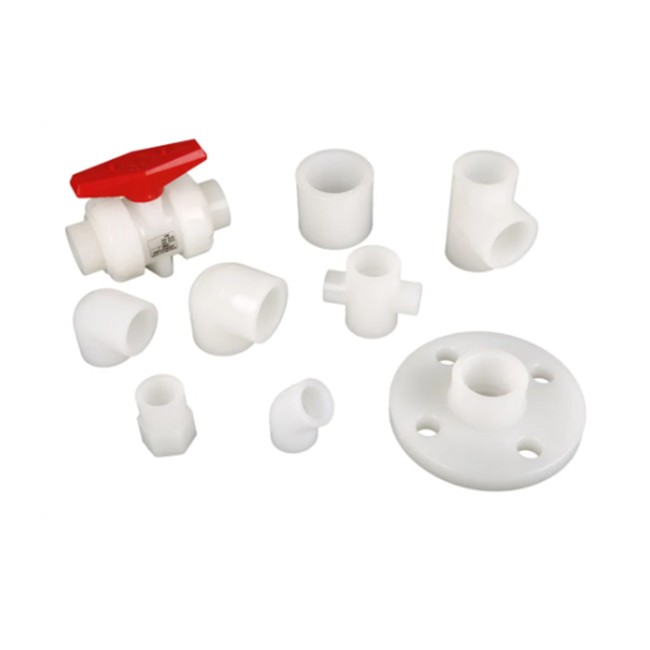
ASTM International publishes the standards that govern how PVDF components are made, tested, and rated in North America. Three documents matter most for a PVDF Piping system: F1673 for fittings, D3222 for resin, and F3687 for pressure-rated parts. Each one answers a different question, and engineers need all three to specify a system correctly.
ASTM F1673 for Fittings
Scope for corrosive-waste and socket-fusion fittings
ASTM F1673 covers PVDF pipe and fittings for corrosive-waste drainage service, in Schedule 40 and 80 IPS sizes[1]. The standard defines dimensions, wall thickness, and the geometry of the fusion socket itself. A socket-fusion joint relies on a heated coil or iron that melts the outer pipe surface and the inner fitting surface at the same time. The two melt fronts then fuse into one material. F1673 therefore sets tolerances on socket depth and diameter, because a loose or tight fit changes joint strength. The standard also specifies test methods for the finished fitting, including joint hydrostatic pressure tests and dimensional verification.
Requirements for corrosive service lines
Corrosive service demands more than mechanical strength. F1673 addresses this by controlling surface finish, material cleanliness, and the absence of voids or contamination at the fusion zone. A fitting that meets F1673 resists chemical attack and will not develop weak zones that fail under service. This matters in chemical processing and waste-handling lines, where a single defective joint can cause a leak. The standard gives manufacturers and inspectors a shared checklist, so a buyer can compare fittings from different suppliers on equal terms.
ASTM D3222 for PVDF Resin
Material classification and quality tests
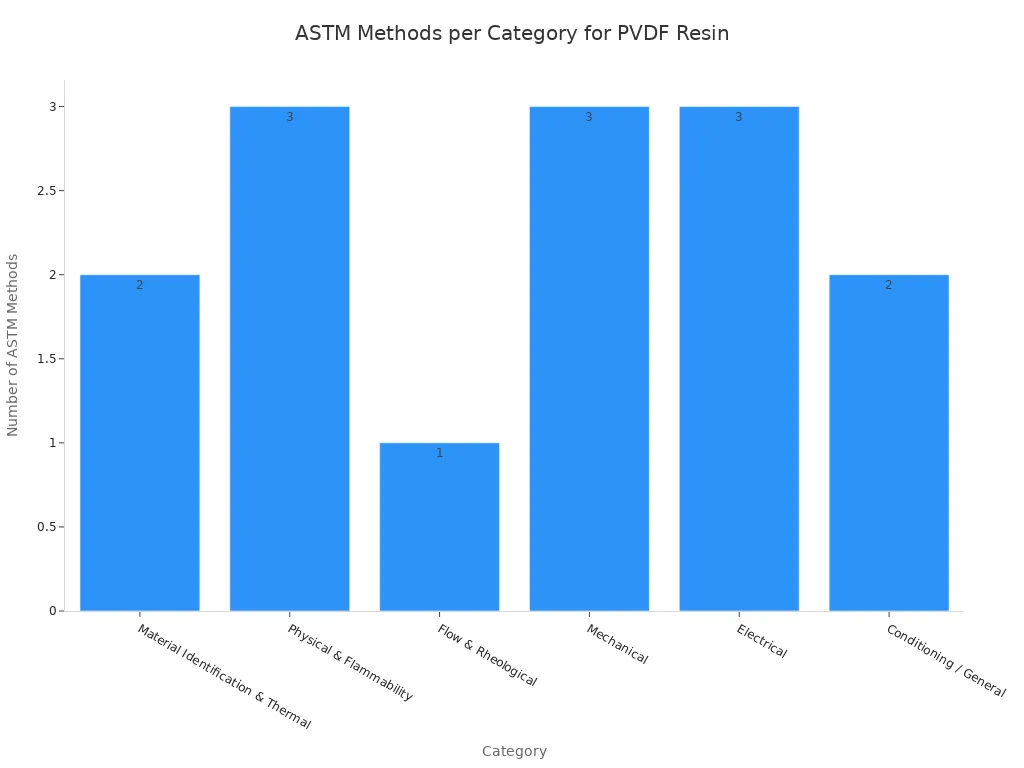
ASTM D3222 defines what counts as standard PVDF resin[2]. It covers virgin, unmodified PVDF homopolymer in pellet or powder form, for molding, extrusion, and coating. The standard recognizes Type I and Type II fluoroplastics. It excludes copolymers, reinforced or filled grades, and modified PVDF that contains additives or treatments affecting properties. Classification rests on measurable properties, and the standard names the test method for each one: melt flow rate, determined per ASTM D1238 at a specified temperature and load. Tensile strength and elongation, measured per ASTM D638. Dielectric constant and dissipation factor, measured per ASTM D150. Color, appearance, thermal stability, and density or specific gravity. The table below groups the referenced methods by property category.
| Category | Properties / Tests | Referenced ASTM Methods |
|---|---|---|
| Material Identification & Thermal | Peak melting endotherm, thermal stability | D3418, D835 |
| Physical & Flammability | Specific gravity, refractive index, limiting oxygen index | D1505, D542, D2863 |
| Flow & Rheological | Melt flow rate, rheological behavior | D1238 |
| Mechanical | Tensile strength, elongation, flexural, impact | D638, D790, D256 |
| Electrical | D-C resistance, dielectric strength, dielectric constant, dissipation factor | D149, D150, D257 |
| Conditioning / General | Specimen conditioning, terminology | D618, D883 |
Impact on final pipe homogeneity
Resin quality decides pipe quality. A batch with an off-spec melt flow rate will not extrude evenly, and uneven extrusion leaves internal stress that shortens service life. D3222 gives buyers a way to verify incoming resin before it becomes pipe. When every lot meets the same classification limits, the finished pipe behaves predictably under pressure and heat.
ASTM F3687 for Pressure-Rated Components
New standard for performance testing
ASTM F3687 is a newer standard that addresses pressure-rated PVDF components directly[3]. It focuses on performance testing rather than dimensions alone. The standard defines how a component should behave under sustained internal pressure, so a rating reflects measured performance instead of a calculated guess. This shifts the emphasis from "does it fit" to "does it hold."
Correlation with system safety margins
A pressure rating only protects a system when it carries a known safety margin. F3687 helps here by tying the published rating to a test result. Engineers can then apply a design factor with confidence, because they know the baseline number came from a controlled procedure. A fitting rated under F3687 gives the designer a defensible starting point for derating at elevated temperature and for cyclic service. Together, these three standards cover the full chain: resin, fitting, and pressure performance. A specifier who references all three closes the gaps that a single standard would leave open.
ISO Standards for PVDF Piping Systems
The International Organization for Standardization publishes the documents that most of the world uses to specify PVDF piping. ISO 10931 is the most common global standard for PVDF. It covers dimensions, pressure ratings, and performance requirements in one framework. A second document, ISO 4070, defines the expected strength of PVDF over time and temperature. Together they give engineers a complete picture for international projects.
ISO 10931 for Industrial Piping
Dimensional standards (SDR system)
ISO 10931 uses the Standard Dimension Ratio system to link wall thickness to outside diameter[4]. The SDR value equals the outside diameter divided by the wall thickness. A lower SDR number means a thicker wall and a higher pressure rating. This system lets a specifier choose one number, the SDR, and know both the dimensions and the pressure class. The approach simplifies procurement across different pipe sizes. A DN50 pipe and a DN200 pipe with the same SDR will have the same pressure rating, even though their absolute wall thicknesses differ.
Pressure rating classifications (PN10, PN16)
ISO 10931 assigns nominal pressure ratings, written as PN followed by a number. PN10 means the pipe or fitting handles 10 bar at the reference temperature. PN16 means 16 bar under the same conditions. These ratings apply at 73°F (23°C). The standard defines the wall thickness needed for each PN class at each diameter. A PN10 fitting therefore has a known, standardized wall thickness that any ISO-compliant manufacturer must meet. XITA PVDF pipe fittings conform to ISO 10931 and carry CE certification, ensuring global compatibility.
ISO 4070 for Strength over Time and Temperature
Reference lines for expected strength
ISO 4070 provides the minimum expected-strength values for PVDF as a function of time and temperature, in the form of reference lines[5]. These values are used in design calculations for PVDF homopolymer extruded pipes and injection-moulded fittings. Engineers rely on them to predict how much strength the material keeps after years of service at a given temperature. This is the technical basis behind pressure derating.
Role in design and long-term safety
ISO 4070 plays a central role in long-term design because it links the published rating to measured material behavior over time. A designer who plans a system for 20 years of service at 100°C must use the strength value that corresponds to that temperature and time horizon, not the short-term rating. The standard therefore supports creep-based design and gives engineers a common language across global projects. For systems that run hot, ISO 4070 provides the baseline that keeps every design calculation consistent.
Comparing ISO 10931 and ASTM F1673
Wall thickness calculation differences
ISO 10931 and ASTM F1673 both define wall thickness, but they use different methods. ISO 10931 relies on the SDR system, which ties wall thickness directly to the outside diameter and the pressure class. ASTM F1673 references the Schedule system, which originated in North American metal pipe standards. The two systems can produce different wall thicknesses for the same nominal pipe size. An engineer must therefore check the actual dimensions rather than assume that a DN50 ISO pipe matches a 2-inch Schedule 80 pipe.
Interchangeability in international projects
Interchangeability between ISO and ASTM components is not automatic. A fitting made to ISO 10931 may not mate perfectly with a pipe made to ASTM F1673, even when both carry the same nominal size. The fusion socket dimensions can differ, and the wall thickness mismatch can weaken a joint. For international projects, the safest approach is to specify one standard for the entire PVDF Piping system. Mixing standards in one system introduces risk at every joint. When a project requires both, the engineer should verify dimensions against both standards before installation.
Pressure Ratings for PVDF Piping Systems
Engineers specify PVDF piping components using one of two rating systems. The common ratings are PN10, PN16, Sch40, and Sch80. Each system answers the same question: how much internal pressure can this part handle safely? The answer depends on wall thickness, temperature, and the standard behind the number.
The PN Rating System (PN10, PN16)
Definition of nominal pressure at 73°F
PN stands for nominal pressure. A PN10 rating means the component handles 10 bar at a reference temperature of 73°F (23°C). PN16 means 16 bar under the same conditions. ISO 10931 defines these ratings and ties each one to a specific wall thickness through the SDR system. A lower SDR number produces a thicker wall and a higher PN class. This gives a specifier one number to check against the application requirement.
Temperature derating requirements
A PN rating applies only at the reference temperature. As temperature rises, the allowable pressure drops. PVDF softens gradually above 73°F, so the safe working pressure falls with it. Engineers must consult the derating curve for the specific material grade. A system rated PN10 at room temperature cannot carry 10 bar at 200°F. The derating requirement protects the system from creep failure and extends service life.
The Schedule Rating System (Sch40, Sch80)
Origin in ASTM pressure piping standards
The Schedule system originated in North American metal pipe standards. Plastic piping adopted the Iron Pipe Size (IPS) system so that a 2-inch plastic pipe has the same outside diameter as a 2-inch steel pipe. IPS standardizes the outside diameter, not the wall thickness. Schedule 80 then defines the wall thickness for that outside diameter. A 2-inch Schedule 80 PVDF pipe has a 0.218-inch wall and a 2.375-inch outside diameter.
| Nominal Size (in.) | Wall Thickness (in.) | Inner Diameter (in.) | Outer Diameter (in.) |
|---|---|---|---|
| 2 | 0.218 | 2.000 | 2.375 |
Wall thickness advantages for high stress
Schedule 80 offers a thicker wall than Schedule 40 at the same nominal size. The extra wall thickness raises the pressure rating and improves resistance to external loads. High-stress applications, such as continuous chemical transfer or full-vacuum service, benefit from this added material. The thicker wall also provides a larger fusion surface for socket joints, which strengthens the connection.
PN vs. Schedule: Which to Choose
Global preference for PN systems
Most international projects specify PN ratings because ISO 10931 governs the design. A PN10 or PN16 rating communicates directly with suppliers in Europe, Asia, and South America. XITA PVDF pipe fittings are rated PN10 per ISO 10931, suitable for most industrial applications. This rating covers chemical processing, water treatment, and pharmaceutical lines.
U.S. preference for Schedule systems
North American engineers typically specify Schedule 40 or Schedule 80. The Schedule system aligns with familiar metal pipe dimensions and local installation practices. A U.S. project may reference ASTM F1673 for fittings and Schedule 80 for pressure class. The choice between PN and Schedule depends on project location, governing standard, and the required pressure margin for the PVDF Piping system.
Factors That Affect PVDF Pressure Ratings
A published pressure rating tells only part of the story. Real operating conditions change how much pressure a PVDF Piping system can safely carry. Temperature, chemical exposure, and the quality of each joint all shift the safe working limit. Engineers who ignore these factors risk premature failure, even when the pipe meets its nominal rating on paper.
Temperature Derating Curves
Why pressure drops above 73°F
PVDF softens as temperature rises. The polymer chains move more freely, and the material loses stiffness. A rating measured at 73°F (23°C) therefore overstates capacity at higher temperatures. The derating curve captures this loss. It plots allowable pressure against temperature, and the curve slopes downward from the reference point. A system that holds 10 bar at room temperature cannot hold 10 bar at 200°F. Creep becomes the dominant failure mode above the reference temperature. The pipe deforms slowly under constant load, and the wall thins over time. Derating protects against this slow, silent failure.
Example: 50% reduction at 250°F
The reduction becomes severe at elevated temperatures. Consider a fitting rated PN10 at 73°F. At 250°F, the allowable pressure falls by roughly half, so a 10 bar rating becomes approximately 5 bar. Engineers must size the system for the derated value, not the published one. The same logic applies at intermediate temperatures. For continuous operation at 212°F, engineers must apply the manufacturer's derating factor for the specific material grade before selecting a pressure class.
Chemical Compatibility
Effect of oxidizing agents on PVDF
PVDF resists most chemicals, and it maintains its strength across a wide pH range of 1 to 14. Strong acids, strong alkalis, salts, and solvents leave the material largely unaffected. Oxidizing agents behave differently. Chemicals such as concentrated nitric acid or hot oxidizing solutions can attack the polymer surface. The attack may not dissolve the pipe, but it can embrittle the surface layer and reduce mechanical strength. The effect grows with concentration and temperature. A chemical that is harmless at room temperature may become aggressive at 150°F.
Importance of proper material selection
Material selection must match the specific chemical service. A generic "PVDF" label does not guarantee performance against every fluid. Engineers should check compatibility charts for the exact chemical, concentration, and temperature. They should also confirm that the resin meets ASTM D3222 requirements for virgin, unmodified PVDF. Additives or fillers can change chemical resistance. A properly selected grade keeps its mechanical properties for the full service life.
Joining Methods (Butt vs. Socket Fusion)
Impact on system integrity
The joint is often the weakest point in any piping system. Butt fusion joins two pipe ends face to face. Socket fusion inserts the pipe into a heated fitting socket. Both methods create a molecular bond when done correctly. Butt fusion produces a smooth internal bore with no crevice. Socket fusion creates a small internal gap at the socket base. That gap can trap fluid and become a stress point under thermal cycling. Butt fusion generally suits larger diameters and higher-pressure lines. Socket fusion works well for smaller sizes and complex fitting geometries.
How to ensure zero-leak connections
Zero-leak connections depend on controlled process parameters. The operator must heat both surfaces to the correct melt temperature, apply the right joining pressure, and hold the parts steady during cooling. Contamination at the fusion zone ruins the bond. So does moisture, oil, or dust on the pipe surface. Proper training and written procedures matter more than the equipment itself. A qualified installer following a validated procedure produces joints as strong as the pipe wall.
Selecting the Right PVDF Piping System Standard
Application requirements drive standard selection. A high-purity water line and a harsh chemical transfer line demand different specifications, even when both use PVDF material. Engineers must match the standard and pressure rating to the actual service conditions.
For High-Purity Water Systems
Preference for ISO 10931 and PN10
High-purity water systems serve semiconductor fabrication, pharmaceutical production, and laboratory applications. These systems prioritize contamination control over maximum pressure capacity. ISO 10931 provides the dimensional framework that most global suppliers follow. A PN10 rating at 73°F handles the typical operating pressures in these systems, which rarely exceed a few bar. The SDR system within ISO 10931 ensures consistent wall thickness across all components. This consistency matters because variations in wall thickness can create flow disturbances or dead zones where bacteria collect.
Need for anti-contamination properties
Ultrapure water aggressively leaches ions and particles from contact surfaces. The fitting material must resist this extraction. Virgin PVDF meets this requirement because it contains no plasticizers, stabilizers, or fillers that could leach into the water stream. The fusion joint plays an equally important role. A properly executed socket or butt fusion creates a homogeneous bond with no crevice for fluid to stagnate. ISO 10931 addresses surface finish requirements that minimize particle shedding. Engineers should verify that fittings carry documentation confirming virgin resin content and compliance with high-purity standards.
For Harsh Chemical Transfer
Preference for ASTM Schedule 80
Chemical processing plants often specify Schedule 80 for aggressive fluid transfer. The thicker wall provides a higher pressure rating and greater resistance to external damage. Schedule 80 also offers more material for fusion joints, which strengthens connections under thermal cycling. ASTM F1673 governs the fitting dimensions for this system. A North American project typically references both standards together. The Schedule system aligns with familiar metal pipe dimensions, which simplifies integration with existing infrastructure.
Necessity of full vacuum capability
Many chemical transfer operations run under vacuum. The pipe must resist collapse when internal pressure drops below atmospheric. Wall thickness determines vacuum resistance. Schedule 80 provides enough material to handle full vacuum service at moderate temperatures. Engineers should verify the vacuum rating against the derating curve, because elevated temperatures reduce collapse resistance. A system rated for full vacuum at 73°F may fail under vacuum at 200°F.
Verification and Certification
Checking mill test reports (MTRs)
Mill test reports provide traceability from raw material to finished product. A complete MTR includes the resin lot number, test results for melt flow rate and tensile strength, and the date of manufacture. Buyers should compare these values against ASTM D3222 limits. Discrepancies indicate potential quality issues. The MTR also confirms that the manufacturer used virgin resin rather than regrind or recycled material.
Ensuring third-party certification (SGS, CE)
Third-party certification adds independent verification. SGS testing confirms that products meet specified standards. CE marking demonstrates conformity with European requirements. For certified PN10 fittings conforming to ISO 10931, choose XITA, backed by 20+ years of experience and SGS certification. As a manufacturer with a 3,000 m² ISO9001-certified factory, XITA supplies PVDF pipe fittings that meet global standards. Trust a supplier with proven expertise for a fully compliant PVDF Piping system.
Choosing the right standard and pressure rating is critical for any PVDF Piping system. ASTM and ISO each provide clear frameworks, and ratings like PN10 or Schedule 80 must match the application. Temperature derating remains the most overlooked factor. Pressure capacity drops significantly above 73°F, so engineers must always consult derating curves. For a fully compliant system, trust a manufacturer with proven expertise and certifications. XITA offers certified PVDF pipe fittings that meet ISO 10931, assuring leak-free and contamination-free operation.
Need PVDF Piping Components That Meet Global Standards?
XITA supplies PVDF pipe and fittings rated PN10 per ISO 10931, with SGS and CE certification, from an ISO 9001-certified factory with 20+ years of experience.
Explore Our PVDF RangeSend Us an InquiryFAQ
What is the difference between ASTM F1673 and ISO 10931?
ASTM F1673 governs PVDF pipe and fittings for corrosive-waste drainage service in North America and uses the Schedule wall thickness system. ISO 10931 serves global projects and uses the SDR system. The two standards can produce different wall thicknesses for the same nominal size, so engineers should not assume direct interchangeability.
Which pressure rating should a PVDF piping system use?
The choice depends on project location and service conditions. International projects typically specify PN10 or PN16 under ISO 10931. North American projects usually specify Schedule 40 or Schedule 80 under ASTM. The required pressure margin and temperature profile decide the final class.
Does a PN10 rating apply at every temperature?
No. A PN10 rating applies at the reference temperature of 73°F (23°C). Allowable pressure falls as temperature rises. A fitting rated PN10 at 73°F drops to roughly 5 bar at 250°F. Engineers must consult the derating curve before selecting a pressure class.
What causes the pressure rating to drop at high temperatures?
PVDF softens above 73°F, so the polymer chains move more freely and the material loses stiffness. Creep becomes the dominant failure mode under constant load. The derating curve accounts for this loss and protects the system from slow wall thinning.
Can ISO and ASTM components mix in one system?
Mixing standards introduces risk at every joint. Fusion socket dimensions and wall thicknesses can differ between ISO 10931 and ASTM F1673 components, even at the same nominal size. The safest approach specifies one standard for the entire PVDF piping system.
Which joining method gives the strongest connection?
Both butt fusion and socket fusion create a molecular bond when performed correctly. Butt fusion produces a smooth bore with no crevice, which suits larger diameters and higher-pressure lines. Socket fusion works well for smaller sizes and complex fitting geometries.
How does a buyer verify PVDF fitting quality?
Buyers should request mill test reports showing resin lot numbers, melt flow rate, and tensile strength against ASTM D3222 limits. Third-party certification such as SGS or CE adds independent verification. XITA PVDF pipe fittings carry SGS and CE certification and conform to ISO 10931 at a PN10 rating.
What chemicals damage PVDF piping?
PVDF resists strong acids, alkalis, salts, and solvents across a pH range of 1 to 14. Oxidizing agents such as concentrated nitric acid or hot oxidizing solutions can attack the surface and reduce mechanical strength. Compatibility depends on chemical concentration and temperature.
References
ASTM F1673-10(2021)e1 — Standard Specification for Polyvinylidene Fluoride (PVDF) Corrosive Waste Drainage Systems. https://www.astm.org/f1673-10r21e01.html
ASTM D3222-21 — Standard Specification for Unmodified Poly(Vinylidene Fluoride) (PVDF) Molding Extrusion and Coating Materials. https://www.astm.org/d3222-21.html
ASTM F3687-24 — Standard Specification for Pressure-Rated Polyvinylidene Fluoride (PVDF) Piping Systems. https://www.astm.org/f3687-24.html
ISO 10931:2005 — Plastics Piping Systems for Industrial Applications — Poly(Vinylidene Fluoride) (PVDF) — Specifications for Components and the System. https://www.iso.org/ics/23.040.01/x/
ISO 4070:2025 — Polyvinylidene Fluoride (PVDF) — Effect of Time and Temperature on Expected Strength. https://www.iso.org/obp/ui/en/#!iso:std:87540:en

