


 May 25, 2026
 View:462
Selecting PVDF fittings for chemical and water systems means you need to pick the right one for your job. The fittings must work with the fluids, be safe to use, and perform reliably every time. Many industries depend on these fittings. The table below shows how widely PVDF fittings have been adopted across key sectors:
| Industry | Adoption Rate of PVDF Fittings |
|---|---|
| Semiconductor | 85% of chemical systems |
| Pharmaceutical | 70% of new facilities |
| Chemical Processing | 60% growth over 5 years |
Common problems include leaks, color changes, and brittleness. Regular visual inspection and pressure testing help keep your system running correctly. Always consider system requirements when selecting fittings.
Key Takeaways
PVDF fittings are essential for chemical and water systems due to their chemical resistance and long service life.
Verify chemical compatibility before installation to prevent leaks and system failures.
PVDF fittings can last 20–50 years, reducing replacement frequency and lowering total cost of ownership.
Always review pressure and temperature ratings to confirm suitability for your operating conditions.
Correct fitting type, size, and joining method are critical to long-term system integrity.
Regular inspections and pressure tests detect issues early.
Purchase only from certified suppliers to ensure quality and regulatory compliance.
Follow manufacturer installation guidelines for best results.
PVDF Fittings Overview
What Is PVDF?
PVDF stands for polyvinylidene fluoride — a high-performance thermoplastic known for exceptional strength and chemical stability. Its strong carbon-fluorine bonds keep it stable when exposed to acids, hydrocarbons, alcohols, and halogenated solvents. PVDF maintains flexibility even at temperatures as low as −40°F, preventing the cracking and brittleness common in other plastics.[1]
Key Properties of PVDF Fittings
Chemical Resistance
PVDF fittings resist degradation from strong acids and aggressive cleaning chemicals, making them ideal for chemical processing and water treatment. Their resistance to biofouling also helps keep water systems cleaner for longer.
Mechanical Strength
PVDF offers a strong combination of tensile strength, impact resistance, and fatigue life compared to competing plastics:
| Property | PVDF | CPVC | Polypropylene | Performance Impact |
|---|---|---|---|---|
| Tensile Strength | 6,500 psi | 8,000 psi | 4,800 psi | Pressure handling |
| Impact Strength | 3.0 ft-lb/in | 1.0 ft-lb/in | 1.2 ft-lb/in | Shock resistance |
| Fatigue Life | >10⁶ cycles | 10⁴ cycles | 10⁴ cycles | Long-term reliability |
PVDF fittings typically last over 25 years, substantially outperforming other plastic alternatives in service life.
Temperature Range
PVDF fittings operate reliably across a broad temperature range, maintaining flexibility in cold conditions and structural integrity at elevated temperatures. This versatility makes them suitable for both indoor and outdoor piping applications.
Common PVDF Piping Applications
Chemical processing: Handles aggressive chemicals while improving operator safety.
Water treatment: Resists corrosion and biofouling in municipal water systems.
Semiconductor manufacturing: Ensures ultra-pure fluid handling with no contamination risk.
PVDF fittings from reputable manufacturers carry certifications such as ISO 10931-5, SGS, and CE, confirming compliance with global quality and safety requirements.
Benefits of PVDF Fittings
Corrosion Resistance
PVDF fittings handle a full pH range of 1–14, covering both strong acids and strong bases. The PN10 pressure rating enables use across a broad range of industrial applications. Key chemical resistance data:
| Property | Description |
|---|---|
| pH Range | 1–14. Handles strong acids and bases. |
| Pressure Rating | PN10. Suitable for moderate-pressure industrial systems. |
| Chemical Resistance | Maintains integrity against acids, bases, solvents, and oxidizing agents. |
| Specific Chemicals | Sulfuric acid, hydrochloric acid, chlorine, sodium hydroxide, and more. |
Durability and Longevity
Under typical operating conditions, PVDF fittings have a service life of 20–50 years, depending on chemical exposure, temperature, flow rate, and mechanical stress.[2] Their low maintenance requirements translate directly into reduced downtime and lower lifecycle costs.
Safety and Environmental Advantages
PVDF is a stable fluoropolymer that does not dissolve in water or degrade under normal conditions, making it safe for drinking water and food-contact applications. It meets FDA requirements for food use and contributes to lower waste generation over time due to its extended service life.
How to Choose PVDF Fittings
1. Chemical Compatibility
The first step is confirming that the fittings will safely handle every chemical in your system — including process fluids and cleaning agents.
Fluid Types and Concentrations
Different applications involve different chemicals at varying concentrations. A water treatment plant may use chlorine; a pharmaceutical plant may use solvents. High concentration increases chemical aggressiveness. Document every fluid and its concentration before making a selection.
Using Compatibility Charts
Compatibility charts show how PVDF responds to hundreds of chemicals at different concentrations and temperatures. Most reputable manufacturers publish these charts.[3] Use them as part of your selection process:
| Selection Factor | Guidance |
|---|---|
| Chemical Compatibility | Verify resistance to all process and cleaning chemicals |
| Temperature Requirements | Confirm the fitting handles peak system temperature |
| Pressure Rating | Select fittings rated at least 50% above maximum system pressure |
| Purity Standards | Use ultra-pure PVDF for semiconductor or pharmaceutical use |
| Connection Method | Match the joining method to maintenance access requirements |
2. Pressure and Temperature Ratings
System Pressure Requirements
Standard PVDF fittings handle 150–400 PSI depending on size and operating temperature. Most are rated PN10. Always specify fittings with a safety margin of at least 50% above maximum system pressure.
Temperature Effects on PVDF
PVDF operates reliably from −20°C to 140°C (−4°F to 284°F) for continuous service, with short-duration peaks up to 150°C (302°F). Its low coefficient of thermal expansion reduces dimensional change across wide temperature swings — an advantage over metal alternatives.
3. Fitting Types and Sizes
Available Fitting Geometries
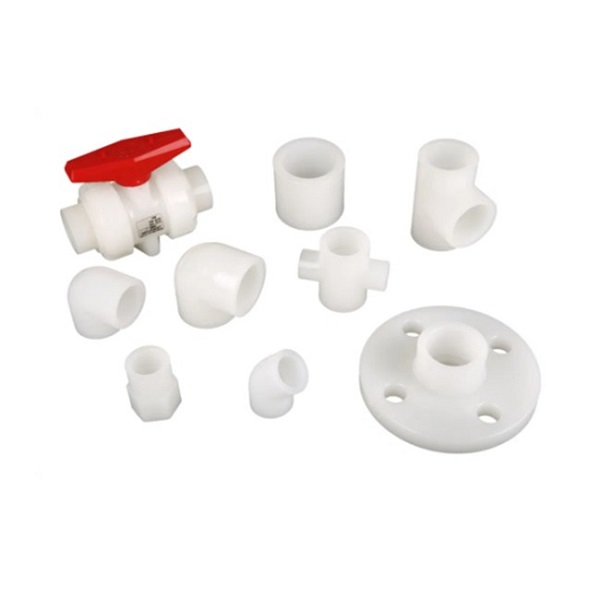
Elbows — Change pipe direction
Tees — Split flow into multiple paths
Reducers — Connect pipes of different diameters
Caps — Close pipe ends
Unions — Allow easy disassembly for maintenance
Flanges — Bolted connections for high-integrity joints
Dimensional Range (DN15–DN300)
PVDF fittings are available from DN15 through DN300. Selecting the correct nominal diameter ensures proper flow rates and system pressure performance:
DN15–DN50 — Laboratory and small-scale equipment
DN65–DN150 — Standard industrial process lines
DN200–DN300 — Large-capacity plant headers and main distribution lines
4. Compliance and Certification
International Standards
| Standard / Certification | Scope |
|---|---|
| ANSI/NSF 61 / NSF 51 / NSF 14 | Drinking water, food contact, and plastic piping systems |
| FDA 21 CFR 177.2510 & 177.2600 | Food-grade PVDF, no manufacturing additives, non-toxic |
| USP Class VI | Pharmaceutical and healthcare biocompatibility |
| ASTM D3222 / D1784 | Dimensional and material specifications for PVDF |
| EN ISO 10931 | Consistent quality and performance for PVDF pipe systems |
Regulatory agencies including the EPA (United States) and ECHA (European Union) set mandatory requirements for chemical systems and water safety. NSF International maintains publicly searchable certification records that buyers can use to verify compliance claims before procurement.[4]
Regulatory Requirements
Certification requirements vary by region and application. Always request current, valid certificates at the point of purchase to ensure your system passes regulatory inspections and insurance audits.
5. Cost and Value
Upfront Cost vs. Quality
PVDF fittings carry a higher initial price — typically two to four times the cost of PVC or HDPE alternatives. This reflects stricter manufacturing tolerances, material cost, and quality testing.[5]
Long-Term Total Cost of Ownership
Over a 20–50 year service life, PVDF fittings deliver substantial savings through reduced replacement frequency, lower maintenance labor, and fewer unplanned shutdowns. Their leak-free performance also reduces environmental liability. For most industrial applications, the premium pays back within a few years of operation.
PVDF Fittings Installation
Preparation and Handling
Follow a structured installation sequence for best results:[6]
Review construction drawings and verify site conditions.
Label and pre-fabricate pipes and fittings according to design documentation.
Inspect all materials on receipt.
Calibrate welding equipment and perform a trial weld.
Cut pipes to the required length using a quality pipe cutter.
Join using infrared or fusion welding as appropriate.
Install supports and hangers.
Align and adjust the completed assembly.
Perform pressure testing.
Complete a final inspection and retain records.
Store fittings in a dry, shaded location in original packaging until use. Clean all surfaces with water and a soft cloth before joining. Avoid abrasive cleaners.
Joining Methods
Butt fusion — Preferred for large-diameter pipes; creates a strong, permanent bond.
Socket fusion — Suitable for smaller diameters; fast and reliable.
Electrofusion — Ideal for repairs and confined spaces.
Mechanical joining — Threaded or flanged connections for systems requiring periodic disassembly.
Solvent welding is generally not used for PVDF due to its low solubility. Thermal fusion methods produce the strongest, most leak-proof connections and are the industry standard for permanent PVDF installations.
Common Installation Mistakes to Avoid
Skipping pipe-end cleaning or facing before fusion.
Incorrect heating temperature or duration.
Uneven pressure application during fusion, creating weak spots.
Over-tightening mechanical joints.
Inadequate pipe support, leading to stress at joint locations.
Failing to account for thermal expansion in long runs.
Required Tools
Butt fusion welding machine — Heater plate, facer, and clamps for large-diameter pipe.
Thermostatically controlled heating tool — For socket fusion on smaller diameters.
Quality pipe cutter — Produces clean, square cuts for tight-fitting joints.
Deburring tools — Remove burrs that could compromise seal integrity.
Measuring tools — Calipers and depth gauges for dimensional verification.
PPE — Heat-resistant gloves and safety glasses are mandatory.
Quality Control and Safety
Inspecting PVDF Fittings
| Inspection Criterion | Details |
|---|---|
| Weld Seam Inspection | Visual inspection plus dimensional measurement with calipers |
| Sampling Ratio | Minimum 30% of welds inspected and recorded |
| Weld Quality Standards | Seams must be even and smooth; pipe gap ≤ 0.2 mm; zero wall thickness difference |
| Documentation | Maintain detailed inspection records for traceability and future maintenance |
Pressure and Leak Testing
Hydrostatic or pneumatic pressure tests should be performed before commissioning. Apply pressure above normal operating level and monitor all joints for movement or leakage. Correct any deficiencies before the system enters service.
Personal Protective Equipment
Workers must wear appropriate PPE when installing or maintaining PVDF piping: heat-resistant gloves, safety glasses or goggles, and respiratory protection where fumes or dust are present. Adequate ventilation is required during any fusion welding operation.
Emergency Procedures
Every facility using PVDF fittings in chemical service should have documented emergency procedures. Key requirements include:
Wearing full PPE — gloves, goggles, face shield, and chemical-resistant clothing — whenever working on chemical lines.
Maintaining adequate ventilation, especially when heating PVDF, which can produce fumes at high temperatures.
Ensuring spill kits and fire extinguishers are readily accessible and staff know how to use them.
Immediate reporting of incidents to enable fast response and containment.
Practicing emergency drills regularly so all personnel can respond without hesitation.
For detailed guidance on safe handling of fluoropolymers, the Fluoropolymers Product Group publishes industry-wide health and safety guidance relevant to PVDF processing environments.[8]
Choosing a PVDF Fittings Supplier
What to Look For
A reliable supplier should hold ISO 9001 and ISO 10931 certification, offer a comprehensive range including custom dimensions, and provide genuine technical support backed by documented test reports. Responsiveness and the ability to supply certificates for every batch are non-negotiable for regulated applications.
Key Questions to Ask Suppliers
| Evaluation Area | Questions to Ask | What to Look For |
|---|---|---|
| Certifications | Which standards do your products comply with? Can you provide batch test certificates? | ISO 9001, ISO 10931, NSF, FDA compliance documentation |
| Product Range | Do you offer custom sizes and joining configurations? | Full DN15–DN300 range; elbows, tees, reducers, flanges, unions |
| Technical Support | Can your team assist with installation method selection and system design? | Clear TDS/MSDS, installation guides, responsive engineering support |
Why XITA
XITA is a specialist manufacturer of PVDF and thermoplastic piping systems, offering a complete range of fittings from DN15 to DN300. Products include elbows, reducers, caps, unions, and flanges with PN10 pressure rating and service life of 30–50 years. XITA fittings meet international safety standards including NSF and CE requirements and are suitable for drinking water, pharmaceutical, semiconductor, and chemical processing applications. XITA provides factory technical support for installation and system commissioning. View the full PVDF fittings range.
Need PVDF Fittings for Your Project?
Our engineering team can help you select the right fittings for your chemical or water system — with full certification documentation and custom sizing from DN15 to DN300.
ISO 9001 & ISO 10931 Certified
Custom Sizes DN15–DN300
NSF / FDA / CE Compliant
30–50 Year Service Life
Technical Installation Support
Frequently Asked Questions
What are PVDF fittings used for?
PVDF fittings connect pipes in chemical, water treatment, and industrial systems. They are preferred wherever aggressive chemicals, high purity requirements, or long service life are priorities.
Can PVDF fittings handle high temperatures?
Yes. PVDF fittings operate continuously from −20°C to 140°C and tolerate short-duration peaks up to 150°C without loss of structural integrity.
Are PVDF fittings safe for drinking water?
Yes. PVDF fittings meet NSF and FDA standards and do not leach harmful substances into potable water systems.
How do I select the correct fitting size?
Match the fitting's nominal diameter (DN) to your pipe specification. Sizes from DN15 to DN300 are available. Consult a sizing chart or contact your supplier's technical team for guidance on larger or custom configurations.
What is the standard pressure rating for PVDF fittings?
Most standard PVDF fittings carry a PN10 rating (approximately 145 psi / 10 bar). Always verify the system's maximum operating pressure before specifying fittings.
What joining methods are used for PVDF fittings?
Butt fusion, socket fusion, and electrofusion are the primary methods for permanent joints. Mechanical (threaded or flanged) connections are used where disassembly may be required. Solvent welding is generally not suitable for PVDF.
How much maintenance do PVDF fittings require?
PVDF fittings require minimal routine maintenance. Periodic visual inspection and pressure testing are sufficient for most applications. Avoid abrasive cleaning tools.
Where can I purchase certified PVDF fittings?
Purchase from suppliers who can provide current certification documentation. XITA offers a complete certified range with full technical support. Contact the team for pricing and availability.
References
PVC Pipe Supplies — PVDF Pipe FAQs: technical properties including low-temperature flexibility and chemical resistance.
China Fluoropolymer — Factors Affecting PVDF Working Life: analysis of chemical, thermal, and mechanical variables influencing service life.
Rapidex Solutions — Chemical Compatibility of PVDF Pipe Fittings: detailed compatibility data by fluid type and concentration.
NSF International — NSF Certified Plastics & Polymers: searchable database of NSF-certified piping materials including PVDF.
Verified Market Reports — PVDF Pipe Fittings Market: market sizing, certification trends, and cost positioning data.
SWD Plastic — PVDF Pipe Installation Guide: step-by-step installation procedures and quality control requirements.
ASTM International — ASTM D2837: standard test method for obtaining hydrostatic design basis for thermoplastic pipe materials.
Fluoropolymers Product Group — Health & Safety Resources: industry guidance on safe handling, processing, and emergency response for fluoropolymer products.

