Understanding the Essential Differences Between PVC and CPVC Pipe
 Aug 29, 2018|
 View:4093
When it comes to selecting piping materials for residential, commercial, or industrial applications, understanding the differences between PVC pipe and CPVC pipe proves essential for making informed decisions. While these thermoplastic materials share similar chemical compositions, their distinct properties make them suitable for different applications. This comprehensive guide explores the key differences, helping property owners, contractors, and facility managers choose the right piping solution for their specific needs.
Key Takeaways
PVC pipe works best for cold water systems, drainage, and applications not exceeding 140°F
CPVC pipe handles temperatures up to 200°F, making it ideal for hot water distribution
Both materials offer excellent corrosion resistance and long service life
Chemical chlorination process distinguishes CPVC from standard PVC
Sizing systems differ between materials, with CPVC available in both NPS and CTS formats
Proper cement selection is critical for creating secure, leak-free connections
What Is PVC Pipe?
Polyvinyl chloride, commonly known as PVC, represents one of the most widely used plastic materials worldwide. As a thermoplastic polymer, PVC can be molded and shaped when heated, then hardens when cooled. This versatility has made it the material of choice for countless plumbing and industrial applications since its introduction in the mid-20th century.
Standard PVC pipe typically appears in white or light gray colors and is manufactured in various wall thicknesses designated as Schedule 40, Schedule 80, and other ratings. The material composition consists primarily of vinyl chloride monomers that are polymerized to create long molecular chains. This structure provides excellent strength, durability, and resistance to chemical corrosion while remaining relatively lightweight and easy to install.
According to ASTM International standards (specifically ASTM D1785 and D2665), PVC pipe performs reliably in applications where temperatures do not exceed 140°F (60°C). Beyond this threshold, the material begins to soften, potentially compromising joint integrity and overall system performance.
Common Applications of PVC Pipe
The versatility of PVC makes it suitable for numerous applications. Cold water distribution systems in residential and commercial buildings frequently utilize PVC pipe due to its cost-effectiveness and reliability. Drainage, waste, and vent (DWV) systems represent another major application area, where PVC's smooth interior surface promotes efficient flow while resisting buildup.
Industrial facilities employ PVC pipe for chemical processing applications where resistance to corrosive substances is required. Irrigation systems, swimming pool plumbing, and outdoor construction projects also benefit from PVC's weather resistance and dimensional stability. The material's light weight simplifies installation, reducing labor costs and project timelines.
Understanding CPVC Pipe Composition
Chlorinated polyvinyl chloride, or CPVC pipe, undergoes an additional manufacturing process that fundamentally alters its chemical structure and performance characteristics. Through a free radical chlorination reaction, manufacturers increase the chlorine content of standard PVC from approximately 56.7% to between 63-69%. This seemingly modest change dramatically improves the material's temperature resistance and chemical stability.
The chlorination process occurs after the initial PVC resin is produced, exposing the polymer chains to chlorine gas under controlled conditions. This additional chlorine content modifies the molecular structure, creating stronger intermolecular bonds that resist thermal degradation. The result is a material that maintains structural integrity at temperatures where standard PVC would fail.
Research published by the chemical engineering community demonstrates that CPVC maintains dimensional stability and pressure ratings at temperatures up to 200°F (93°C), making it suitable for hot water distribution systems. This temperature tolerance represents a critical advantage in residential and commercial plumbing applications.
Manufacturing Process Differences
While both materials start as thermoplastic polymers, the manufacturing divergence occurs during the chlorination phase. Standard PVC pipe production involves extrusion of the polymer through dies to create the desired pipe dimensions, followed by cooling and cutting to length. Quality control focuses on dimensional accuracy and pressure rating verification.
CPVC manufacturing includes these same steps but adds the critical chlorination process. Manufacturers must carefully control chlorine exposure time, temperature, and concentration to achieve consistent results. Post-chlorination testing verifies that the material meets specifications for chlorine content, temperature resistance, and mechanical properties. This additional processing contributes to CPVC's higher cost compared to standard PVC.
Critical Differences Between PVC and CPVC Pipe
| Property | PVC Pipe | CPVC Pipe |
|---|---|---|
| Maximum Temperature | 140°F (60°C) | 200°F (93°C) |
| Chlorine Content | 56.7-57% | 63-69% |
| Typical Color | White or dark gray | Light yellow or light gray |
| Sizing Systems | Nominal Pipe Size (NPS) | NPS or Copper Tube Size (CTS) |
| Primary Applications | Cold water, drainage, venting | Hot and cold water distribution |
| Relative Cost | Lower | 15-30% higher |
| Fire Rating | Self-extinguishing | Self-extinguishing, higher rating |
Temperature Tolerance and Performance
The most significant distinction between these materials centers on temperature performance. Standard PVC pipe begins to lose structural integrity above 140°F, with the material softening and joints weakening under sustained exposure. This limitation restricts PVC to cold water applications and drainage systems where elevated temperatures are not encountered.
In contrast, CPVC pipe maintains its mechanical properties up to 200°F (93°C), safely handling hot water from residential and commercial water heaters. This capability allows CPVC to serve both hot and cold water distribution needs within a single piping system. Building codes in most jurisdictions now mandate CPVC or equivalent materials for hot water applications, recognizing the safety and performance advantages.
Chemical Resistance Characteristics
Both materials demonstrate excellent resistance to a wide range of chemicals, including most acids, bases, salts, and aliphatic hydrocarbons. However, the additional chlorination of CPVC provides enhanced resistance to certain oxidizing agents and elevated-temperature chemical exposures. This makes CPVC particularly valuable in industrial applications where chemical concentrations or temperatures exceed PVC's capabilities.
When selecting between materials for chemical applications, consulting manufacturer chemical resistance data ensures compatibility with specific substances and operating conditions. Some chemicals that are compatible with PVC at ambient temperatures may require CPVC when elevated temperatures are involved.
Sizing Systems and Dimensional Considerations
Understanding the different sizing systems used for these materials prevents costly purchasing errors and installation complications. Standard PVC pipe follows the Nominal Pipe Size (NPS) system, which has been used for decades in North American plumbing. In this system, the nominal size approximates the inside diameter, though actual dimensions vary by schedule (wall thickness).
CPVC pipe adds complexity by being available in two different sizing systems. Schedule 40 and Schedule 80 CPVC follow the same NPS dimensions as PVC, allowing direct replacement in existing systems. However, CPVC is also manufactured in Copper Tube Size (CTS) dimensions, which match the outside diameter specifications of copper tubing. This CTS sizing facilitates transitions between copper and CPVC in renovation projects.
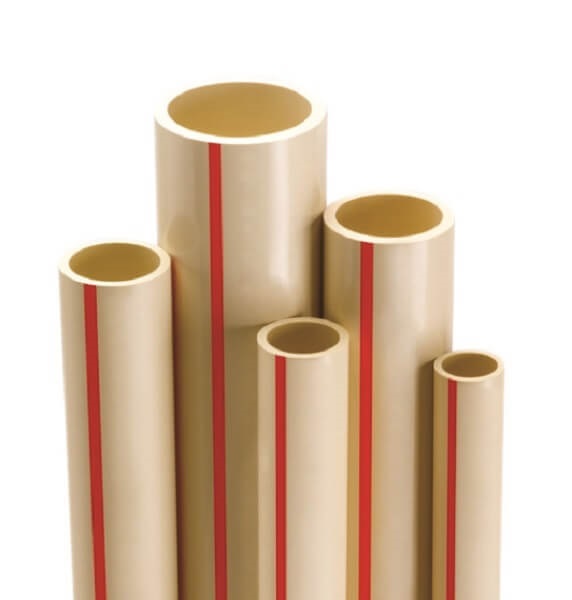
Visual identification helps distinguish between types. CTS CPVC typically appears in a light yellowish color, while Schedule 80 CPVC (NPS) presents in light gray. Standard PVC most commonly appears white or dark gray. However, always verify manufacturer markings printed on the pipe, which specify material type, pressure rating, and applicable standards.
Wall Thickness and Pressure Ratings
Both materials are available in multiple schedule ratings that indicate wall thickness. Schedule 40 represents the standard for most residential applications, offering adequate pressure ratings for typical municipal water pressures. Schedule 80 provides thicker walls and higher pressure ratings, suitable for industrial applications or locations with elevated system pressures.
Pressure ratings decrease as temperature increases. A PVC pipe rated for 480 PSI at 73°F might only be rated for 280 PSI at its maximum temperature of 140°F. CPVC maintains higher pressure ratings across its extended temperature range, though similar derating occurs as temperatures approach 200°F. Consulting manufacturer specification sheets ensures the selected pipe meets both pressure and temperature requirements for the intended application.
Installation Requirements and Best Practices
While installation techniques for PVC and CPVC share many similarities, important differences exist in cement selection and joint preparation. Using incorrect materials or techniques can compromise system integrity and lead to premature failures.
Solvent Cement Selection
The chemical differences between PVC and CPVC require different solvent cements for creating secure joints. PVC cement is formulated to chemically soften and bond PVC's molecular structure, while CPVC cement is specifically designed for the chlorinated polymer. Using PVC cement on CPVC joints results in weak bonds that may fail under pressure or temperature stress.
Many manufacturers now offer "universal" cements rated for both PVC and CPVC applications. While convenient, these products sometimes sacrifice optimal performance for versatility. For critical applications or projects involving numerous joints, using material-specific cements provides the strongest, most reliable connections.
Primer application is also essential for both materials. The primer cleans the pipe surface, removes manufacturing residues, and begins the chemical softening process that allows the cement to create a molecular bond. Skipping primer or using improper products can result in joints that initially appear sound but fail under operating conditions.
Proper Joining Techniques
Successful pipe installation begins with clean, square cuts using appropriate tools. Burrs and debris must be removed before applying primer and cement. A light chamfer on the pipe end helps prevent cement from wiping off during insertion and creates a small gap that fills with cement, strengthening the joint.
After applying primer to both the pipe and fitting, cement should be applied generously to the pipe end and the inside of the fitting socket. The pipe should be inserted firmly until it bottoms out in the fitting socket, then twisted a quarter turn to distribute the cement evenly. Holding the joint together for 10-15 seconds allows initial bonding to occur before moving to the next connection.
Temperature and humidity affect cure times. In cold weather, extended cure times are necessary before pressurizing the system. Manufacturers provide detailed cure schedules based on pipe size, temperature, and humidity conditions. Following these guidelines prevents premature system pressurization that can compromise joint integrity.
Cost Considerations and Value Analysis
Material cost represents an important factor in project planning, though it should be evaluated in context of total system value. Standard PVC pipe offers the most economical option, with pricing typically 15-30% lower than equivalent CPVC products. For cold water applications, drainage systems, and venting, this cost advantage makes PVC the logical choice.
However, for hot water distribution or applications requiring broader temperature tolerance, the additional cost of CPVC provides essential capabilities that PVC cannot deliver. Attempting to use PVC in hot water applications to save money inevitably leads to system failures, expensive repairs, and potential liability issues. The cost differential between materials becomes insignificant when compared to the expense of premature replacement or damage from system failures.
Installation labor costs remain similar for both materials, as techniques and time requirements are comparable. The primary economic consideration centers on material selection appropriate to the application. Using CPVC where only PVC is needed wastes money, while using PVC where CPVC is required creates serious problems.
Can PVC and CPVC Be Used Together?
A common question among contractors and property owners concerns mixing these materials within a single system. While physical compatibility exists—NPS sized components fit together regardless of whether they are PVC or CPVC—this practice is strongly discouraged for pressurized applications.
Mixing materials creates a system with performance characteristics limited by the weaker component. If PVC and CPVC are joined in a hot water system, the entire system becomes limited to PVC's 140°F maximum temperature, negating CPVC's superior temperature tolerance. Additionally, mixed material systems can create confusion during future maintenance or modifications, potentially leading to incorrect repair materials being used.
Building codes and plumbing standards typically require consistent materials throughout pressurized piping systems. This ensures predictable performance and simplifies inspection and approval processes. The only acceptable scenario for mixing materials involves transitions between pressurized and non-pressurized sections, such as where a cold water PVC supply line connects to a CPVC hot water distribution system through appropriate fittings.
Industry Standards and Code Requirements
Both materials must meet rigorous industry standards to ensure consistent quality and performance. Understanding these standards helps specify appropriate products and verify that purchased materials meet project requirements.
PVC pipe manufactured for pressure applications in North America typically conforms to ASTM D1785 (for Schedule 40 and 80 pipe) or ASTM D2241 (for SDR pipe) standards, which specify material composition, dimensions, pressure ratings, and testing requirements. For drainage, waste, and vent (DWV) applications, ASTM D2665 provides the governing standard. These specifications ensure that pipe from different manufacturers will perform consistently when properly installed.
CPVC pipe follows ASTM D2846 and ASTM F442 standards for hot and cold water distribution applications. These standards include requirements for the chlorination process, resulting material properties, and performance testing at elevated temperatures. Products meeting these standards are suitable for both hot and cold water service within their rated pressure and temperature limits.
The NSF International certification program provides additional assurance for potable water applications. NSF/ANSI 14 certification verifies that plastic piping system components are suitable for potable water contact, while NSF/ANSI 61 certification ensures that materials do not leach harmful substances into drinking water. Specifying NSF-certified products ensures compliance with health and safety requirements for water supply systems.
Environmental and Sustainability Considerations
As building practices increasingly emphasize sustainability, understanding the environmental impact of piping materials becomes important. Both PVC and CPVC offer environmental advantages compared to traditional metal piping, including lower energy requirements for manufacturing and transportation due to reduced weight.
The long service life of both materials—typically 50 years or more when properly installed—reduces replacement frequency and associated environmental impacts. Neither material corrodes or scales, maintaining consistent flow characteristics throughout their service life and eliminating the water quality issues associated with corroded metal pipes.
Both materials are recyclable, though collection and processing infrastructure varies by location. Some manufacturers now incorporate recycled content into their products, further improving sustainability profiles. At end of life, these materials can be ground and reprocessed into new products, reducing landfill impacts.
Making the Right Choice for Your Project
Selecting between PVC and CPVC ultimately depends on specific application requirements. For cold water distribution, drainage, waste, and vent systems, standard PVC pipe provides excellent performance at the most economical cost. Its proven reliability, ease of installation, and wide availability make it the default choice for these applications.
When hot water distribution or elevated temperature exposure is involved, CPVC pipe becomes the appropriate choice. Its superior temperature tolerance and enhanced chemical resistance justify the additional cost in applications where these properties are required. Many building codes now mandate CPVC or equivalent materials for hot water service, making proper material selection not just good practice but a legal requirement.
For facilities requiring comprehensive piping solutions, working with experienced suppliers ensures access to both materials along with compatible fittings, valves, and installation supplies. Professional guidance helps navigate the selection process, ensuring that specifications align with both technical requirements and budget constraints.
Professional Recommendation: Whether you need standard PVC for cold water applications or CPVC for hot water systems, sourcing from reputable manufacturers with proven quality control ensures reliable system performance. Quality materials from certified suppliers provide the foundation for installations that deliver decades of trouble-free service.
Conclusion
Understanding the differences between PVC and CPVC pipe enables informed decisions that balance performance requirements with project economics. While these materials share common origins and many similar properties, their distinct capabilities suit them to different applications. PVC excels in cold water and drainage applications where its cost advantages deliver maximum value. CPVC's superior temperature tolerance makes it indispensable for hot water distribution and elevated-temperature applications.
Proper material selection, combined with correct installation techniques and appropriate jointing materials, creates piping systems that deliver reliable performance for decades. Whether planning new construction, renovations, or system expansions, taking time to specify the right material for each application pays dividends in system longevity, reduced maintenance, and trouble-free operation.
Frequently Asked Questions
What is the main difference between PVC and CPVC pipe?
The primary difference lies in temperature tolerance. PVC pipe is limited to applications not exceeding 140°F, while CPVC can handle temperatures up to 200°F due to additional chlorine content in its molecular structure.
Can I use PVC pipe for hot water applications?
No. PVC pipe should never be used for hot water distribution. The material softens at temperatures above 140°F, leading to joint failures and potential system damage. Building codes typically require CPVC or equivalent materials for hot water service.
Why is CPVC more expensive than PVC?
CPVC costs 15-30% more than PVC due to the additional chlorination manufacturing process, enhanced raw material requirements, and more rigorous quality control testing needed to ensure proper temperature and chemical resistance properties.
Do I need different cement for PVC and CPVC?
Yes. Each material requires specific solvent cement formulated for its chemical composition. Using incorrect cement creates weak joints that may fail under operating conditions. Universal cements are available but material-specific products provide optimal performance.
How long do PVC and CPVC pipes last?
When properly installed and operated within their rated parameters, both materials typically provide 50+ years of service life. Neither material corrodes or scales, maintaining consistent performance throughout their lifespan.
Can PVC and CPVC be joined together in a plumbing system?
While they are physically compatible, mixing PVC and CPVC in pressurized systems is not recommended. The system becomes limited to the lower-rated material's capabilities, and building codes typically require consistent materials throughout pressurized piping.
Which material is better for chemical applications?
Both materials resist many chemicals, but CPVC provides enhanced resistance to oxidizing agents and better performance at elevated temperatures. Consult chemical resistance charts for specific substances and operating conditions before selecting materials.
What does CTS sizing mean for CPVC pipe?
CTS (Copper Tube Size) CPVC matches the outside diameter of copper tubing, facilitating transitions between copper and CPVC systems. This differs from NPS (Nominal Pipe Size) CPVC, which matches standard PVC dimensions.