


What Is Self-Install Piping System? A Practical Guide for Plant Owners
 Nov 24, 2026|
 View:21
A self install piping system is a factory-fabricated package of pipe, fittings, and valves that arrives cut, marked, and ready for assembly by plant personnel. It removes field cutting and welding from thermoplastic lines, but it depends on an accurate drawing and a documented material match.
Key Takeaways
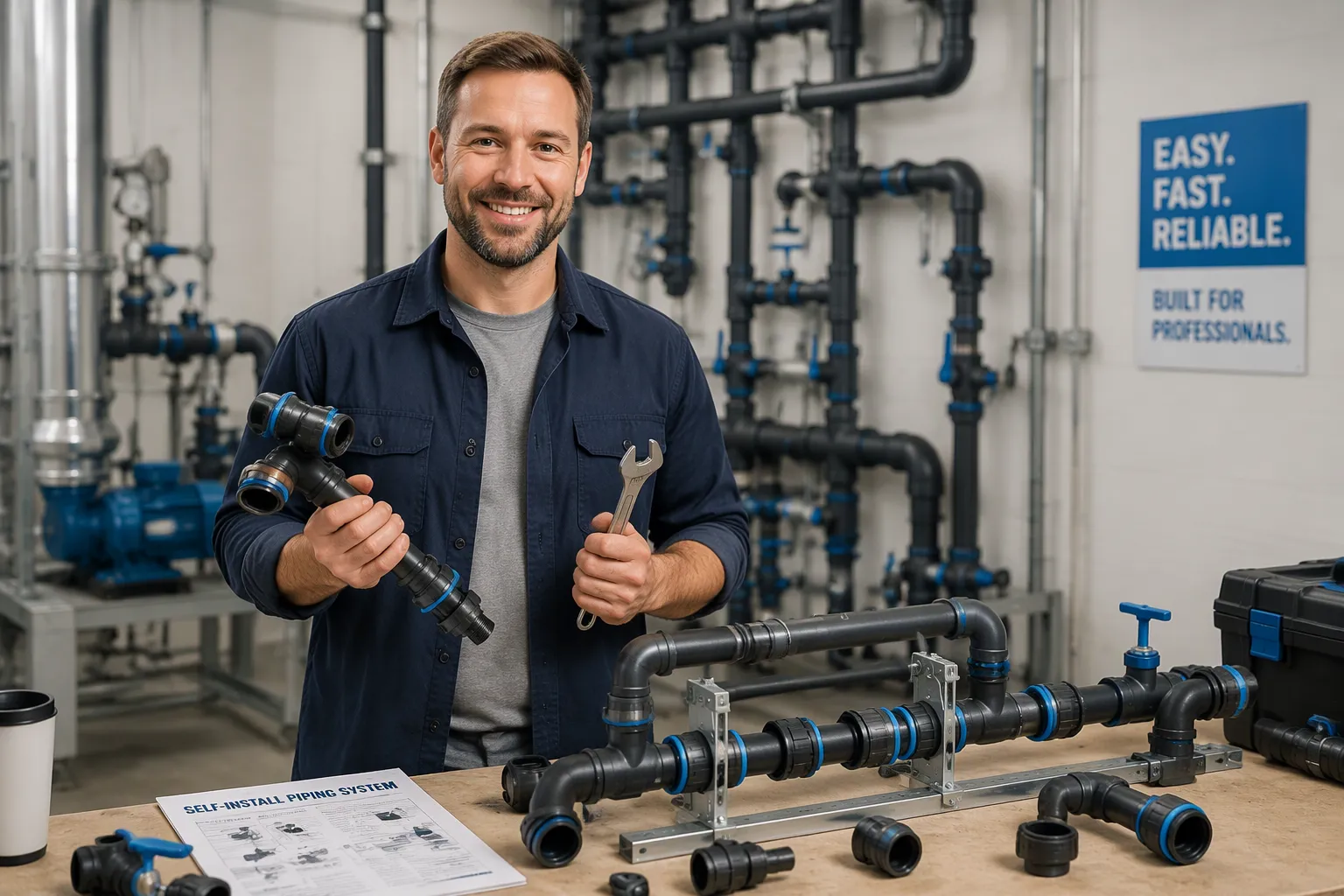
A self-install piping system arrives cut and marked, ready for the plant crew to assemble.
The factory builds the system to a confirmed drawing, which supports accurate fit and consistent material grade.
Plant staff perform the assembly instead of contracted welding crews, reducing site labor and supervision.
Installation runs faster because cutting and marking happen in the factory, not on site.
The approach suits thermoplastic lines in water treatment, chemical auxiliary service, and equipment connections.
Avoid self-install for high-pressure steel lines, alloy service, or routes that change during construction.
Check that the supplier ships instructions, spool identifiers, and material certificates with the order.
Many plants use both methods, assigning each line to the approach that fits it.
What Is a Self Install Piping System?
A Plain-Language Definition
A self install piping system is a complete set of pipes, fittings, and valves that a factory produces to a specific drawing, then ships to the plant for assembly by the plant's own crew. The term describes both the product and the method. The product is a matched package; the method is on-site assembly without field cutting or welding.
The applicable boundary matters here. A self install piping system suits thermoplastic lines in water treatment, chemical auxiliary service, and equipment connections. It does not replace engineered fabrication for high-pressure steel lines or heavily customized runs. Plant owners should treat the package as a pre-engineered kit, not as a universal substitute for every piping job.
Key Components
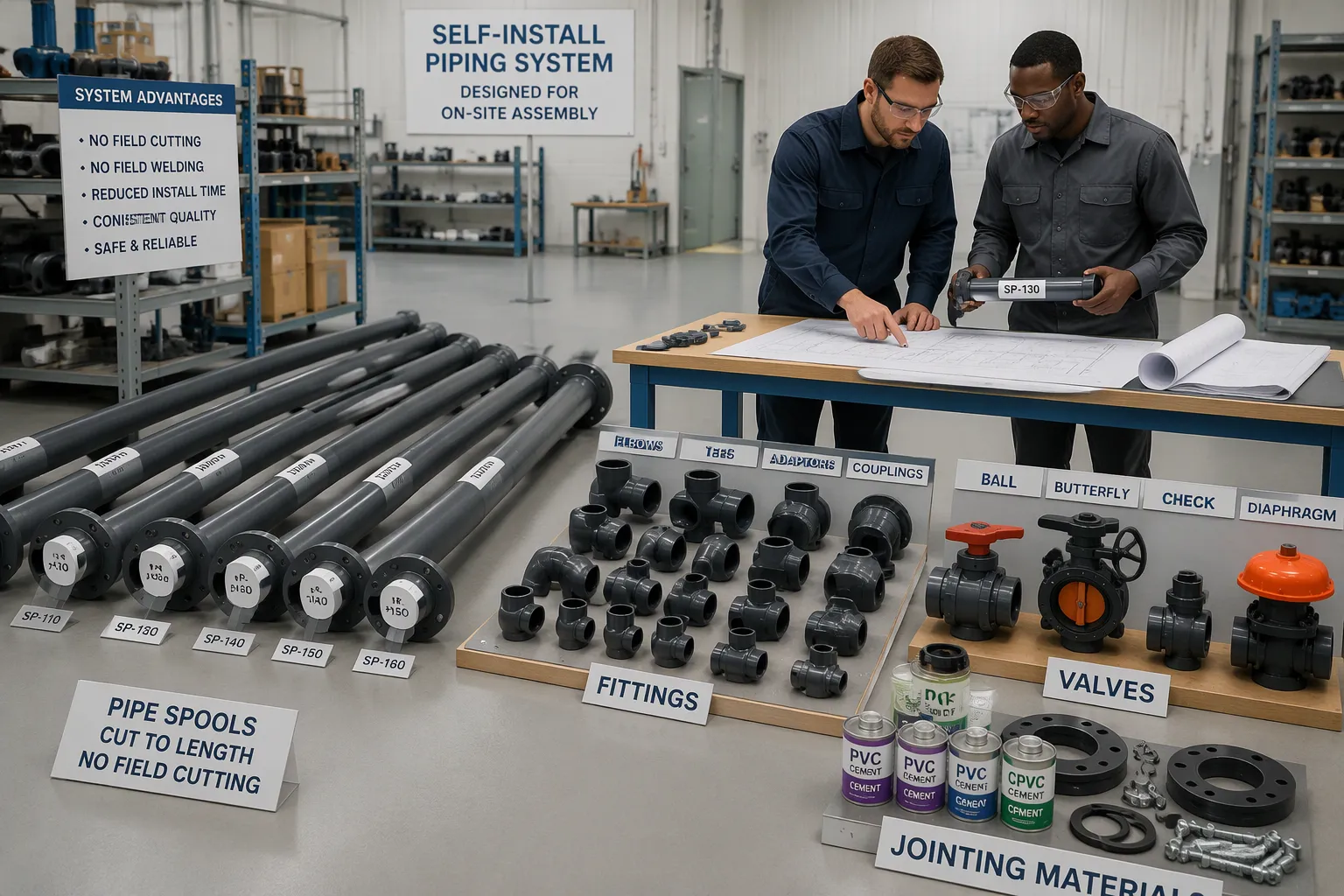
Each package contains a defined set of parts. The factory fabricates every piece to the confirmed drawing and marks it before shipment. A typical order includes the following elements.
Pipes cut to length. Each spool arrives at the exact dimension shown on the drawing, so the crew does not measure and cut in the field.
Fittings. Elbows, tees, adaptors, and couplings connect the spools, and each fitting carries a mark that ties it to a location on the drawing.
Valves. Ball, butterfly, check, and diaphragm valves arrive with the line, already matched to pipe size and material; the ball valve range covers the quarter-turn isolation points in most water-side packages.
Jointing materials. Solvent cement, gaskets, and flanges come in the same shipment, so the crew does not source them separately.
Marked spools and a drawing set. Every spool carries an identifier. The crew matches the identifier to the drawing and sets the part in place.
The marking step carries most of the risk. A package with clear identifiers assembles in sequence. A package with vague labels forces the crew to interpret the drawing at every joint.
How the Parts Work Together
Assembly follows the drawing, not the crew's judgment. The crew unpacks the shipment, sorts the spools by identifier, and works through the line in the order the drawing sets. Each spool connects to the next through a marked fitting or valve. The jointing method depends on the material: solvent cement joins PVC and CPVC lines, and the difference between PVC and CPVC pipe determines which cement and temperature range apply. Thermal fusion joins PPH and PVDF lines. Threaded or flanged connections handle the points where the line meets equipment.
The factory controls the variables that field fabrication usually leaves open. Pipe length, fitting placement, and material grade all come from one production run against one drawing. That control gives the plant a predictable fit. The crew supplies labor and basic tools; the factory supplies dimensional accuracy and material consistency.
Two conditions keep the system reliable. First, the drawing must reflect the actual site: a package built to an outdated drawing will not fit, no matter how well the factory marks it. Second, the crew must follow the sequence, because skipping ahead or substituting parts breaks the match between spool and drawing.
A plant owner can judge a package before ordering by asking three questions. Does the supplier fabricate to a confirmed drawing? Does every spool carry a clear identifier? Does the shipment include jointing materials and instructions? A yes to all three signals a package built for self-installation. A no to any one signals a parts order presented as a system.
The Real Cost of Traditional Piping
Labor and Supervision
Field fabrication carries a labor structure that plant owners often underestimate. Welding and fitting demand certified tradespeople, and their rates reflect that skill level. A single line may need welders, fitters, and helpers working as a crew, and each hour adds to the project total.
Supervision adds a second layer: someone must coordinate the crew, check each joint, and sign off on the work. Inspection follows the same pattern, with visual checks and, on many lines, non-destructive testing by a qualified inspector. Permits for hot work add administrative time before the first joint is even made, and the requirements are set out in the standard for hot work operations. None of these costs is waste, since each protects quality on a demanding line. The point is that they scale with every joint made in the field.
Schedule and Sequencing
Traditional piping ties the schedule to crew availability and to the sequence of field operations. Cutting, fitting, welding, and inspection happen one after another on site, and a delay at any step pushes the rest of the line back. Weather, competing projects, and crew turnover all affect the timeline, and plant owners absorb that uncertainty.
Sequencing also creates dependencies. The line cannot close until inspection passes, equipment connections wait on the piping crew, and every handoff between trades adds a window where the project sits idle. On a large or complex job, that idle time is a real cost even though no invoice line item names it.
External Coordination
Traditional fabrication pulls in parties beyond the plant's own staff. A contractor manages the crew, and the plant manages the contractor. Permits, insurance, and site access rules all require attention, and communication between plant engineers and contractor supervisors becomes a daily task.
This coordination suits complex work well. High-pressure lines, alloy steel, and heavily customized runs need the judgment of experienced fabricators on site, and traditional piping remains the right choice for those jobs. The cost structure simply reflects what the work demands. A plant owner weighing options should match the method to the line, not to a general preference.
Three Prerequisites for Self Install
Factory Production to Drawing
Production to drawing forms the foundation of every reliable self install piping system. The factory builds each spool, fitting, and valve to a confirmed drawing rather than to a generic catalog size, which removes the guesswork that field fabrication normally leaves to the crew.
The drawing must reflect the actual site before production begins. A package built to an outdated layout will not fit, no matter how carefully the factory marks each part. Plant owners should walk the route, verify dimensions, and sign off on the final drawing before the factory cuts the first pipe. Production then follows one controlled run against one approved document.
Instructions Shipped with the System
Clear, illustrated installation instructions must ship with every order. The crew needs more than a drawing set: they need a sequence, a jointing method for each material, and a clear view of how the spools connect.
Illustrations carry most of the weight here. A labeled diagram of each connection removes language barriers and reduces callbacks to the supplier, and the instructions should also state the required tools and the order of assembly. A package without this documentation forces the crew to improvise, and improvisation erodes the fit the factory worked to achieve.
Material and Component Matching
Every part in the package must match in material, size, and pressure rating. A mismatched fitting undermines the whole line, even when each individual piece meets its own specification. Suppliers should document the material grade of every component before shipment.
XITA produces PVC, CPVC, PPH, PVDF, and PP-R piping systems, and its published specifications list PPH pipe and DIN 8077/8078 fittings alongside the other material families. Standards commonly cited for PVC pressure pipe include BS EN ISO 1452 and ASTM D1785, which gives plant owners a checkable reference for material quality. For corrosive service, the behavior of PVDF diaphragm valves in corrosive environments is one example of the data a buyer should request. A purchaser can confirm that the valves, fittings, and pipes in one order share a consistent grade and a named standard; that consistency protects the joint, the seal, and the service life of the line.
Check the Drawing Before the First Spool Is Cut
Share the route dimensions and duty conditions to confirm the material grade, marking scheme, and documents that ship with the order.
How a Self Install Piping System Is Delivered
The delivery sequence has three stages, and each one has a document attached to it.
Step 1: Drawing Confirmation
Delivery begins with the drawing. The plant supplies site dimensions, and the supplier converts them into a fabrication drawing. Both parties then review the document together. The plant confirms the route, the valve positions, and the connection points before anyone approves production.
This step protects the entire order. A drawing error caught here costs a revision; the same error caught after fabrication costs a full rebuild. Suppliers with engineering experience usually flag conflicts at this stage, such as a fitting that will not clear a wall or a valve handle that blocks access. XITA, a Changzhou-based maker of thermoplastic valves and fittings with more than 20 years in the field, treats drawing confirmation as the formal start of every order.
Step 2: Factory Fabrication
The factory then cuts, assembles, and marks each component against the approved drawing. Production runs under a controlled quality system, and XITA states that its product lines are produced in accordance with an ISO 9001 quality management system. Every spool receives an identifier that matches a location on the drawing set.
Fabrication also covers the small parts that field crews often chase down. Jointing materials, gaskets, and flanges go into the same shipment as the pipe and valves. The factory checks material grade and size across the whole order before packing, which keeps a PVC fitting out of a CPVC line and a mismatched valve off a spool.
Step 3: Shipping and Receiving
The packed system ships as one matched order, sorted and labeled for unloading. The plant receives it, checks the spools against the packing list, and stores the parts by identifier. A receiving check takes little time and catches shortages before installation starts.
The crew then assembles the line in drawing sequence, using the instructions shipped with the order. No field cutting and no welding enter the process. A plant that completes these three steps receives a self install piping system that fits the route it was built for.
Benefits and Limitations
Where Self Install Wins
Cost. A plant that assembles its own line avoids contractor mobilization, field welding crews, and the supervision those crews require. The factory ships a matched package, the plant's own staff performs the assembly, site labor hours drop, and the invoice reflects that reduction.
Speed. Field fabrication moves one step at a time on site, with each step waiting on the one before it. A prefabricated package arrives ready to set in place, and the crew works through the drawing sequence without cutting, fitting, or waiting on inspection of field welds. Schedule pressure eases because the slowest operations happen in the factory, not at the plant.
Flexibility. A plant can phase installation around production windows, shut down a line for a short block, and resume later. Marked spools make it possible to stop and restart without losing the sequence. A self install piping system also suits plants with limited access to specialized trades, since assembly needs basic tools rather than certified welders.
Limitations to Know
Scope limits deserve an honest look. Complex lines with many direction changes, tight clearances, or unusual support requirements may still favor traditional fabrication. High-pressure service and alloy steel fall outside the typical thermoplastic range. Heavily customized runs that change during construction also fit poorly, because the factory builds to a fixed drawing.
Site conditions matter as well. A package built to an outdated drawing will not fit, and the plant absorbs the rework. Crews need basic competence with solvent cement or thermal fusion, and a plant without that skill should plan training before the shipment arrives.
Compliance and Reliability
Regulatory compliance depends on documented material grades and named standards. A supplier should state the standard behind each component so the plant can verify the line against local codes, and documentation shipped with the order supports inspection and record-keeping.
Long-term reliability rests on factory control. One production run against one drawing keeps material grade and dimensions consistent across the line, which protects joints and seals over years of service. Plant owners should still confirm pressure ratings for their specific duty, since no package suits every application.
Typical Plant Applications
Water Treatment Lines
Water treatment plants handle large volumes of water at moderate temperatures and pressures, and PVC and CPVC suit these lines well. Both materials resist corrosion from treated water and stay light enough for a plant crew to handle without lifting equipment. PVC serves cold-water runs and dosing lines, while CPVC extends the same service to warmer streams such as backwash water or heated process feeds.
A self install piping system fits water treatment because the layout tends to follow a predictable pattern. Headers, valve banks, and filter connections repeat across a plant, so the factory can build spools to a drawing that covers several similar runs, using PN10 UPVC fittings on the lower-pressure sections. The crew assembles the marked parts during a short shutdown window and returns the line to service. XITA supplies piping components to the water supply and water treatment industries, which gives the company direct exposure to this kind of layout.
Chemical Auxiliary Lines
Chemical auxiliary lines carry dosing chemicals, rinse streams, and waste flows, and material choice depends on the chemical in contact. PPH handles many acids and alkalis at elevated temperatures, while PVDF pipe covers more aggressive service where other thermoplastics would degrade. Neither material belongs on a line without a check against the chemical compatibility data for the specific fluid, and the material selection criteria for electroplating bath chemistries show how detailed that check needs to be.
These lines often run in bundles with many branches and small valves, and that density makes factory fabrication valuable. The plant confirms the drawing once, and the factory cuts and marks every branch to match. A crew then assembles the auxiliary network in sequence without field cutting near active chemical equipment. XITA serves chemical processing, pharmaceutical, electroplating, and PCB plants, where auxiliary lines of this type are common.
Equipment Skid Connections
Equipment skid connections link pumps, filters, and packaged units to the main piping. These runs are short, but they demand accurate dimensions: a skid sits at a fixed point, and the connecting spools must meet its ports without stress on the flanges. Factory fabrication to a confirmed drawing addresses this directly, because the crew sets each spool in place and the connection lines up against the measured gap.
Skid connections also suit phased work. A plant can install one connection at a time as equipment arrives, using the marked spools to keep each run separate. PVC and CPVC cover water-side connections, while PPH and PVDF handle chemical feeds to the same skid. The package approach keeps these short runs consistent across a plant with many identical units.
Self Install vs. Traditional Piping
Performance and Fit
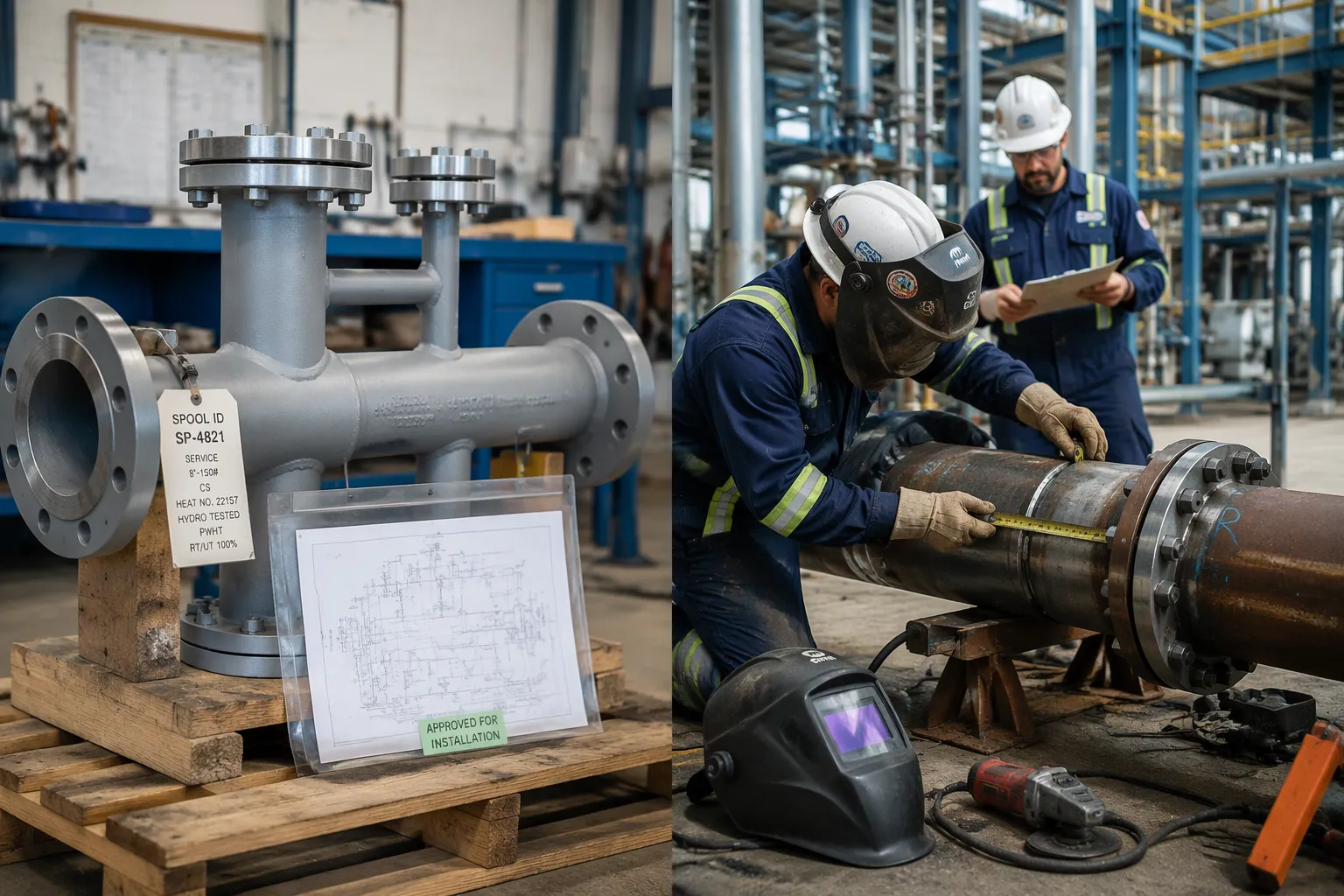
Both methods can deliver a line that performs to specification. The difference lies in where the work happens and who controls the variables. A self install piping system moves dimensional control into the factory: one production run against one approved drawing keeps pipe length, fitting placement, and material grade consistent across the order. Traditional fabrication places that control in the field, where a skilled crew measures, cuts, and welds each joint on site.
Fit follows the same split. Factory-built spools arrive marked and matched to the drawing, so the crew sets parts in sequence. Field fabrication adapts to surprises as they appear, which gives it an edge on routes that change during construction; a line with many direction changes, tight clearances, or unusual supports often suits traditional work better. A repeatable layout of headers, valve banks, and skid connections suits factory production. Joint quality deserves a fair word on both sides as well: a certified welder produces a strong, inspectable joint on high-pressure steel lines, while solvent-cemented and thermally fused joints perform well within their rated service when the crew follows the correct procedure. Thermoplastic piping associations such as the Plastic Pipe Institute publish the handling and joining guidance behind those procedures. The method should match the line, not a general preference.
Compliance and Documentation
Regulatory compliance rests on documented material grades and named standards, whichever method a plant chooses. A self install package should state the standard behind each component, such as BS EN ISO 1452 or ASTM D1785, so the plant can check the line against local codes and keep the paperwork for inspection.
Traditional fabrication generates its own record trail: weld maps, inspection reports, and non-destructive testing results document each joint as it is made. That trail suits high-pressure and alloy service, where code requirements often demand joint-by-joint verification. A prefabricated package documents material and dimensions instead, and the installation record covers the assembly sequence. Neither trail is stronger in absolute terms; each matches the work it describes. Plant owners should confirm that the supplier provides material certificates and standard references before the order ships, and that the installation instructions cover the jointing method for each material.
Cost Comparison
Upfront cost favors the factory package in most thermoplastic applications. The plant pays for a matched set of parts and performs the assembly with its own staff, so contractor mobilization, field welding crews, and the supervision those crews require drop out of the budget. Traditional fabrication carries a different cost profile: certified tradespeople, inspection, permits, and contractor management all add line items, and those costs buy capability that complex work genuinely needs. A high-pressure steel line justifies every one of them.
Long-term cost depends on fit and material consistency. A package built to an accurate drawing installs without rework, and consistent material grade protects joints and seals over years of service. A package built to an outdated drawing shifts rework back onto the plant, which erases the upfront savings. Traditional fabrication carries less of this risk on changing routes, because the crew adapts as the work proceeds. The table below summarizes where each option fits.
| Factor | Self Install Package | Traditional Fabrication |
|---|---|---|
| Best-fit lines | Thermoplastic water, chemical auxiliary, skid connections | High-pressure, alloy steel, heavily customized runs |
| Dimensional control | Factory, against one approved drawing | Field crew, adjusted on site |
| Documentation | Material certificates and named standards | Weld maps and joint inspection records |
| Upfront cost | Lower site labor and supervision | Higher, reflecting specialized trades |
| Schedule risk | Low, once the drawing is confirmed | Tied to crew availability and sequencing |
The table works as a routing guide. Repeatable thermoplastic layouts point toward the factory package; complex, high-pressure, or fast-changing lines point toward traditional fabrication. Many plants run both methods side by side, and that mix often serves the site best. For the joints themselves, a designer can compare PVDF fittings with other plastic fittings, and review how PVDF fittings protect joints and seals before fixing the specification.
Bring the Line List Before Choosing a Method
Compare drawing confirmation, spool marking, and shipped documents against the line list for each system in the plant.
Three component families recur in the packages described above; each linked page lists the sizes and material grades that matter for a line take-off.

PPH Pipe
Polypropylene homopolymer pipe used where acids and alkalis at elevated temperatures rule out many other thermoplastics.
View Product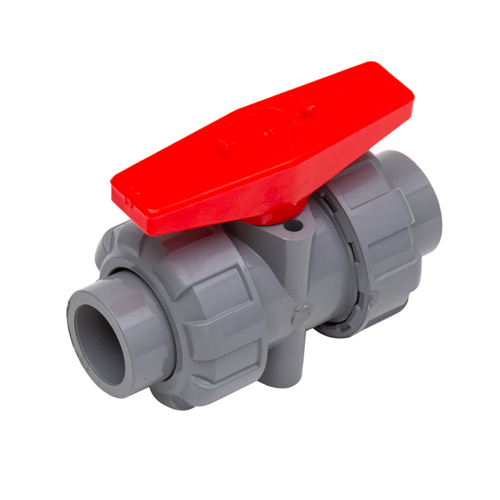
Plastic Ball Valve
Quarter-turn isolation valve for water-side and chemical connections, matched to the pipe material in a self-install package.
View Product
Plastic Check Valve
A one-way valve that protects pumps and equipment from backflow, available to match PVC, CPVC, PPH, and PVDF lines.
View ProductA plant owner can settle the choice with four checks. Choose a self install piping system when the factory builds it to a confirmed drawing, when site labor is limited, when schedule pressure is high, and when the line matches the typical thermoplastic uses covered above. Weigh the limits honestly as well: complex, high-pressure, or heavily customized lines may still favor traditional fabrication. Buyers can compare a supplier's drawing confirmation, spool marking, and documentation steps with the three-stage sequence above.
Confirm the Package Contents in Writing
Ask for the drawing, marking plan, jointing instructions, and material certificates to be listed in the quotation.
FAQ
When should a plant avoid self-install?
A plant should avoid self-install when the line runs at high pressure, uses alloy steel, or changes shape during construction. These conditions need field judgment that a fixed factory drawing cannot supply, so traditional fabrication fits those jobs better.
Can a self-install package handle high-pressure service?
Typical self-install packages cover thermoplastic lines in water, chemical auxiliary, and skid connection service at their rated pressures. High-pressure steel lines fall outside that range and should go to engineered fabrication with certified welders and joint inspection.
What happens if the site drawing is wrong?
The package will not fit. The factory builds every spool to the confirmed drawing, so an outdated layout shifts rework back onto the plant. Owners should walk the route and sign off on dimensions before production starts.
Does self-install suit lines that change during construction?
Poorly. A factory package follows one fixed drawing, while routes that shift as work proceeds favor field fabrication, where the crew adapts on site. Plants should confirm the layout is final before ordering.
Which conditions make self-install a poor fit?
Skip self-install for high-pressure lines, alloy steel service, routes with many late changes, and sites without crew skill in solvent cement or thermal fusion.
Do crews need special skills for assembly?
Yes, basic skill matters. PVC and CPVC lines use solvent cement, and PPH and PVDF lines use thermal fusion. A crew without that experience should plan training before the shipment arrives; the work needs basic tools rather than certified welders.
Can a plant mix both methods on one site?
Yes. Many plants run factory packages on repeatable thermoplastic layouts and traditional fabrication on complex or high-pressure lines. That mix often serves the site best, with each method covering the work it suits.
Where can a plant owner find a supplier?
Compare suppliers on drawing confirmation, spool marking, and shipped documentation. XITA, a Changzhou-based maker of thermoplastic valves and fittings with more than 20 years in the field, publishes an English product FAQ and a German-language product FAQ that buyers can check against project requirements.
References and Notes
Standard for hot work operations — basis for permit and inspection time in traditional fabrication (nfpa.org, accessed 2026-11-24)
ASTM D1785 specification overview for PVC plastic pipe — material documentation reference (astm.org, accessed 2026-11-24)
Plastic Pipe Institute — joining and handling guidance for thermoplastic piping systems (plasticpipe.org, accessed 2026-11-24)
Data notes: the supplier's own site lists more than 20 years in the industry and an ISO 9001 quality management system, and its PPH fittings are listed to DIN 8077/8078. The draft claim that all products comply with DIN 8063 could not be verified and was removed. Pressure ratings remain duty specific.
Internal links: all original links pointing to www.czxita.com are preserved; the former German-language product FAQ anchor is now described accurately, and an English FAQ link was added beside it.

