


What Is a Prefabricated PPH Piping Assembly and When Should You Use One?
 Nov 10, 2026|
 View:5
A prefabricated PPH piping assembly is a shop-built spool of beta-crystalline polypropylene homopolymer (β-PPH) pipe, fittings, flanges and valves, cut, fused, supported and pressure-tested off-site before delivery.
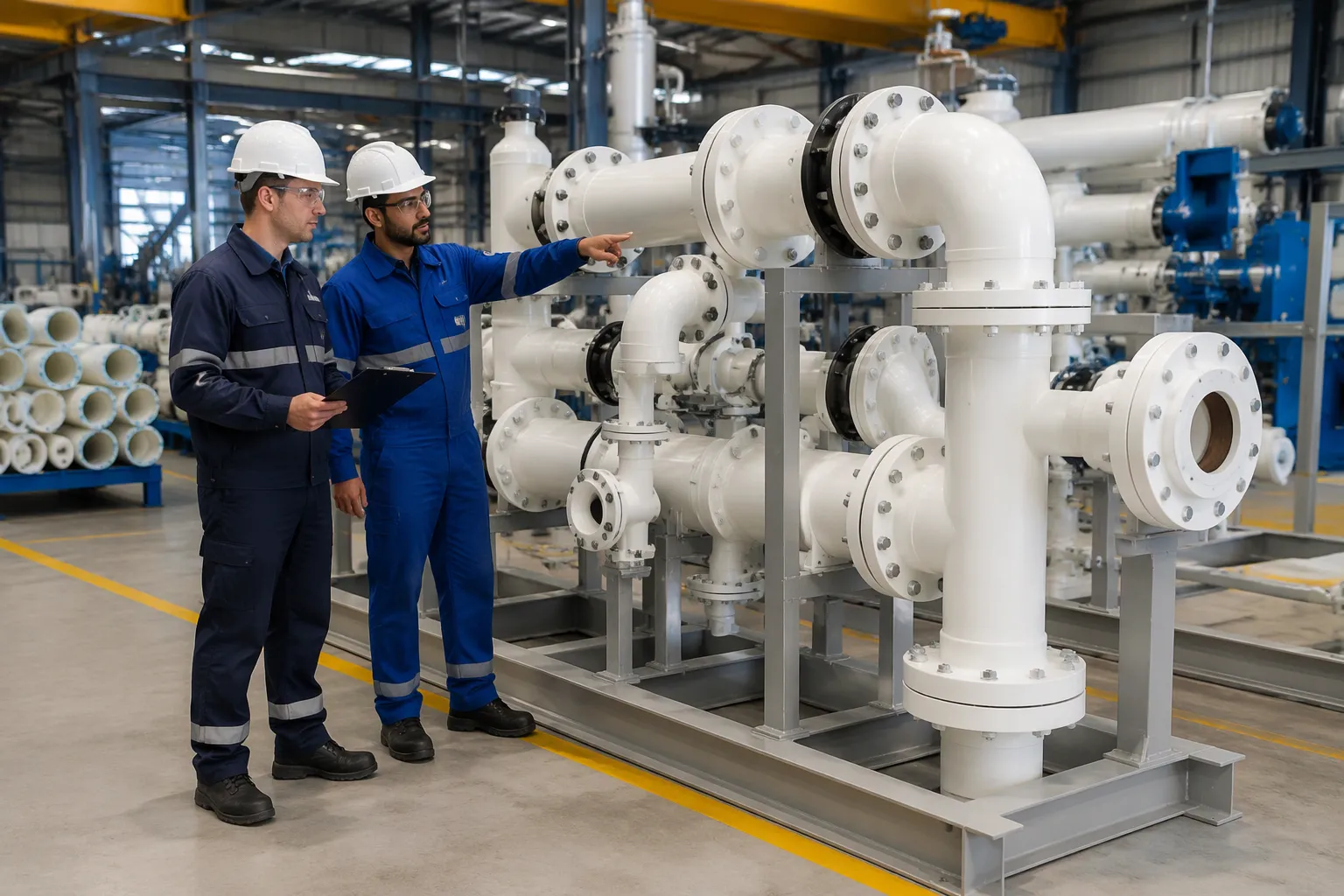
Two practical questions drive most specifications. The first covers what the assembly contains and how a fabricator builds it. The second covers when the assembly earns its place on a project, judged on technical fit, application, compliance, and cost. Engineers and technical buyers who specify corrosion-resistant piping form the main audience here. Alternative materials appear throughout as fit comparisons, not as a ranking of good against bad.
Key Takeaways
A prefabricated PPH piping assembly is a shop-built spool of β-PPH pipe, fittings, flanges, and valves. It arrives ready to install.
Shop fabrication improves quality control and, in published supplier data, reduces on-site welding time by up to 40%. This speeds up projects.
β-PPH resists many chemicals and has an upper service limit near 95–100°C. It suits applications of PPH fittings in chemical processing, marine, and pharmaceutical systems.
Prefabrication suits tight schedules, congested sites, and repeated designs. It saves time and labor.
Avoid prefabrication for late design changes or very small one-off runs. Field fabrication offers more flexibility.
Confirm chemical compatibility, temperature limits, and local codes before ordering. Request material certificates and test reports.
One market estimate puts lifecycle cost 30–40% below stainless steel or cast iron; check the figure against a project quote. Prefabricated assemblies also need less maintenance.
Choose PPH for corrosive service at moderate temperatures. Choose metals for high temperature or pressure. Use the PVDF pipe versus other plastics comparison when a different plastic fits the duty.
What Is a Prefabricated PPH Piping Assembly?
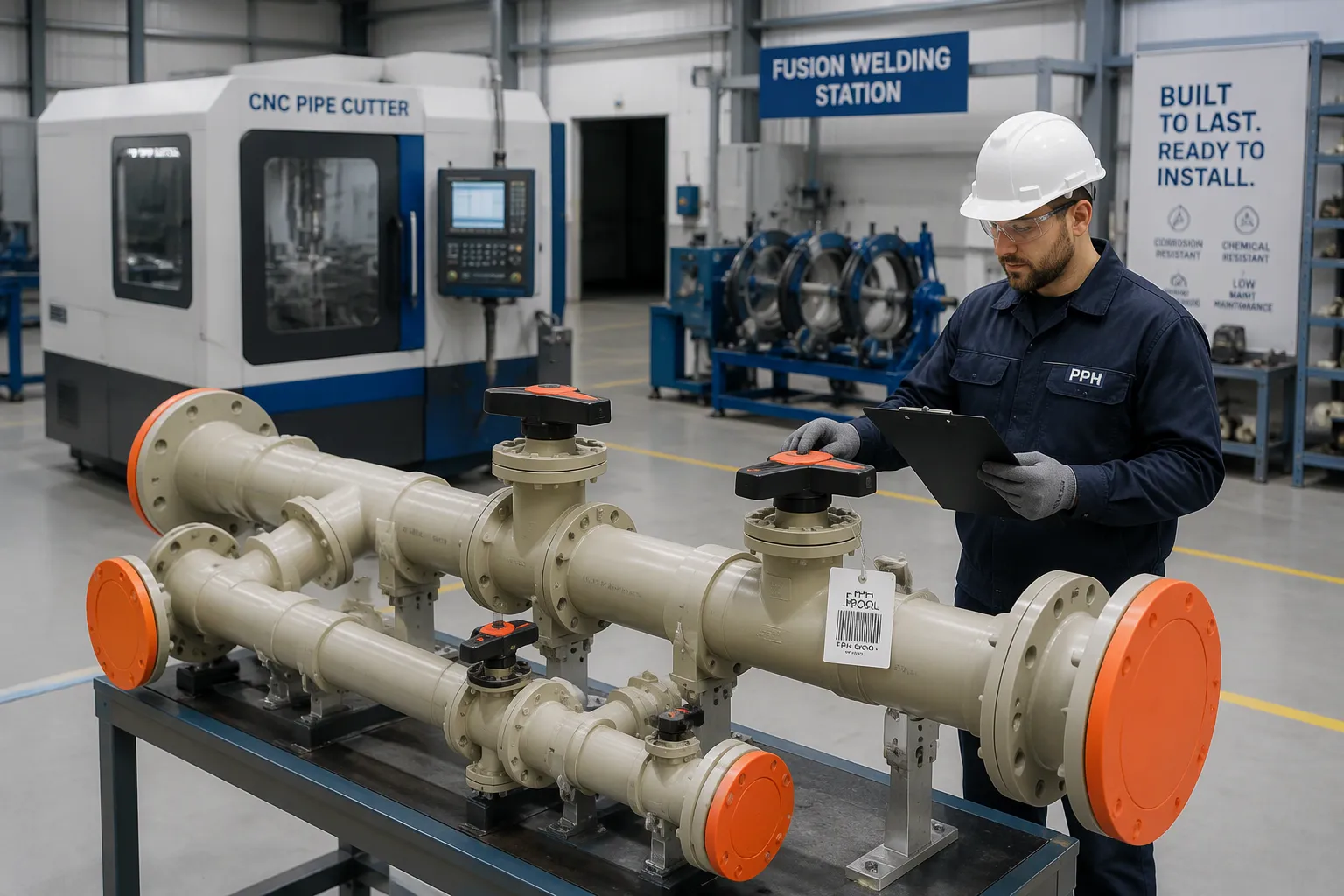
The PPH pipe systems guide describes a prefabricated PPH piping assembly as a complete spool of β-PPH pipe, fittings, flanges, valves, and supports that a fabricator cuts, fuses, and tests in a shop before shipping it to the jobsite. The spool arrives as one tagged unit, so crews lift it into place instead of building it piece by piece. This section explains how that shop process works and why the base material matters.
Prefabrication Versus Field Fabrication
Shop-built spools and controlled conditions
A pipe spool is a piece of pre-assembled pipe and fittings, usually prepared in a shop so that installation on the construction site can be more efficient. Shop conditions stay clean, dry, and temperature-stable. Fabricators use CNC pre-cutting, edge beveling, and slot milling to deliver ready-to-install components while reducing field errors. Controlled fusion produces full-penetration, gas-tight seams, and dye penetrant testing can verify seam integrity. Field work rarely matches this level of control. Traditional manual welding can create micro-porosity along seam lines, which allows chemical leakage and reduces long-term reliability.
What arrives on delivery
Pipe normally ships as sticks of roughly 20 feet, called single random length, or as prefabricated spools with elbows, tees, and valves already joined. Spools usually carry a bar code tag, and plastic caps protect the ends. Pipe smaller than 2 inches is typically not prefabricated, so small-bore runs often stay field-built.
Why β-PPH as the Base Material
Homopolymer structure and impact resistance
What PPH material is explains the base resin: β-PPH is a beta-crystalline polypropylene homopolymer. The beta crystal structure gives the material enhanced impact resistance and improved creep resistance compared with standard polypropylene grades. PP-H shares the homopolymer chemistry but lacks the beta modification. PP-R is a random copolymer, and sanitary applications use it mainly for hot and cold water lines. Industrial chemical service favors β-PPH because the crystalline structure holds its shape under sustained load.
Chemical and temperature profile
β-PPH has an upper service limit near 95–100°C and resists acids, alkalis, salts, and many aggressive chemicals. That combination suits hot chemical transfer, marine piping, and pharmaceutical systems. PP-R serves sanitary work well at lower demands. The distinction matters at the specification stage, because the wrong grade shortens service life in aggressive duty.
How Prefabrication Changes Project Execution
Parallel work and schedule effects
Shop fabrication runs while civil, structural, and equipment work proceeds on site. Modular, prefabricated PPH assemblies accelerate on-site installation and reduce field labor requirements. Pre-fabricated sections cut on-site welding time by up to 40% in one supplier's field data, which supports faster installation and phased commissioning. Crews then sequence spool delivery to match construction milestones.
Less on-site welding and site labor
PPH systems rely on fusion welding, socket fusion, or mechanical fittings. Each method carries installation implications, including required equipment, heat input control, and field-qualification requirements. Moving that work into the shop concentrates the equipment and the qualified operators in one place. The table below summarizes the contrast.
| Aspect | Prefabricated PPH assemblies | Field-fabricated PPH piping |
|---|---|---|
| Quality control | CNC pre-cutting and beveling reduce field errors; dye penetrant testing verifies seams | Manual welding can leave micro-porosity along seam lines |
| Installation efficiency | On-site welding time falls by up to 40%, per Qeehua Plastic | More on-site fabrication and shutdown time |
A prefabricated PPH piping assembly therefore shifts risk from the field to a controlled shop, where inspection happens before delivery rather than after installation.
Components and Fabrication Process
Core Components
Pipe, fittings, and flanges
A prefabricated spool starts with β-PPH pipe and a matched set of fittings. The PPH material guide sets out the resin grade behind those components. Elbows change direction, tees branch the run, reducers step the diameter down or up, and end caps close a line. Unions and couplings join sections that may need future separation. Flanges terminate a spool at equipment, valves, or tank nozzles, and they give crews a bolted connection point where fusion is impractical. Published product ranges list β-PPH fittings from DN15 to DN100 in these categories, made from beta-crystalline PPH to DIN 8077, DIN 8078, and GB/T standards.
Valves, supports, and taps
Valves arrive as either fused or flanged bodies, and the fabricator positions each one at the drawing coordinate. Supports carry the filled pipe weight and control thermal movement. Taps and instrument connections are welded in at the shop, so no field crew drills into a live line. Every component carries the same material grade, which keeps the thermal expansion behavior uniform along the spool.
Step-by-Step Fabrication
Cutting, alignment, and socket fusion
Fabrication begins with cutting and beveling each pipe end to length. Socket fusion then creates a permanent fused joint and eliminates gaskets, threads, and seals that can loosen or leak. The process follows a fixed sequence described in the PPH heat fusion joining instructions:
Cut and bevel the pipe end, then clean both mating surfaces.
Mark the insertion depth on the pipe.
Heat the pipe outside and the fitting inside simultaneously at 260 ± 10°C until both surfaces turn soft and glossy.
Insert the pipe to the marked depth in one smooth, straight motion without twisting.
Hold the joint steady under gentle, even pressure until cooling completes.
Support placement and dimensional control
Prefabricated assemblies must account for field tolerances and uneven floors. Fabricators build in adjustment at support locations and verify overall dimensions against the isometric before the spool leaves the bench. Hanger and shoe positions follow the support spacing schedule, and the shop marks each one on the pipe.
Quality Control and Testing
Visual, dimensional, and weld inspection
Inspectors check every joint for a uniform melt bead against the bead criteria in the fabricator's approved fusion procedure. The ASTM heat fusion practice often quoted here covers polyethylene pipe and fittings, not polypropylene, so the governing bead criteria for PPH should come from the PP fusion procedure and the project specification. Gaps, voids, burn marks, cracks, or a missing bead mean the joint is cut out and re-fused. Dimensional checks confirm face-to-face lengths, flange orientation, and branch angles.
Pressure testing before delivery
All spools can be leak-tested in the shop before installation, which improves quality control. The test seals the ends, fills the line with water or air, raises pressure to typically 1.5 times the working pressure, and holds it for about 30 minutes while monitoring for any drop. A water test then confirms no moisture appears outside the joints.
Planning Spools for a Corrosive Line?
Send the isometric, medium and design temperature to confirm the pipe grade, joint method and test package.
Technical Criteria for Prefabricated PPH
Chemical Resistance Fit
Acids, alkalis, and salts
β-PPH resists acids, alkalis, salts, and aggressive chemicals that corrode stainless steel and UPVC. Published chemical resistance tables list the media that polypropylene handles well:
Concentrated acids
Alkalis
Salt solutions
Alcohols
Aldehydes
The material resists aggressive inorganic acids, caustic baths, and salt solutions. That resistance reduces the risk of stress corrosion cracking in aggressive chemical environments. A smooth, non-scaling internal surface also minimizes friction and pressure drop, which keeps pumping energy costs down over long service.
Concentration limits to verify
Resistance is not unlimited. Published tables often give no specific concentration limits, and buyers should confirm actual concentration and temperature limits against the manufacturer's chemical resistance data. Service temperature, exposure duration, and the presence of mixed chemicals all shift the answer. A grade that suits a dilute stream may fail in a concentrated one. Request written compatibility data for the exact medium before releasing a spool for fabrication.
Temperature and Pressure Envelope
Service range and derating
Published product data puts the upper service limit of β-PPH around 95–100°C, while comparison tables for continuous duty quote about 90°C. The difference comes from rating basis and derating. Pressure capability falls as temperature rises, so the allowable pressure at the top of the range sits well below the rating at ambient. Designers should apply the manufacturer's derating curve rather than the headline pressure number. Cyclic temperature service deserves extra margin, because repeated expansion and contraction stresses fusion joints over time.
Pressure ratings and support spacing
Support spacing follows the manufacturer's schedule for the pipe diameter and the service temperature. Hot lines need closer supports than cold ones, since the material softens and sags more as it warms. Industry guidance on polypropylene pressure piping separates PP-R and PP-RCT, which cover pressure applications such as chilled water, process piping, reclaimed water, and hydronic heating and cooling, from PP-H, the homopolymer grade used mainly in industrial chemical service. Fabricators should confirm the rating basis for each spool before pressure testing.
Purity and Contamination Control
High-purity water service
Polypropylene suits ultra-pure work because fusion joints can leave a smooth, bead-free bore. That bore leaves fewer places for bacteria or particles to collect. The installation method requires special fusion equipment, which favors shop fabrication over field work. Industry guidance also lists industrial and process piping for semiconductor manufacturing and high-purity pharmaceuticals among polypropylene's uses.
When PPH is not suitable
PPH has clear limits. Industry guidance separates PP-H from the PP-R and PP-RCT grades used for hot and cold water distribution, so PP-H generally stays in industrial process service. Some plumbing codes also restrict polypropylene in return air plenums on flammability grounds, and the authority having jurisdiction decides. Specifiers should route those services to another material and reserve β-PPH for chemical, process, and high-purity duty where its strengths apply.
When to Use a Prefabricated PPH Piping Assembly
PPH material properties answer half the question. Project conditions answer the rest. A spool that suits the chemistry can still lose money on the wrong job. This section maps the industries that specify β-PPH and the site conditions that reward shop fabrication, then covers the cases where field work makes better sense.
Industries That Commonly Specify PPH
Chemical processing and marine engineering
Chemical plants handle acids, alkalis, and salt solutions daily. β-PPH stays resistant to these media, and its upper service limit sits near 95–100°C. That profile suits hot chemical transfer lines, dosing runs, and scrubber piping. Stainless steel corrodes in many of the same streams, and UPVC softens at lower temperatures. Marine work adds salt spray and constant motion. PPH weighs a fraction of metal, so crews handle spools more easily on decks and offshore platforms. The material also resists seawater attack, which supports long service on ballast and cooling lines.
Water treatment and pharmaceutical systems
Water treatment plants use PPH for chemical feed lines, where chlorine, caustic, and coagulant streams attack metal pipe. Pharmaceutical systems specify it for high-purity water because fusion joints leave a smooth, bead-free bore. That bore gives bacteria and particles fewer places to collect. The virgin grade is non-toxic and odorless, which supports food-grade and pharmaceutical-grade requirements. Both industries value repeatable quality, and shop fabrication delivers it spool after spool.
Project Conditions That Favor Prefabrication
Tight schedules and congested sites
A compressed schedule rewards parallel work. Shop fabrication proceeds while civil and structural crews finish the building. Pre-fabricated sections cut on-site welding time by up to 40% in published supplier data, and that saving compounds on a fast track. Congested sites add a second reason. A chemical plant revamp often leaves no room to stage fusion equipment, generators, and pipe stock. Shop-built spools arrive tagged and sequenced, so a crane lifts each one into place and the crew moves on. Site labor drops, and so does the congestion.
Repeatable skids and multi-train projects
Repetition amplifies every prefabrication benefit. A plant with four identical reaction trains needs four identical spools. The fabricator builds the first one, proves the dimensions, and then replicates it. Jigs hold the geometry, and every copy matches the original. Multi-train projects also spread the shop setup cost across more units, which improves the economics. Water treatment plants with parallel filter banks and pharmaceutical suites with mirrored process lines fit this pattern well.
Conditions That Argue Against Prefabrication
Late design changes and unconfirmed dimensions
Prefabrication freezes geometry early. A spool built to a drawing cannot absorb a pump that moves during detailed design. Projects with open P&IDs or unconfirmed equipment locations should wait. Field fabrication lets crews measure the actual nozzle, cut pipe to fit, and fuse on the spot. The trade-off favors flexibility over speed. Buyers should confirm equipment locations, anchor bolt plans, and nozzle orientations before releasing spools to the shop.
Very small one-off runs
Prefabrication carries fixed costs. The shop needs drawings, setup, jigs, testing, and freight. A single short run may not absorb those costs, and field fabrication can win on total price. Pipe smaller than 2 inches is typically not prefabricated, so small-bore work often stays on site anyway. A one-off repair or a short tie-in line usually suits direct field work better. Neither approach is wrong here. The scope simply decides.
The decision table below summarizes the fit zones.
| Project signal | Prefabrication fit | Field fabrication fit |
|---|---|---|
| Schedule pressure | Strong, parallel work saves time | Weak, site work gates progress |
| Site congestion | Strong, less staging needed | Weak, more equipment on site |
| Design maturity | Strong, dimensions confirmed | Weak, changes still likely |
| Repetition | Strong, jigs and setup amortize | Weak, no repeat units |
| Scope size | Strong on multi-spool runs | Strong on tiny one-off runs |
A prefabricated PPH piping assembly earns its place when corrosion resistance, purity, schedule, and site constraints all point the same way. When design is still moving or the scope is a single short run, field fabrication remains a sound choice.
Checking a Spool Against Your Specification?
Share the medium, concentration, temperature and test pressure to see which grade and documentation set apply.
Standards, Codes, and Documentation
Codes and Standards to Confirm
PPH pipe and fitting standards
Specifiers should confirm that the pipe and fittings follow a recognized product standard before releasing any spool for fabrication. DIN 8077 and DIN 8078 cover β-PPH pipe and fittings, and they give buyers a common reference for dimensions, material grade, and quality requirements. GB/T standards apply where the project or supplier works to Chinese national specifications. Buyers should request the current material and conformance certificates with the quote rather than rely on a catalogue claim.
Buyers should also check that the pipe and the fittings come from the same standard family. A spool that mixes a DIN-rated fitting with pipe from another system may fuse poorly or fail a dimensional check. The ASTM specification for pressure-rated polypropylene piping systems is one further reference, and the project specification should name the exact edition that governs the order.
Local pressure-piping codes
Product standards cover the components. Local pressure-piping codes govern the installed system; process piping codes such as ASME B31.3 are a common reference in industrial plants. Jurisdictions differ on inspection, registration, and testing requirements for thermoplastic lines, and the authority having jurisdiction decides which rules apply. The fabricator and the buyer should confirm the applicable code before design freezes, because code requirements can change support spacing, test pressure, or documentation.
Documentation Buyers Should Request
Material and fusion records
Traceability starts with the material. Each spool should travel with certificates that identify the resin grade, the pipe batch, and the fitting batch. Fusion logs come next. A fusion log records the operator, the machine, the heating time, and the joint location for every weld. These records let an inspector trace any joint back to its conditions, and they support warranty claims years later.
Test reports and as-built drawings
Pressure-test reports should accompany each spool. The report states the test medium, the test pressure, the hold duration, and the result. As-built drawings close the package. They show the final geometry, including any shop changes made during fabrication. Certificates, fusion logs, and pressure-test reports should travel with each spool, so the site crew and the client both hold the same record set at handover.
Cost Factors and Alternatives
Where the Cost Sits
Engineering, fabrication, and freight
Prefabrication moves spending from the field into the shop, and buyers should read the quote with that shift in mind. Engineering covers isometrics, spool drawings, and support schedules. Fabrication covers cutting, fusion, inspection, and testing. Freight covers crating and transport to site. One market estimate puts total installed and lifecycle cost for β-PPH systems 30–40% below stainless steel or cast iron, including material, transport, installation, and maintenance savings; the figure should be checked against a project-specific quote. PPH also weighs a fraction of metal, which eases handling in marine and offshore work.
Field labor and rework savings
Field labor carries the highest hourly burden on most projects. Shop-built spools cut on-site welding time, so crews spend fewer hours in the rack. Rework savings follow. A joint that fails inspection in the shop costs a re-fuse. The same joint discovered after installation costs removal, downtime, and disposal. Buyers should weigh those avoided costs against the shop setup and freight line items.
PPH Versus Metal Piping
Lifecycle cost in corrosive service
Metals win on strength and lose on chemistry. Stainless steel corrodes in many acid and salt streams, and cast iron rusts. Replacement cycles then drive lifecycle cost far above the purchase price. β-PPH stays resistant to those media, so the installed line avoids repeated replacement. The 30–40% cost estimate cited above already folds in maintenance savings over the service life.
Where metal fits better
Metals remain the better fit for high temperature and pressure. A line above the PPH ceiling, or one carrying high-pressure steam, belongs in steel or a suitable alloy. Mechanical strength also favors metal where impact, vibration, or heavy external loads dominate. Specifiers should route those duties to metal without hesitation.
PPH Versus Other Plastics
PVC, CPVC, and PVDF fit
Each plastic occupies its own zone. A published comparison of the four materials gives these values:
| Properties | PVDF | PPH | PVC | CPVC |
|---|---|---|---|---|
| Chemical Resistance | Excellent | Excellent | Good | Very Good |
| Max. Continuous Temperature | ~140 °C | ~90 °C | ~60 °C | ~95–100 °C |
| Relative Cost | Higher | Moderate | Low | Moderate-High |
PVDF handles strong oxidizing agents and halogens and is quoted at continuous service up to 140°C in how PVDF pipe compares with other plastics. PPH covers acids, alkalis, and organic solvents at a lower cost.
Selection cues by service
Choose PVDF for hot ultrapure chemicals and clean-in-place cycles, where purity and temperature are mission-critical; what PVDF pipe is and how it performs sets out the material behind that choice. Choose PPH where chemical compatibility and moderate purity suffice, such as industrial water treatment, chemical tanks, and general process lines. PVC and CPVC suit lower-temperature service at lower cost. The service conditions decide, not a ranking.
Specifying and Ordering Checklist
What to Give the Fabricator
Isometrics and service conditions
A clean order starts with a complete drawing package. Buyers should specify each spool on an isometric that shows line numbers, dimensions, branch angles, flange orientations, and support locations. The package should also name the medium, the design temperature, the design pressure, and the test requirements. Fabricators build to the drawing, so a missing dimension becomes a shop assumption or a hold on the order.
Service conditions deserve the same care. The fabricator needs the chemical exposure, the operating temperature, and any cyclic duty before cutting pipe. Buyers should attach the manufacturer's chemical resistance data for the exact medium. That attachment settles grade questions early and prevents a re-order later.
Testing and delivery requirements
The purchase order should state the test method, the test pressure, and the hold duration for every spool. Buyers should also specify the acceptance criteria for fusion joints, such as the bead inspection rules in the approved fusion procedure. Delivery terms matter just as much. State the tagging format, the crating method, the shipping sequence, and the site address. A spool that arrives out of sequence sits in the laydown yard and blocks the crane.
Verifying the Supplier
Fusion qualification and QC program
Buyers should verify that the fabricator qualifies its fusion operators and records the results. Request the welding procedure specification and the operator qualification records before placing an order. A supplier with a documented QC program inspects every joint, logs every weld, and holds nonconforming spools for rework. Ask how the shop handles a failed joint and who signs the release.
Lead time and documentation
Lead time should come in writing, broken down by engineering, fabrication, testing, and freight. Buyers should request quotes with that breakdown, so schedule risk stays visible. Documentation belongs in the same conversation. Confirm that material certificates, fusion logs, pressure-test reports, and as-built drawings ship with each spool. A supplier who cannot commit to that package in writing leaves the buyer exposed at handover.
Two items from the PPH product range are shown below; both appear in the spool component list earlier in this guide.

β-PPH Pipes
Polypropylene homopolymer pipe listed at 1.0–1.6 MPa pressure rating for chemical and process lines.
View Product
Motorized PPH True Union Ball Valve
Fused or flanged valve body with an electric actuator for automated chemical dosing lines.
View ProductA prefabricated PPH piping assembly is a shop-built, tested spool of β-PPH pipe, fittings, flanges, and valves delivered ready to install. Choose one when corrosion resistance, purity, schedule, and site constraints align, and only after confirming temperature, pressure, and code limits. The PVDF valve guide for corrosive environments shows how another material family approaches the same duty. Metals and other plastics each have a suitable zone, so service conditions should drive the final selection rather than a blanket preference. Buyers can work through the checklist above with any fabricator before placing an order.
Need a Spool Package With Full Records?
Request the material certificates, fusion qualification records, pressure-test reports and as-built drawings for your order.
FAQ
How long does fabrication take?
Lead time depends on drawing completeness, spool count, and testing scope. Buyers should request a written breakdown covering engineering, fabrication, testing, and freight. A complete isometric package shortens the front end considerably. Incomplete dimensions stall the shop and push delivery dates.
Can crews modify a spool in the field?
Minor adjustments are possible at designated points. Fabricators build in tolerance at support locations to absorb uneven floors. Major changes to fused joints require cutting out the section and re-fusing on site. Crews need fusion equipment and a qualified operator for that work. Buyers should confirm field-modification rules before shipment.
What equipment does socket fusion require?
Product frequently asked questions list the socket fusion kit: a heating tool with pipe and fitting adapters, a pipe cutter, a beveling tool, a depth marker, and a clean rag. The process heats both surfaces at 260 ± 10°C until they turn soft and glossy. Operators then insert the pipe to the marked depth and hold it steady until cooling completes.
Does a small line still qualify for shop fabrication?
Often it does not. Pipe smaller than 2 inches is typically not prefabricated. Small-bore runs usually stay field-built. A short tie-in or a one-off repair rarely absorbs the shop setup, testing, and freight costs. Scope size decides the economics more than material choice does.
How does a buyer confirm chemical compatibility?
Buyers should request the manufacturer's chemical resistance data for the exact medium, concentration, and service temperature. Mixed chemicals and long exposure shift the answer. A grade that suits a dilute stream may fail in a concentrated one. Written compatibility data should accompany the order before fabrication starts.
Is pressure testing repeated at the jobsite?
Shop testing verifies each spool before delivery. Site crews typically re-test the completed system after jointing spools together, because field joints fall outside the shop test. The project specification and local pressure-piping code set the site test pressure and hold duration. Buyers should confirm both requirements early.
What happens when a fusion joint fails inspection?
The shop cuts out the joint and re-fuses it. Inspectors check every weld for a uniform melt bead against the approved fusion procedure criteria. Gaps, voids, burn marks, cracks, or a missing bead trigger rejection. A documented QC program logs the failure, the rework, and the release signature.
Does PPH handle outdoor sunlight exposure?
β-PPH suits indoor and buried service well. Ultraviolet light degrades unstabilized polypropylene over time, so outdoor runs need UV-stabilized grades, pigmentation, or a protective jacket. Buyers should state the exposure condition on the inquiry. The fabricator then selects a grade and coating that match the installation.
Next reading: Everything You Need to Know About PPR Piping Systems
References and Notes
Pipe and prefabricated spool background — definition of a pipe spool, random lengths and small-bore practice (wikipedia.org, accessed 2026-11-10)
ASTM specification for pressure-rated polypropylene piping systems — the PP product standard to name by edition (astm.org, accessed 2026-11-10)
ASTM heat fusion practice for polyethylene pipe — scope check showing why its bead criteria are not the governing reference for PPH joints (astm.org, accessed 2026-11-10)
Industry guidance on polypropylene pressure piping — PP-R and PP-RCT grade applications versus PP-H homopolymer (plasticpipe.org, accessed 2026-11-10)
Data notes: the 40% on-site welding time saving, the 30–40% cost comparison, the 260 ± 10°C fusion temperature and the 1.5 times working pressure test are supplier or market-estimate figures, not code requirements; confirm them on the current data sheet and project specification. The upper service limit near 95–100°C is an upper rating, while the ~90 °C figure in the comparison table is a continuous-duty value; the difference reflects derating. The table figures for PVDF, PVC and CPVC are published comparison values for representative grades. DIN 8077, DIN 8078 and GB/T editions, plus any SGS or ISO certificate claims, should be verified on the documents supplied with the order.
Internal links: all original links to czxita.com are preserved, with anchor text rewritten to describe the destination page.

