


Applications of PVDF Ball Valves in Different Industries
 Sep 16, 2026|
 View:1180
The demand for reliable, corrosion-resistant flow control solutions continues to grow across multiple industries. Chemical processing, semiconductor manufacturing, water treatment, pharmaceuticals, and food and beverage operations rely heavily on PVDF ball valves. This type of ball valve uses a spherical disc to control flow with minimal leakage. Its construction from high-purity PVDF provides exceptional chemical resistance and durability against aggressive fluids. For procurement professionals, selecting the right PVDF ball valve supplier directly impacts system safety and operational uptime. This discussion explores why these industries choose ball valves made from PVDF and how they benefit.
Key Takeaways
PVDF ball valves resist strong acids, bases, and solvents better than PVC or CPVC.
They handle temperatures up to 150 °C, making them ideal for chemical processing.
In semiconductor manufacturing, PVDF valves meet strict purity standards like SEMI F57.
Water treatment plants rely on PVDF valves for chlorine and ozone resistance.
Pharmaceutical and food industries choose PVDF for FDA and USP Class VI compliance.
PVDF valves reduce maintenance costs with true union designs for quick disassembly.
Emerging applications include renewable energy, pulp and paper, and mining.
Selecting a certified supplier ensures quality and extends equipment lifespan.
PVDF Ball Valve Applications in Chemical Processing
Chemical processing facilities depend on reliable fluid control equipment. These plants routinely handle aggressive substances that degrade standard piping components. A ball valve built from PVDF offers a solution that withstands harsh corrosive media. The material's unique properties make it suitable for continuous exposure to strong chemicals.

Handling Aggressive Chemicals
Acids, Bases, and Solvents
Strong acids, bases, and solvents require flow control components that resist chemical attack. A ball valve made from PVDF handles these substances effectively. Industry research confirms that PVDF significantly outperforms PVC and CPVC in handling strong acids. While PVC manages dilute acids only at ambient temperatures, PVDF maintains structural integrity up to 150 °C in aggressive chemical environments. CPVC improves the temperature ceiling to 95 °C but still cannot match PVDF's resistance to strong oxidizers, aromatic hydrocarbons, and ketones. PVDF's carbon-fluorine backbone provides exceptional stability against these chemicals.
The following table compares material performance for strong acid service:
| Material | Resistance to Strong Acids | Max Service Temperature | Degradation Conditions |
|---|---|---|---|
| PVC | Adequate for dilute acids at ambient temps | 60 °C | Degrades above 60 °C; stress cracking with ketones, chlorinated solvents, oxidizing acids |
| CPVC | Enhanced vs PVC; bridges performance gap | 95 °C | Cannot match PVDF against strong oxidizers, aromatic hydrocarbons, ketones |
| PVDF | Superior resistance to strong acids, oxidizers, chlorinated solvents[1] | 150 °C | Vulnerable to strong bases at elevated temps, polar aprotic solvents, certain amines |
Chemical Dosing and Transfer
Dosing systems require precise flow control. Transfer operations move aggressive liquids between storage and processing equipment. A PVDF true union ball valve serves these applications well. Its virgin PVDF construction provides broad chemical resistance to solvents, strong acids, and hydrocarbons. The true union design allows quick disassembly without cutting the pipeline. It operates at high temperatures up to 150 °C.
Why PVDF Ball Valves Excel
Chemical Resistance vs. Other Plastics
PVDF offers clear advantages over other plastic materials for chemical processing. PVC degrades above 60 °C and experiences stress cracking with certain chemicals. CPVC improves performance but cannot handle strong oxidizers and aromatic hydrocarbons at higher concentrations. A PVDF ball valve maintains its properties across a broader chemical range. The carbon-fluorine backbone provides stability that other plastics lack. No direct comparison between PVDF and polypropylene for strong acid resistance exists in available research; PVDF's proven performance in harsh environments makes it a strong candidate for severe chemical service.
Long Service Life
Chemical processing operations benefit from long-lasting equipment. A PVDF ball valve resists degradation from chemical exposure over extended periods. The fully welded ball structure eliminates dead zones and prevents media retention. This design maintains consistent performance through years of service. In a fine chemical plant, controlling aggressive chemical transfer requires a ball valve that endures constant exposure to harsh substances. The true union design enables quick maintenance without pipeline disconnection.
Key Benefits for Chemical Plants
Safety and Leak Prevention
Safety takes priority in chemical processing environments. A reliable ball valve design prevents leaks that could harm workers or damage equipment. The PVDF construction resists corrosion that might cause valve failure. The fully welded ball structure reduces risk by eliminating areas where chemicals could collect. Chemical plants choose this design for its superior leak prevention. A durable ball valve minimizes the chance of dangerous spills.
Cost Savings Through Durability
Durable equipment reduces operating costs over time. A PVDF ball valve requires less frequent replacement than valves made from less resistant materials. The true union design allows maintenance without cutting pipeline connections. This feature reduces labor costs and minimizes production downtime. For chemical processing operations, this reliability delivers significant financial benefits over the valve's lifespan.
Semiconductor Manufacturing
Semiconductor fabrication demands extraordinary levels of cleanliness. Even microscopic contamination can destroy wafer performance. Manufacturers require flow control components that prevent particle shedding and chemical leaching. A ball valve built from high-purity fluoropolymers meets these exacting standards.
Ultra-Pure Fluid Handling
Wafer Processing Contamination Control
Wafer processing uses aggressive chemicals like hydrofluoric acid, sulfuric acid, and hydrochloric acid. These substances must remain free from metallic and ionic contaminants. The SEMI F57 standard[2] defines maximum limits for contaminants that can leach from plastic components. This standard covers 22 metals, 8 ions, and total organic carbon levels. Contaminants are measured in micrograms per square meter, often in single digits. Qualification requires a 7-day extraction process in 85 °C ultrapure water.
PVDF demonstrates excellent resistance to hydrofluoric acid at both room temperature and elevated process temperatures up to 140 °C. Its fluorinated backbone provides this stability. Unlike PTFE, which deforms under cutting forces, PVDF machines cleanly and holds tight tolerances.
CMP Systems
Chemical mechanical planarization systems require precise slurry delivery. These abrasive mixtures can damage standard valve components. A ball valve made from PVDF resists both chemical attack and mechanical wear. The material maintains dimensional stability under repeated temperature and chemical cycling.
Why PVDF Ball Valves Fit
Low Extractables and Particle Shedding
The SEMI F57 standard sets surface roughness limits at 0.25 µm for smooth wetted areas[3]. PVDF valves consistently perform well below all specified extractable and roughness limits. Total organic carbon contributions remain well below the 60,000 µg/m² threshold. This performance ensures minimal contamination risk.
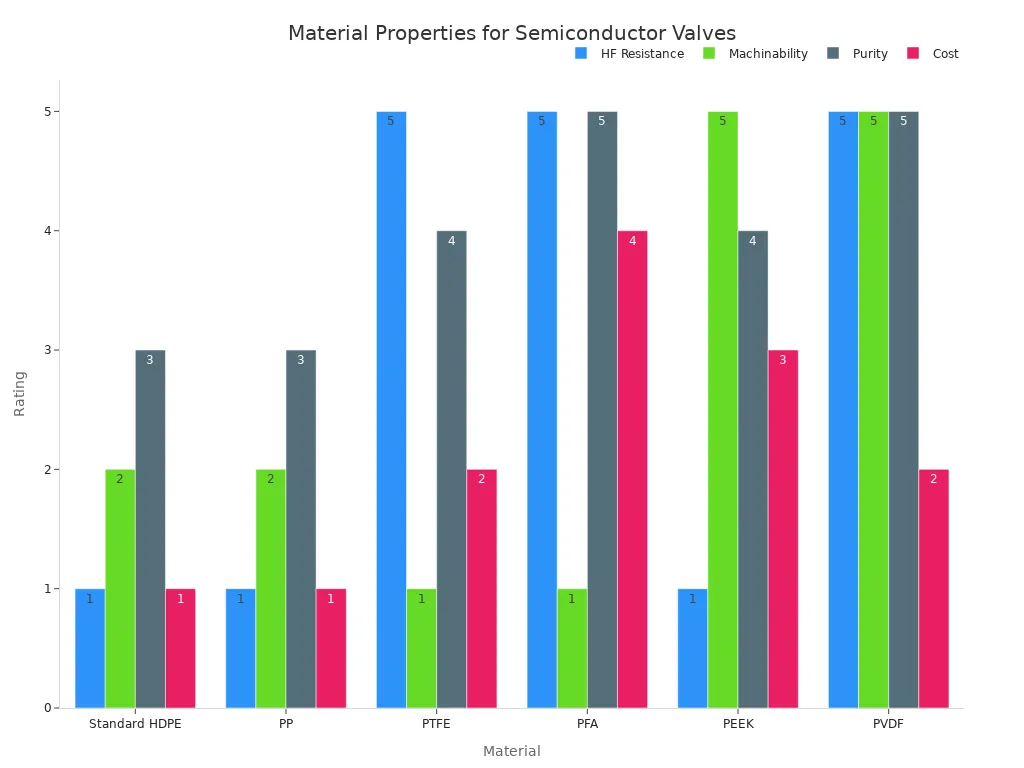
High-Purity Chemical Compatibility
PVDF handles concentrated acids across the full concentration range up to 80 °C. It resists hydrogen peroxide, ozone, and ammonium hydroxide. The material shows weight change typically below 1% after 30 days in aggressive media at 60 °C[4]. Thermal decomposition begins above 380 °C in inert atmosphere.
A PVDF ball valve delivers semiconductor-grade performance. Its ultra-low leachability supports pure chemical transport.
Benefits for Semiconductor Fabs
Enhanced Yield and Reliability
Contamination directly impacts chip yield. A reliable ball valve prevents particle shedding that could ruin wafers. The true union design reduces maintenance downtime without cutting the pipeline. In a semiconductor fab controlling ultra-pure chemical delivery, this feature minimizes production interruptions.
Cleanroom Compliance
Semiconductor valves require ultra-high purity classification. Typical internal surface finish targets for wetted components are in the range of 5 Ra[5]. Many valves are manufactured in ISO Class 3 cleanrooms. PVDF is inherently flame retardant without additives, meeting cleanroom safety requirements without compromising purity. Compliance with SEMI F57 ensures purity for handling chemicals like hydrofluoric acid and 18 MΩ·cm water.
Water Treatment and Desalination
Water treatment facilities and desalination plants handle aggressive chemicals on a daily basis. These operations require flow control components that resist corrosion from disinfectants and pH adjusters. A lined ball valve provides an effective solution for these demanding environments. Its protective lining shields the valve body from chemical attack. This design extends equipment life in continuous service. Wastewater treatment operations face similar challenges with corrosive chemicals and abrasive materials.
Water Purification Systems
Chemical Dosing for pH and Disinfection
Treatment operators dose chlorine, fluoride, and pH balancing agents into water streams. Sodium hypochlorite and chlorine gas are highly aggressive to many common metals. For hypochlorite service, components made from PVDF or lined materials hold up best. A lined ball valve handles these harsh chemicals without degradation. The valve's lining protects the internal surfaces from corrosion. This ball valve design resists the oxidizing power of chlorine compounds. Operators select this ball valve for reliable performance in chemical injection points. The valve maintains precise dosing accuracy over extended periods.
Reverse Osmosis and Membrane Filtration
RO systems require precise flow control for feed water and chemical addition. Antiscalants and cleaning solutions pass through valves regularly. A lined ball valve prevents contamination of sensitive membranes. The smooth internal surface reduces fouling and biofilm growth. This ball valve maintains consistent flow rates for optimal membrane performance. Desalination plants depend on this ball valve design for pre-treatment and post-treatment stages. The valve handles high-pressure RO feed streams without leakage.
Why PVDF Ball Valves Work
Resistance to Chlorine and Ozone
Chlorine and ozone serve as powerful disinfectants in water treatment. These oxidizers attack standard plastic and metal components. A pvdf ball valve resists this chemical attack effectively. The material's fluorinated backbone provides stability against strong oxidizers. A lined ball valve also offers excellent protection against these aggressive chemicals. The lining creates a barrier that prevents chemical contact with the valve body. This protection extends valve life in disinfection systems.
Durability in Continuous Operation
Treatment plants operate 24/7 with minimal downtime. Valves must withstand constant cycling without failure. A lined ball valve delivers long service life in this demanding environment. The durable lining resists wear from frequent operation. This ball valve maintains leak-tight performance over years of service. Wastewater treatment applications benefit from this durability. The valve handles abrasive slurries in sludge treatment lines.
Lined Ball Valve Advantages
Reduced Downtime and Maintenance
A lined ball valve simplifies maintenance in treatment systems. The lining protects the metal body from corrosion. This design eliminates the need for frequent replacement. Operators can service the valve without removing it from the pipeline. A lined ball valve reduces maintenance costs significantly. This ball valve design minimizes production interruptions. The lined ball valve provides long-term value for treatment facilities. Fewer replacements mean lower total ownership costs.
Safe Handling of Treatment Chemicals
Safety remains a top priority in chemical handling. A lined ball valve prevents leaks that could expose workers to hazardous substances. The fluoropolymer lining provides a non-reactive barrier against treatment chemicals. A lined ball valve ensures safe operation in chemical dosing applications. This ball valve design meets industry standards for hazardous fluid handling. Operators trust this ball valve for critical safety applications. The valve contains aggressive chemicals without compromising plant safety.
Pharmaceutical and Biotechnology
Drug manufacturers demand flow control components that protect product integrity. A ball valve used in this sector must resist aggressive chemicals and withstand repeated sterilization. PVDF offers properties that meet these strict requirements.
Drug Manufacturing Applications
API Production
Active pharmaceutical ingredient production involves aggressive solvents and reagents. A ball valve must handle these chemicals without leaching contaminants into the process stream. PVDF provides excellent chemical resistance and mechanical strength for aggressive chemical handling. Precision-engineered fittings prevent leakage and dead space where contaminants accumulate.
CIP and Sterilization Systems
Clean-in-place and sterilization systems expose valves to hot caustic solutions and steam. A ball valve must endure these conditions without degrading. PVDF valves feature smooth, non-porous internal surfaces that prevent particle entrapment. This design supports effective cleaning and reduces contamination risk.
Why PVDF Ball Valves Are Chosen
Non-Toxic and FDA-Compliant Material
Under U.S. FDA regulations (21 CFR 177.2510), PVDF resin is permitted for use in articles intended for food-contact applications. PVDF grades used in pharmaceutical and food service are selected to comply with applicable food-contact and biocompatibility requirements.
PVDF components meet regulatory requirements for materials used in pharmaceutical processing.
Resistance to Sterilization Agents
Repeated sterilization cycles can degrade inferior materials. Diaphragm valves made of FDA and USP Class VI-compliant materials such as PTFE, EPDM, and silicone resist chemical attack. These materials endure repeated sterilization without deterioration. A pvdf ball valve offers similar durability. The material maintains its properties through steam sterilization and chemical sanitization.
Benefits for Pharma Manufacturers
Product Purity and Safety
Valve material selection directly affects product quality. The table below shows how different valve types contribute to contamination.
| Valve Type | Particle Contamination Mechanism | Contributing Factors |
|---|---|---|
| Needle valves | Generate sub-micron to multi-micron metallic wear particles at stem-seat interfaces and threaded dead spaces[6]. | Surface finish, passivation, installation cleanliness, cavitation, corrosion, thermal-cycling effects. |
| Diaphragm valves | Shed fatigue- and chemically degraded polymer particles around the diaphragm and weir. | Surface finish, passivation, installation cleanliness, cavitation, corrosion, thermal-cycling effects. |
PVDF valves address these concerns through low extractables and leachables. This ensures fluid purity throughout pharmaceutical production.
Regulatory Compliance
Pharmaceutical manufacturers must follow strict regulations. Good Manufacturing Practices mandate rigorous hygiene and validation protocols for equipment including valves. Contamination control and sterilization requirements for aseptic processing equipment are set by industry standards. Cleanroom classification standards govern valve installations. Non-compliance brings severe penalties, product recalls, and reputational damage. A ball valve made from high-purity materials helps manufacturers meet these standards. Each ball valve in a sterile system must support validation protocols. Proper ball valve selection ensures consistent product quality and patient safety. Manufacturers rely on a ball valve that complies with FDA and USP Class VI requirements. This ball valve design protects both products and patients.
Food and Beverage Processing
Food and beverage producers need flow control equipment that protects product taste, texture, and safety. A ball valve used in these lines must never react with ingredients or harbor bacteria. PVDF offers a material solution that meets these demands.
Food Production Lines
Beverage Dispensing and Ingredient Mixing
Beverage plants mix concentrates, syrups, and water at precise ratios. A ball valve controls these streams without altering flavor. PVDF resists adhesion of food components like sugars and acids. Residues rinse away quickly during cleaning cycles.
Dairy and Liquid Food Processing
Dairy lines move milk, cream, and cultured products through repeated heating and cooling stages. Nitric acid descales pipelines and heat exchangers during clean-in-place (CIP) routines. A ball valve built from PVDF withstands this aggressive chemical exposure. Its smooth bore supports full drainage and prevents milk residue from collecting.
Why PVDF Ball Valves Are Ideal
Non-Reactive and Easy to Clean
PVDF is suitable for use in food liquid storage and separation equipment. The material is non-toxic and odorless, and it contains no small-molecule additives such as plasticizers or BPA that could leach into food. A ball valve made from PVDF therefore protects product purity throughout the line.
Resistance to Cleaning Chemicals
CIP systems expose valves to sodium hypochlorite, sodium hydroxide, and citric acid. PVDF withstands exposure to strong acids and bases. It tolerates sodium hypochlorite in repeated cleaning cycles. Thermal stability reaches 150 °C, which suits elevated-temperature in-line CIP and steam-sterilizable modules. A ball valve in dairy service handles nitric acid descaling without loss of integrity.
Benefits for Food Producers
Hygiene and Product Quality
Hygienic design standards guide valve selection. These standards set maximum surface roughness limits for food contact surfaces. Equipment must be self-drainable and free from crevices, sharp corners, and shadow zones. PVDF's dense surface resists protein and fat adhesion, and residues remove quickly with CIP technology. Extractable testing shows PVDF releases far fewer contaminants than stainless steel 316L[7].
Extended Equipment Lifespan
PVDF resists repeated backwashing, hydraulic shocks, and mechanical stress. These traits extend service life under continuous CIP cycles. A ball valve made from this material outlasts components that corrode or fatigue. Food producers gain fewer replacements and lower maintenance costs over time.
Other Emerging Applications
PVDF ball valves continue to find new roles beyond their traditional markets. Renewable energy systems, pulp and paper mills, and mining operations each present unique fluid handling challenges. A ball valve built from this fluoropolymer delivers reliable service in these demanding settings.
Renewable Energy Systems
Solar Panel and Battery Production
Battery manufacturing requires precise control of corrosive electrolytes. Automated filling processes use sulfuric acid. This chemical attacks standard metal components rapidly. PVDF ball valves handle this aggressive service without degradation. The material resists concentrated sulfuric acid across full operating cycles. A ball valve in this application provides instantaneous, repeatable shut-off control. Manufacturers process thousands of batteries per day with virtually uninterrupted service.
| Application | Chemical Involved | Operating Conditions | Key Requirement |
|---|---|---|---|
| Automated battery filling | Sulfuric acid (H₂SO₄) | Standard conditions | Instantaneous, repeatable, long cycle-life shut-off control |
Solar panel production also benefits from PVDF ball valves. The manufacturing environment exposes components to humidity, temperature changes, and airborne pollutants[8]. Corrosion-resistant materials protect the integrity of solder interconnections and panel assemblies.
Pulp and Paper Industry
Bleaching Agents and Corrosive Liquors
Paper mills depend on hydrogen peroxide as a primary bleaching agent. A PVDF ball valve handles this bleaching medium without material degradation. The valve maintains structural integrity under continuous peroxide exposure. High-purity corrosion-resistant PVDF construction ensures reliable long-term service.
| Parameter | Details |
|---|---|
| Medium | Hydrogen peroxide (H₂O₂) with chemical stabilizers |
| Temperature | Suitable for standard process temperatures |
| Pressure | Suitable for standard system pressures |
| Valve Material | High-purity corrosion-resistant PVDF |
Process parameters depend on the specific mill application; confirm ratings against the actual service conditions.
Mining and Metal Refining
Acidic Leach Solutions and Reagents
Mineral processing relies on aggressive chemicals to extract valuable metals from ore. Concentrated sulfuric acid, hydrochloric acid, and chlorine-based compounds serve as primary leach solutions. These reagents quickly degrade standard valve materials. PVDF is widely used for aggressive mining chemical services including concentrated sulfuric acid, hydrochloric acid, and chlorine-based chemistry. No metal exists in the wetted flow path of an all-plastic PVDF ball valve, so galvanic corrosion of the wetted path is not a concern.
For applications requiring additional protection, a lined ball valve creates an extra barrier between corrosive fluids and the valve body. This design extends service life in the harshest mining environments.
Need PVDF or Lined Ball Valves for Your Process?
Tell us your medium, operating temperature, pressure, and connection requirements. Our engineers will help you select the right PVDF or lined ball valve for your industry.
Send Us an InquiryReferences
PatSnap Eureka — PVC vs PVDF chemical resistance for harsh service. https://eureka.patsnap.com/report/pvc-material-vs-pvdf-chemical-resistance-for-harsh-service
IAPD Magazine — High-performance Fluoropolymers for Semiconductor Processing Equipment. https://digital.iapd.org/issue/december-2025-january-2026/high-performance-fluoropolymers-for-semiconductor-processing-equipment/
Semiconductor Digest — Using SEMI F57 Compliance to Improve Semiconductor Fluid Handling Systems. https://sst.semiconductor-digest.com/2004/01/using-semi-f57-compliance-to-improve-semiconductor-fluid-handling-systems/
PatSnap Eureka — PVDF semiconductor grade material intelligence. https://eureka.patsnap.com/materials/pvdf-semiconductor-grade
Semiconductor Digest — Valves in Cleanroom Processes. https://sst.semiconductor-digest.com/2007/08/valves-in-cleanroom-processes/
PatSnap Eureka — Needle Valve vs Diaphragm Valve Particle Contamination Risk. https://eureka.patsnap.com/report/needle-valve-vs-diaphragm-valve-particle-contamination-risk
Food Engineering Magazine — Why choose polyvinylidene fluoride (PVDF) for conveyor belting? https://www.foodengineeringmag.com/articles/97320-why-choose-polyvinylidene-fluoride-pvdf-for-conveyor-belting
PMC — National Library of Medicine (solar module environmental degradation reference). https://pmc.ncbi.nlm.nih.gov/articles/PMC12250229/


